


DEPT® Unveils Deptify, Its AI Orchestration Layer for the Agentic Era


Today at the Cannes Lions Festival, DEPT® unveiled Deptify, its AI orchestration layer for the agentic era. Deptify is designed for a simple reality: most companies are not struggling because they lack AI tools. They are struggling because AI has been added to old ways of working. Context gets lost between platforms. Teams are asked to use too many tools. Training does not keep up. Pilots prove a point, but they do not scale.
Speaking to LBB on why the industry’s current approach to AI is causing this friction, Roy Armale, chief product officer at DEPT®, explains, "Most tech is set up in a way where you have the stuff – so Jasper, Google, whatever it is – and then the AI inside the stuff. And if you want to move from one AI to another AI, you have to leave the stuff. Which is a problem. You've got to take the stuff with you. So we've changed the term 'stuff' into ‘context’. Every technology platform is trying to build AI within its platform, which forces the context to remain in-platform."
Deptify is built to change that. It is an AI orchestration layer that connects the tools, data, and workflows brands already use, so work can move continuously from briefing to strategy, content, media, measurement, and learning. Instead of resetting with every campaign, the system compounds what it learns.
Deptify is connector-first by design. It works across client-owned systems, with no forced migrations and no walled garden. Data and applications remain in the client environment. The orchestration layer sits on top, bringing together existing tools rather than replacing them.
Contrasting Deptify against the massive operating systems the large holding companies have built, Roy (who was formerly chief product and growth officer at WPP Open) notes, "What we needed to do is figure out a way to get the AI to be its own layer that's connected to all your stuff. It had to be outside. The holding companies did the first way, which is they created the operating system to put everything inside it. The second way was to build the connecting layer between them without making this heavy thing all around."
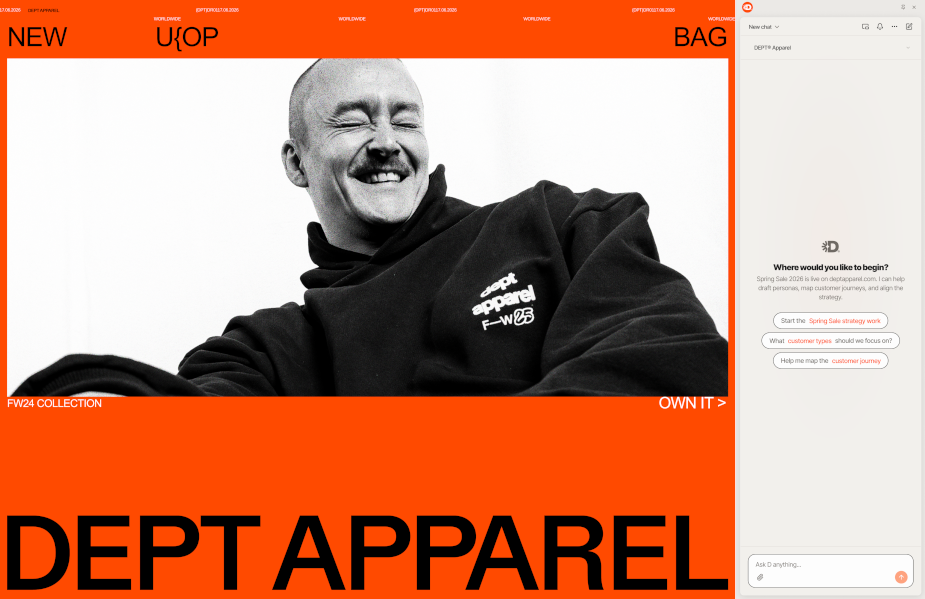
At the centre of Deptify is D, a persistent AI assistant that reads context across briefs, data, brand history, and intent. D is designed to anticipate what teams need, surface relevant insight, and route work to the right people, tools, or agents. It is guided by DEPT®’s Empathy-First Framework, which maps where AI should automate, where it should augment, and where human judgement should lead.
To determine exactly where those boundaries lie, DEPT® abandons the vague industry notion of keeping a "human in the loop" in favour of a strict four-box grid. This matrix plots tasks along two axes: the type of thinking required (ranging from human empathy to robotic dispassion) and the nature of the information (context-dependent truth versus canonical, set-in-stone facts).
Depending on where a deliverable lands on this gradient, it falls into one of four distinct workflows:
- Human with an assistant: For tasks demanding high empathy and context, the human takes the lead. The AI acts as a researcher or sounding board – for example, pulling background data while the human writes the actual copy.
- Human with an agent: Here, the human is still leading the overall project but completely outsources specific, defined subtasks. A strategist writing a brief might deploy an agent to independently generate a full audience profile, bringing it back only when finished.
- Agent with direction: Moving to the dispassionate, autonomous side of the grid, the AI takes the wheel but needs a human to point it towards the truth. Marketing or media mix modelling sits here; the agent does the heavy mathematical lifting, but the human must set the initial parameters.
- Agent with supervision: For highly canonical, repetitive tasks, the agent works with full autonomy. The human’s only role is to check the final output. Scaling a single master ad into 10,000 different format iterations falls squarely into this box.
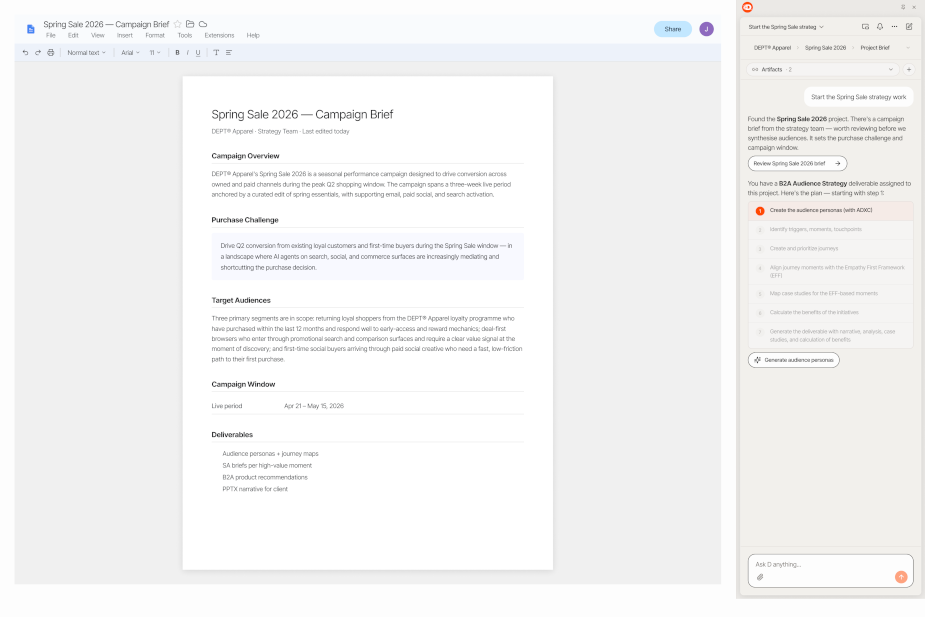
Demystifying how this persistent assistant actually orchestrates these distinct roles without replacing the human, Roy adds, "Let's explain orchestration, because this is another thing that is very misunderstood within AI. A lot of companies are saying we've deployed 40,000 agents. How do you figure out which agent to use once you've got 40,000 agents? What we've done is we've created a layer in between called a persistent assistant. The persistent assistant's job, it's very dumb. Like it is terrible at any job that you need to give it. The agents are very good at doing the job. The one thing it's really good at is understanding you and what you need to do. So it'll understand you, it'll understand the context of what you're doing, and then it will go to the agent registry and find the correct agent to help you do that."
“Deptify is what Growth Invention looks like as a product,” says Roy. “It connects the systems brands already use, removes friction between insight and execution, and helps value compound over time. It is the codification of how we believe modern growth should operate: connected systems, persistent intelligence, human-centred AI, and just-in-time learning embedded in the flow of work.”
This reflects a conscious decision by the agency to play nice with existing client tech stacks rather than forcing a proprietary solution. "We need to be a little bit more humble about this stuff," Roy explains. "Instead of trying to contain everything into my black box and serving it to a client as if it's mine and pissing off all of my partners, I need to go to my client and tell them, 'Look, you tell me what you're comfortable using box-wise, I'll figure out how to connect things.' That'll be my job."
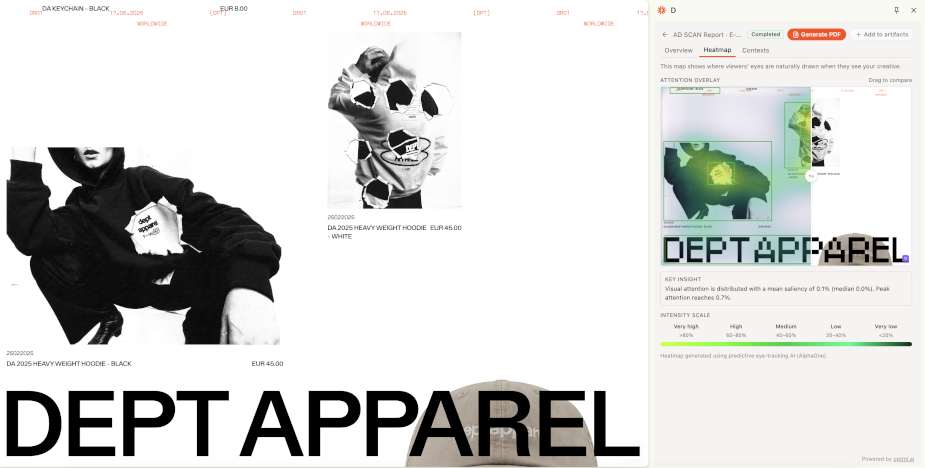
Over the past couple of months, Deptify has been in use across DEPT®'s global client base, applied both to how internal teams deliver work and how clients operate their own marketing functions. From large-scale commerce programmes to regulated industries and global content operations, the system is already speeding up approval cycles, reducing friction between insight and execution, and connecting AI-enabled workflows to measurable business outcomes.
Crucially, Deptify isn't just about connecting software; it's about forcing an evolution in agency talent. Roy draws a historical parallel to the introduction of Microsoft Excel, which transformed traditional accountants into financial analysts, and early machine learning, which turned analysts into Wall Street 'quants'.
Generative AI, he argues, is currently collapsing the adjacencies between traditional agency roles. A front-end developer using modern AI tools can now design from scratch, while a designer can suddenly write deployable code. This shifts the industry ideal from a 'T-shaped' individual – someone with deep expertise in one specific area – to an 'M-shaped' hybrid who is highly proficient across multiple disciplines.
To engineer this shift without resorting to mass hiring and firing, DEPT® is using Deptify to implement what Roy calls "just-in-time training". If the persistent assistant, D, routes a user to a platform they haven't mastered, it instantly serves them the relevant training course at the exact moment of need. "You get trained on the thing you're about to do, which means that you're going to remember it once you're done," Roy explains.
The agency is aggressively applying this upskilling model to its own workforce, using Deptify to train its internal teams before rolling the capability out to clients.
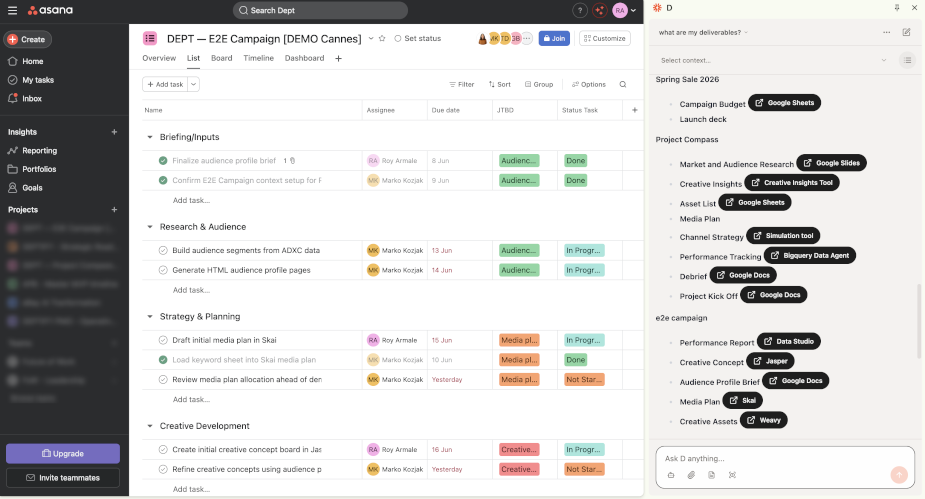
The announcement also reflects DEPT®’s broader vision for the Future of Work: redesigning how work happens, preserving context, giving people better training at the moment of need, and using AI where it creates the most value. In that model, human judgement handles what matters most, and AI handles the repetitive work that slows teams down.
“Ten years in, we are more certain than ever that growth is something you need to engineer, not execute,” says Dimi Albers, global CEO at DEPT®. “Deptify helps our clients move faster, helps our teams work smarter, and gives us a better way to build for the future.”


