


2026: The Year Brands Stop Playing It Safe (Or Get Left Behind)


Image credit: Jonathan Martin Pisfil via Unsplash
In our recently launched Trouble Making 100 Report (TM100), we observed an uncomfortable truth.
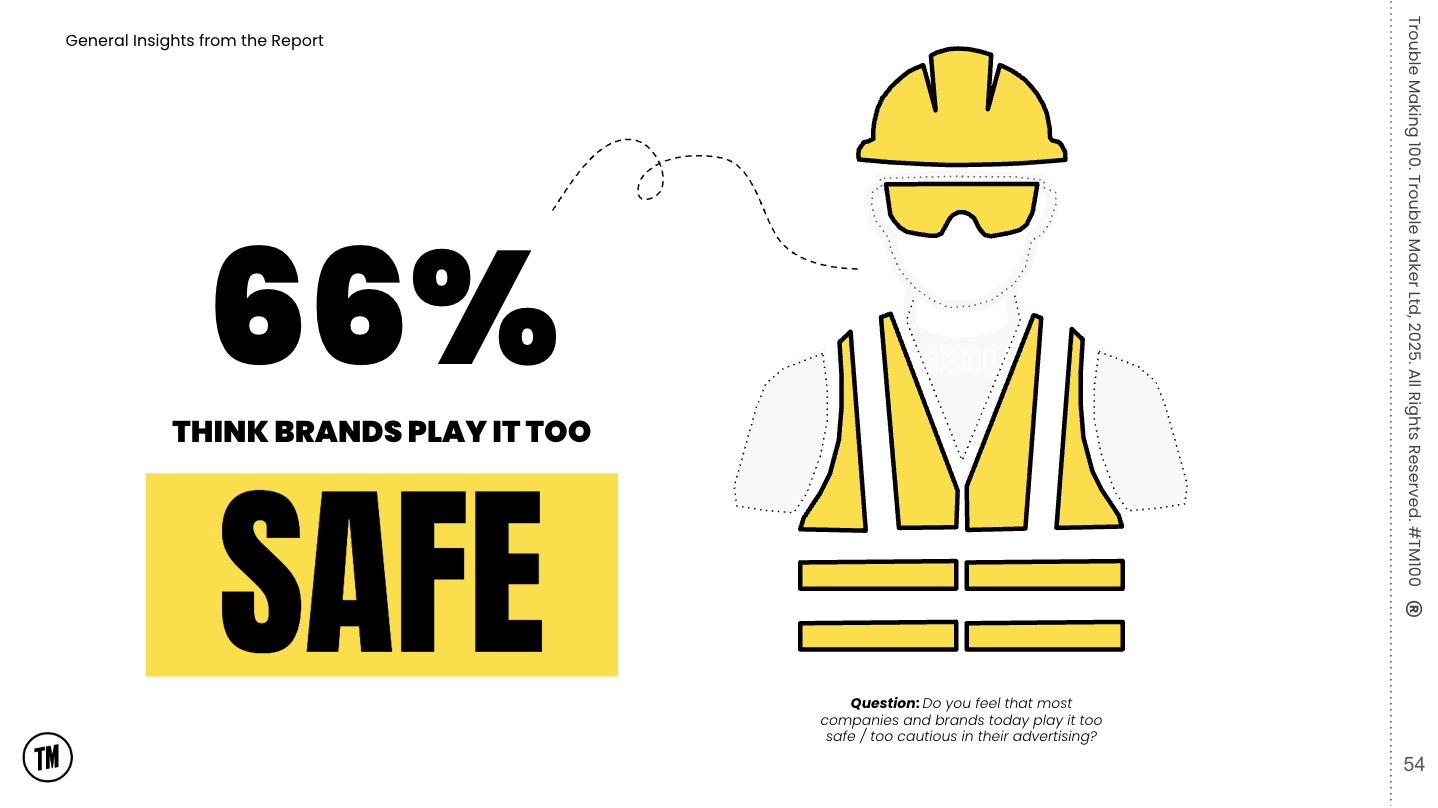
Two thirds of the UK think brands are boring.
Not a bit safe. Not occasionally predictable. Too safe.
66% percent of people, to be precise (rising 75% for younger audiences), according to the TM100, our study into challenger brands, viewed not through the misty lens of the marketing industry, but through the eyes of actual human beings.
That’s not an old-hat adage. That’s a warning shot.
And yet, if you sit in enough meetings, you’ll hear the same concerns whispered again and again:
“Can we say that?”
“Will legal allow it?”
“What if someone complains?”
Somewhere along the way, “brand safety” quietly morphed into “brand sedation”.
So what’s the solution?
Troublemaking Doesn’t Mean Being a Menace
Let’s clear something up straight away.
Being a challenger brand does not mean you have to behave like Paddy Power on a stag do - The TM100 shows something far more interesting.
When we asked people what they actually like in challenger brands… big, bold, entertaining personalities beat out qualities like mischief and stunts, or industry disruption.
Vis a vis - you don’t have to cosplay as another ‘fighty’ brand. Any brand can unlock challenger behaviour and a bit of trouble making, by being themselves - only bold and amplified.
In other words: people don’t want brands constantly poking the bear.
They want brands with a pulse.
A point of view.
A sense of humour.
A bit of swagger.
Challenger behaviour isn’t about being anarchic - it’s about being alive.
An Edgy Billboard Is Not a Strategy
Another sacred cow we should probably tip over while we’re here:
That clever billboard your industry mates loved on LinkedIn? The one with the cheeky line and the PR headline? According to the TM100, out-of-home accounts for just 2% of challenger brand discovery.
Meanwhile, social media is where challenger brands are actually found, followed, argued about and shared. That’s where personalities are built. Where fans participate. Where brands behave rather than simply announce.
If your "challenger strategy” ends at a poster site and a press release, you’re not challenging anything. You’re decorating the wallpaper. 2% of the budget released specifically for award-fodder and internal PR. Great for our echo chamber, but not so effective at impacting the bottom line.
Some Industries Are Sleepwalking
One of the most surprising findings in the TM100 was which sectors people don’t see as hotbeds of challenger behaviour.
Consumer electronics for example, an industry filled with astonishing technology, world-changing devices and billion-pound innovation, ranked barely above utilities and pharmaceuticals.
An industry that literally puts supercomputers in our pockets is perceived as safer than Ryanair’s seatbelt instructions.
This isn’t a criticism - it’s an opportunity. Because if even the most exciting categories are playing it safe, then the bar for standing out has never been lower.
The Rebels Are Already There
Perhaps the most hopeful stat of all: 51% of the UK see themselves as rebellious.
Even better? Nearly two thirds of them say they keep that side of themselves hidden. Which means there’s a massive, underserved audience quietly craving brands that give them permission to be a little bolder, louder, freer - even if just for a moment.
The appetite for trouble is already there. Society just pretends it isn’t.
Finally - Maybe the Real Risk Is Not Making Trouble
So here’s the uncomfortable conclusion.
In a world where most brands look, sound and behave the same…
Where two thirds of people think you’re playing it too safe…
Where discovery happens in fast, chaotic, digital spaces…
Playing it safe might be the riskiest strategy of all.
Challenger behaviour in 2026 doesn’t mean being reckless.
It means being brave.
It means choosing personality over politeness.
Meaning over mass appeal.
Connection over caution.
The brands that win won’t be the loudest or the rudest. They’ll be the ones willing to make a bit of trouble - and stand for it.
The data is clear.
The audience is ready.
The only question left is whether you are.
Download the full TM100 report here - and if you’d like to chat about what this means for your brand in 2026 and beyond - you know where to find us.


