


Rory Sutherland Asks Why Agency Pockets Just $350k on $1bn Idea


Rory Sutherland has urged marketers to siphon a portion of their budgets directly to their strategists and creatives, and question why their agencies are not fairly remunerated for ideas that change a brand’s fortunes.
At yesterday’s RESET conference in Sydney, the renowned adman and vice chair of Ogilvy UK revealed that ‘Share a Coke’ has driven $1 billion in value for the company, yet Ogilvy Sydney made just $350,000 in profit.
“So you have a billion dollar idea in marketing, you don't get enough money to buy a crap flat in a shit part of Sydney.”
Speaking to LBB after his keynote, he added, “My argument is that it's not just the agency that was short-changed there. The Coke marketing people who came up with that idea have been short-changed, because it hasn't bought them any indulgence in subsequent years.”
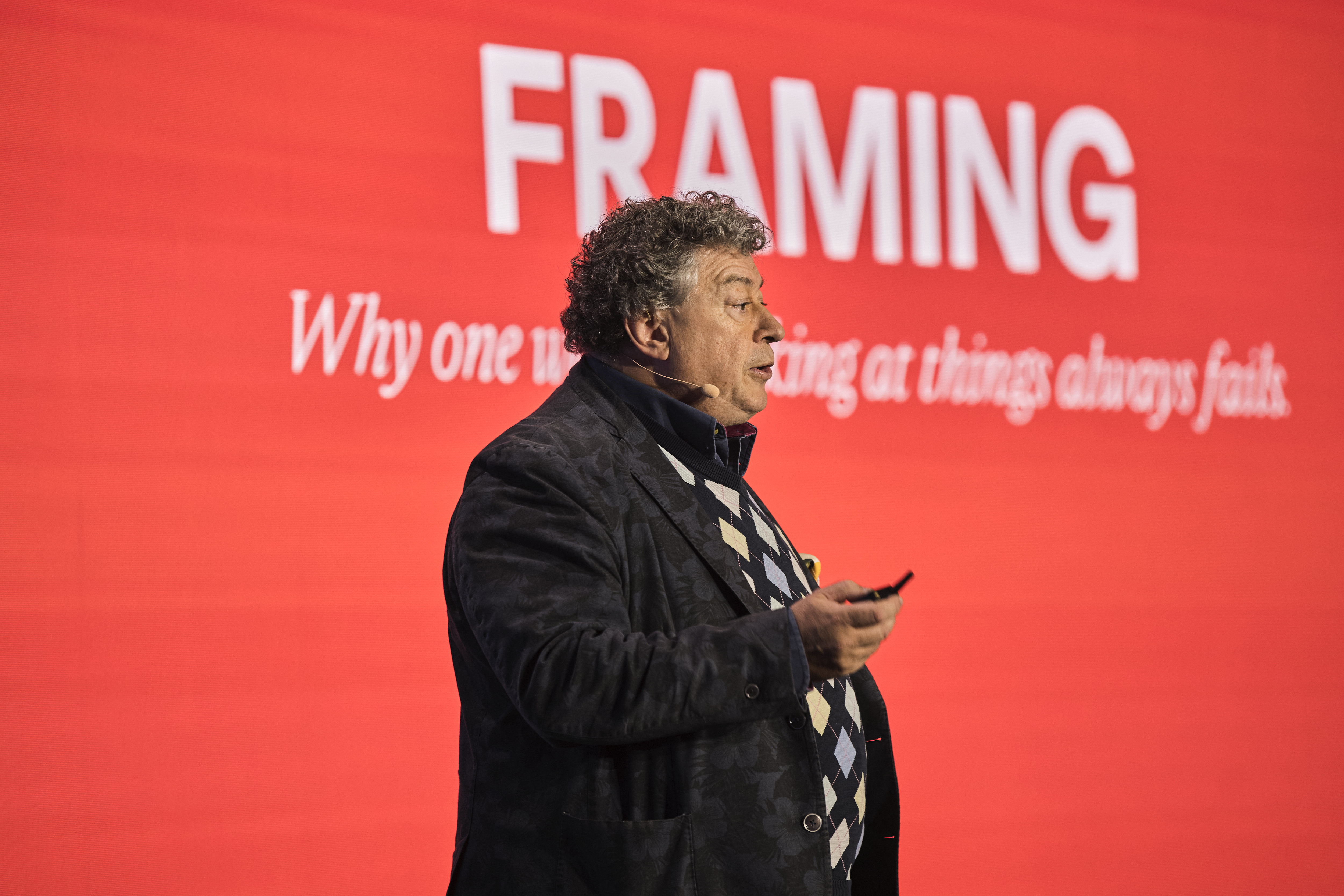
On stage, he argued the finance department’s power is fundamentally unfair: it means business problems will primarily be framed as finance problems. In medicine, Rory explained, the theory of ‘diagnostic momentum’ means if a person in hospital first sees a cardiologist, “they are wildly over-disposed to attribute whatever problem you have to some sort of cardiovascular issue, and from then on, even if your real problem is dermatological or psychological, you'll be stereotyped as a cardiovascular patient for the rest of your stay.”
Similarly, “the second you've handed anything to finance, you'll end up with cost cutting.”
He told the room of 600 marketers, “When was it agreed that finance got to own the metrics? Serious point. The only thing finance can measure is value as expressed in immediate financial transactional value. That's about 30% of all value that can exist in the marketplace.
“It's the asymmetry of the fact that creative people always have to present their ideas to finance people for approval. Never fucking happens the other way around, does it? Do you notice that? This is a fundamental asymmetry in decision-making.
“You're held responsible for every penny of cost, but you only get to lay claim to a small percentage of the upside.”
Asked by LBB how agencies can price the value of a big idea when marketing teams face this battle internally, he said, “Payment by outcome, agencies don't have the risk appetite for that. There's an argument that some part of agencies need to be closer to venture capital.
“Because we're paid by the hour, we've fallen into the trap of thinking that what we're paid for is where we're really valuable. I would argue that the most valuable thing an advertising agency does is the conversation it asks and the questions it asks.”
He referenced one UCLA business professor, who proposes the right question over which to obsess is inevitably, what’s really going on here?
The leader added an agency's job is to make a brand fame and fortune, but the true impacts of making a brand famous are “impossible to calculate".
“And so the obsession with this financial fantasy of micro measurement, where every pound of expenditure is matched to 15 cents of incremental revenue, or whatever it may be, is a completely false god. And what it's done is it's made us small.
“Nothing wrong, by the way, with doing bottom of the funnel stuff. It's a perfectly worthwhile source of funds. But don't expect to grow. Don't expect to get lucky. It will give you less resilience.
“The hidden cost you pay is that with increasing efficiency comes diminishing opportunity.”
That is the explore-exploit trade off. For 20 million years, bees have arranged themselves so 80% of the swam are exploiting, and 20% “are continually exploring. What's different, what's changed, what didn't we know, what can we discover?"
Rory said, “The beehives that didn't make that trade-off may have had a very efficient three weeks of pollen collection, but they went extinct.”
Marketers should think of their budgets in the same way, carving off a chunk to actively experiment. “Take a proportion of the budget you spend with every agency, give it to the planners and the creatives to spend as they choose. That's your random bee bit.”
He worked on the AMEX account for 15 years, and told LBB across that period, perhaps three accidental “discoveries” were immensely valuable. One involved observing people were not applying for the AMEX Gold Card because of a deeply human fear of rejection. The business changed the application process, so the tone was inclusionary, and the form only required a signature. It worked.
“The point about the random bees isn't that they're efficient. Most of their journeys are a waste of time. But every now and then, they discover something fat-tailed and huge.
“There's no reliable process to generate them. Behavioural science provides you with a good route to effectively discover more of them.
“Sometimes they're psychological insights, sometimes they are executional accidental discoveries, but over time, if you have one of those every two years in your particular division of the business, over time, the effects on that are absolutely monumental.”
Short-termism -- across thinking, results, marketer tenures, and agency relationships -- minimises appetite for experimentation and risk, and increases paranoia, he observed. “When you're fundamentally risk-averse and short-termist, the only ball left in the bag is cost-cutting.” But the creative process is inefficient, and demands openness to experimentation, imagination, and accidental discoveries.
“Every single advertising agency you'll talk to will pretend there's this thing called process. There isn't. It's complete bollocks. In effect, what you do is you talk shit until you get lucky. The reason we have to retain this process is because procurement would go batshit insane if they thought there was a single second of anybody's time which wasn't directly accounted for.”
The RESET conference also featured former Mastercard global CMO Raja Rajamannar, tennis legend Andre Agassi, and Suncorp CMO Mim Haysom, among others. Rory argued brands that truly want to reset should not benchmark themselves against competitors, which results in “a race to the bottom”, but instead “find something that everybody else has overlooked and doesn't regard as important, double down on it.”
That can include media choices -- the likes of jingles, longform-copy, direct mail, and cartoons still work, he said, they have just fallen out of fashion.
“Actually, I always wanted to start an agency called Unfashionable, where the rule was you can only use unfashionable media because they're underexploited, because everybody is barking at every passing car.”


