


'Unc Found the Meme': Omnicom Advertising and Snapchat Guide Brands Through Next-Gen Humour


There is perhaps nothing more mortifying for a marketer than stumbling into a youth culture trend too late, only to be met with a chorus of "unc found the meme" or the dreaded "silence, brand". Younger audiences are laying down the gauntlet, pitching themselves as the funniest generation yet and leaving those born before the millennium struggling to grasp the punchline.
To help brands avoid these catastrophic creative misfires, Omnicom Advertising and Snapchat have teamed up to launch a new study, 'How to Laugh (and Win) with the Next Generation'. Drawing on the views of more than 6,000 social media users aged 13 to 28 across six countries, the research reveals that young people use in-jokes and randomness as their core social infrastructure.
The research focuses on the ‘next gen’ demographic aged 13 to 28, encompassing younger gen z and older gen alpha consumers. Marketers must recognise that this is the first cohort raised entirely within a social media ecosystem. And to make that point authentically, the report needed someone like Jess Francis, director of creative intelligence at Omnicom Advertising, who admits to being so ‘chronically online’ she has an AI-generated song stuck in her head about transporting huge steel coils.
If you don’t know what ‘unc’ means, it’s short for uncle. “Unc is a new way to say, ‘OK boomer’,” says Jess. “It's all stacking up on each other. People who do not have the chronically online internet history that I have, or you're not born of the internet generation, you don't understand the referential humour that comes from it. To gen z and gen alpha, this new LMAO, they're all just building on what was already there, in the internet’s history. That to me is the biggest thing. I usually try to tell people, calm down, the kids aren't as radical as you might think they are. It's all related to one another.”
Decoding the Language of Modern Internet Humour
Young people describe their humour as deeply ironic, self-deprecating, and absurd. The study shows that to connect authentically, brands need to understand that this generation recycles and twists inside jokes until they abandon traditional logic. But whether it’s Charlie Chaplin or Monty Python, jokes have never had to make sense. “To me, it dismantles the idea that any of this is inherently new,” says Jess. “Humour and the ability to have a laugh and joke is so enduring to who we are.” She talks about the eye rolls that ‘six-seven’ provokes whenever it comes up – “the joke that everyone wants to die” – but she underlines that young people have always had in-jokes that annoy older people.
To successfully tap into this demographic, brands can't just throw content into the void and hope it sticks. With Snapchat reaching 90% of 13- to 24-year-olds across more than 25 countries, the app serves as a critical testing ground for youth culture. But as this global survey of 6,028 daily social users reveals, truly penetrating that space requires more than just a media spend; it demands operational agility and a deep understanding of platform-specific behaviours.
As Jess notes, finding the right moment to strike depends entirely on the people behind the brand and their grasp of these nuances. “That comes from the team you have put into place and also knowing where your audiences are and that timing – when it comes to your audiences across different platforms, which is why I think Snapchat was an interesting platform as well, because they're not a discovery platform, they're very much focused on sharing and group connection.”
Why Authenticity and Internal Culture Drive Commercial ROI
That focus on private, group connection makes perfect sense when you consider what these digital spaces are actually being used for. For the next gen audience, humour is no longer just a punchline; it acts as essential emotional infrastructure. A massive 87% use it to discuss serious topics, while 90% rely on jokes to express thoughts they otherwise could not say directly.
If young people are using comedy to navigate the heavy stuff, brands need to tread carefully – but they also need to recognise the sheer power of getting it right. As Omnicom Advertising chief intelligence officer Laura Simpson notes, leaning into this isn't just about appealing to youth culture; it’s an antidote to the sterile, tech-heavy landscape we find ourselves in. She says, “I wonder if there's also a thread around just the humanisation of businesses in general at this moment. There's so much angst around everything becoming so synthetic and AI-driven and actually humour is probably one of the hardest things to replicate. It's the tip of the spear of authenticity, isn't it?”
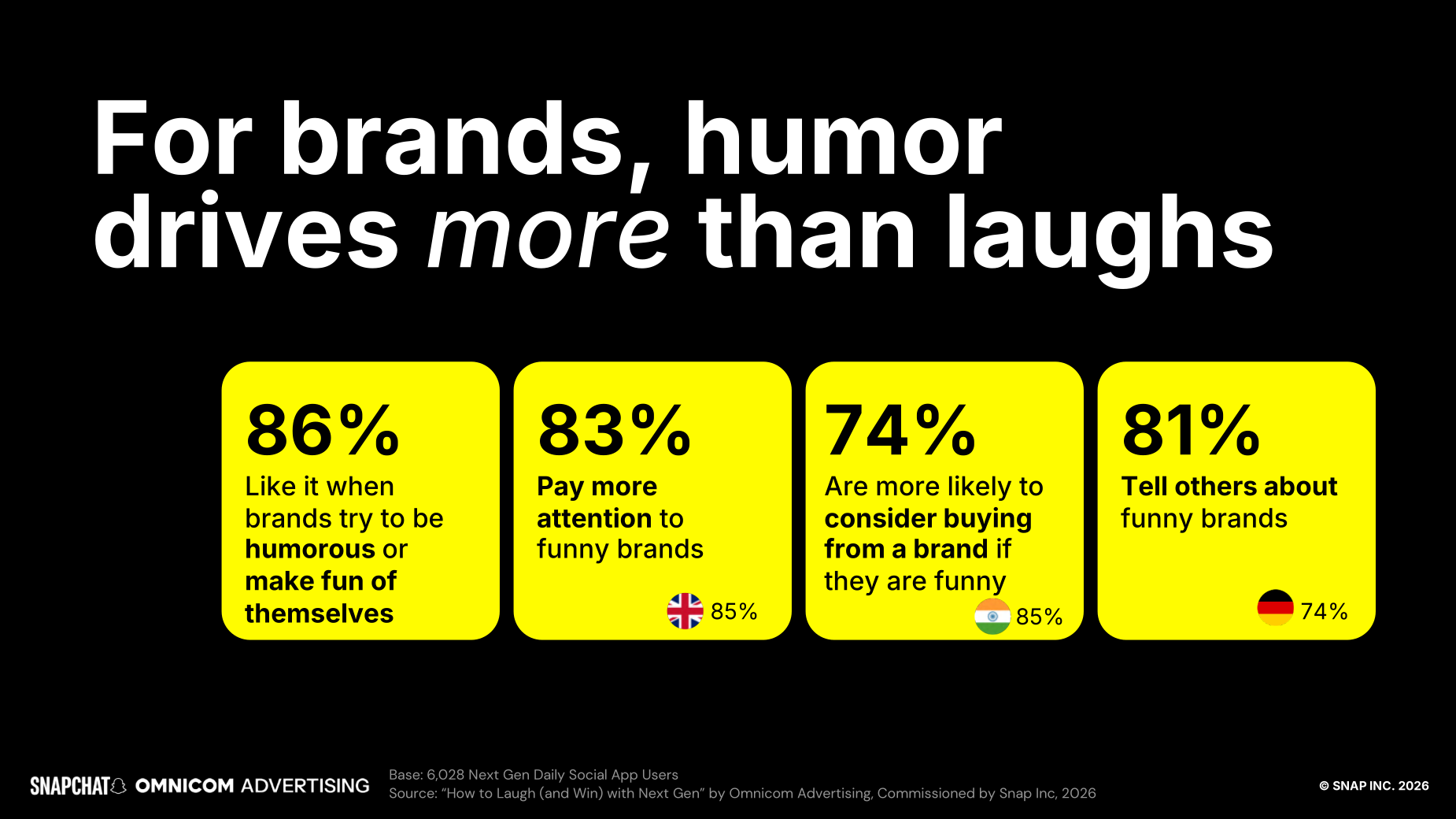
Nailing comedic tone is no longer just a soft metric for creative flair; it directly drives commercial performance. According to the research, 85% of young consumers pay closer attention to funny brands, while 74% are more likely to consider making a purchase when a brand demonstrates a genuine sense of humour. But winning that consideration requires marketers to pivot away from hard-sell product pitches and towards authentic personality. As Jess explains, the brands seeing real traction are those leaning into their internal culture rather than traditional advertising claims: “So many brands don’t actually talk about their product, service, or anything they do. They’re just going to show that they have a really funny culture, and that's what people want who engage with their content.”
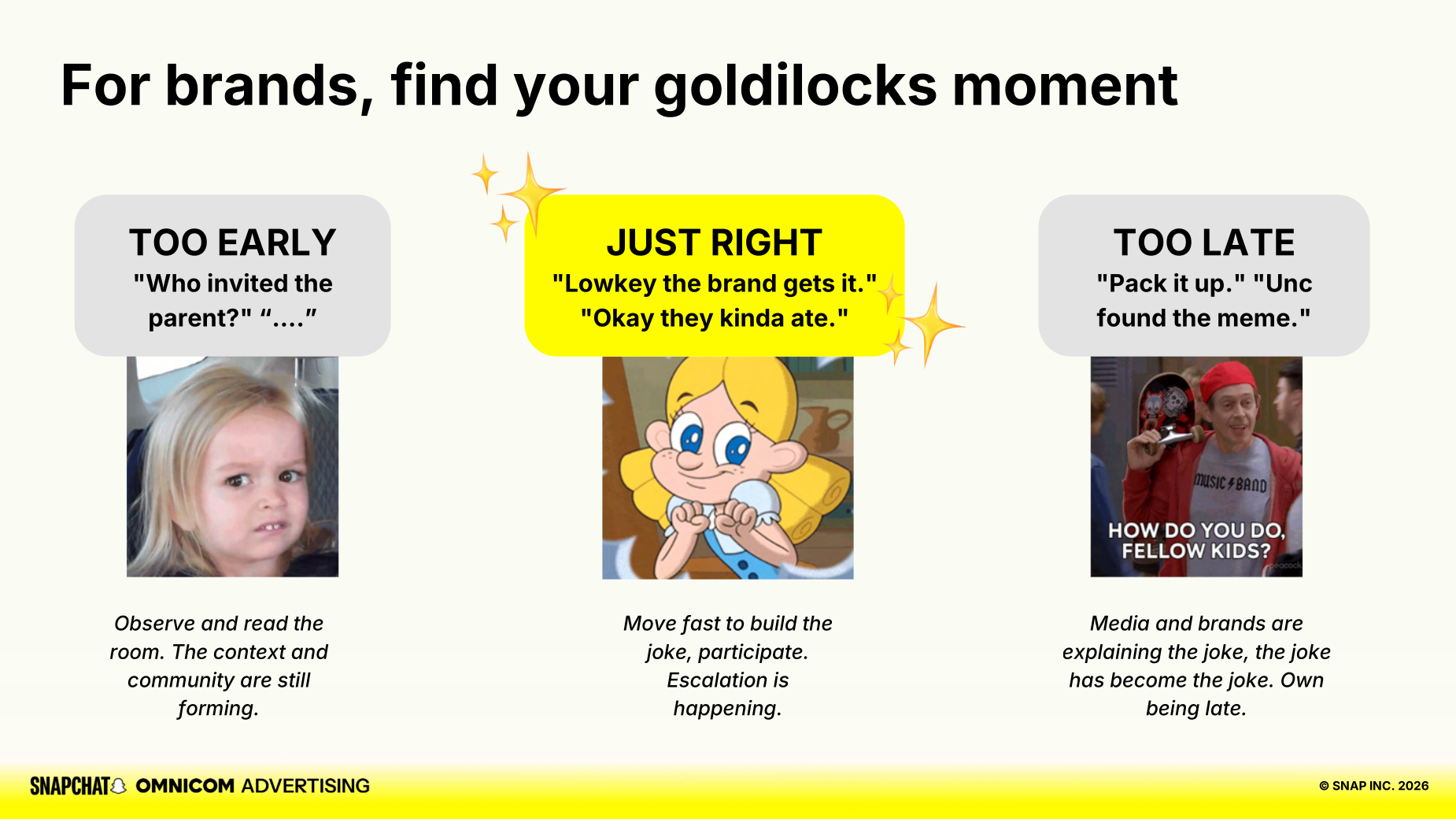
The primary risk for advertisers is coming across as out of touch, often resembling the classic ‘How do you do, fellow kids’ meme – 100% chopped, unc behaviour. Currently, three in four young people feel that brands attempting online humour just look like older people trying far too hard.
From Structured Absurdism to Escalation
To avoid strategic missteps that might lead your brand there, the report introduces a four-step framework known as the ‘Zoomer Humor Playbook’. This model guides creative teams through reading the room, building jokes, timing participation, and converting engagement into results.
“The first thing I think brands need to do is ask three big questions: “Do you get the reference? “Can you add something to it? “Does it make sense for you to do anything with it? “There's so much self-awareness I think brands need to have about how they show up online,” she adds.
The first step of the playbook focuses entirely on diagnosing what next gen audiences actually find funny. It emphasises that learning to read the cultural room is a non-negotiable prerequisite before a brand ever attempts to enter the conversation. “Not every brand needs to be funny in this exact way that gen z is funny,” says Jess. “It's quite intentional that the first thing we say is read the room and do you actually know how to read the room?”
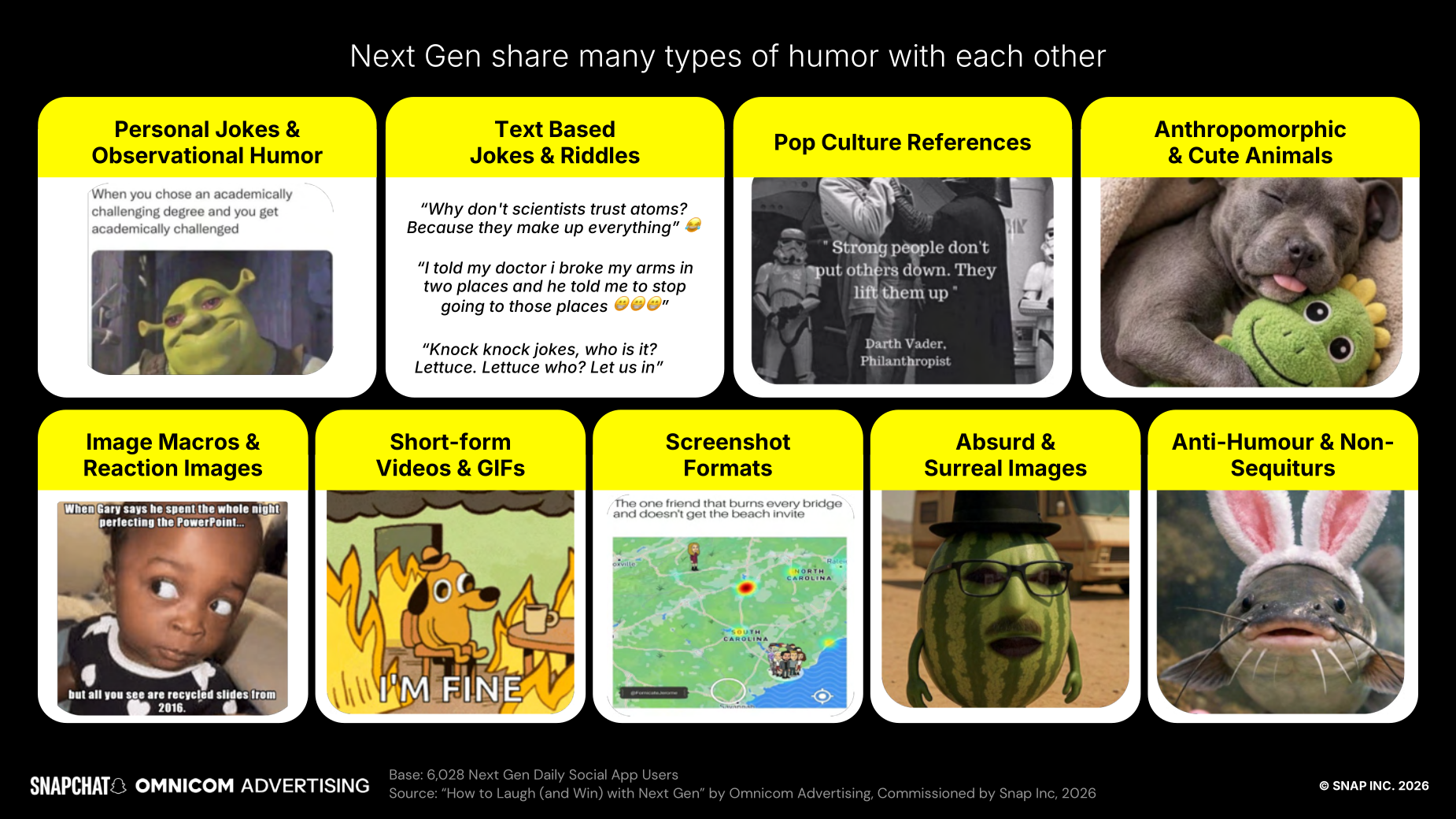
Youth humour is highly fragmented, spanning text-based riddles, pop culture nods, image macros, and surreal video clips. Agency teams should familiarise themselves with these varied formats, which frequently lean on dad jokes, puns, and anti-humour. Again, none of this is new in the human condition. Of the thousands of posts drawn upon in this study, Jess notes that “many of them were just straight up puns and dad jokes – really old school style humour”.
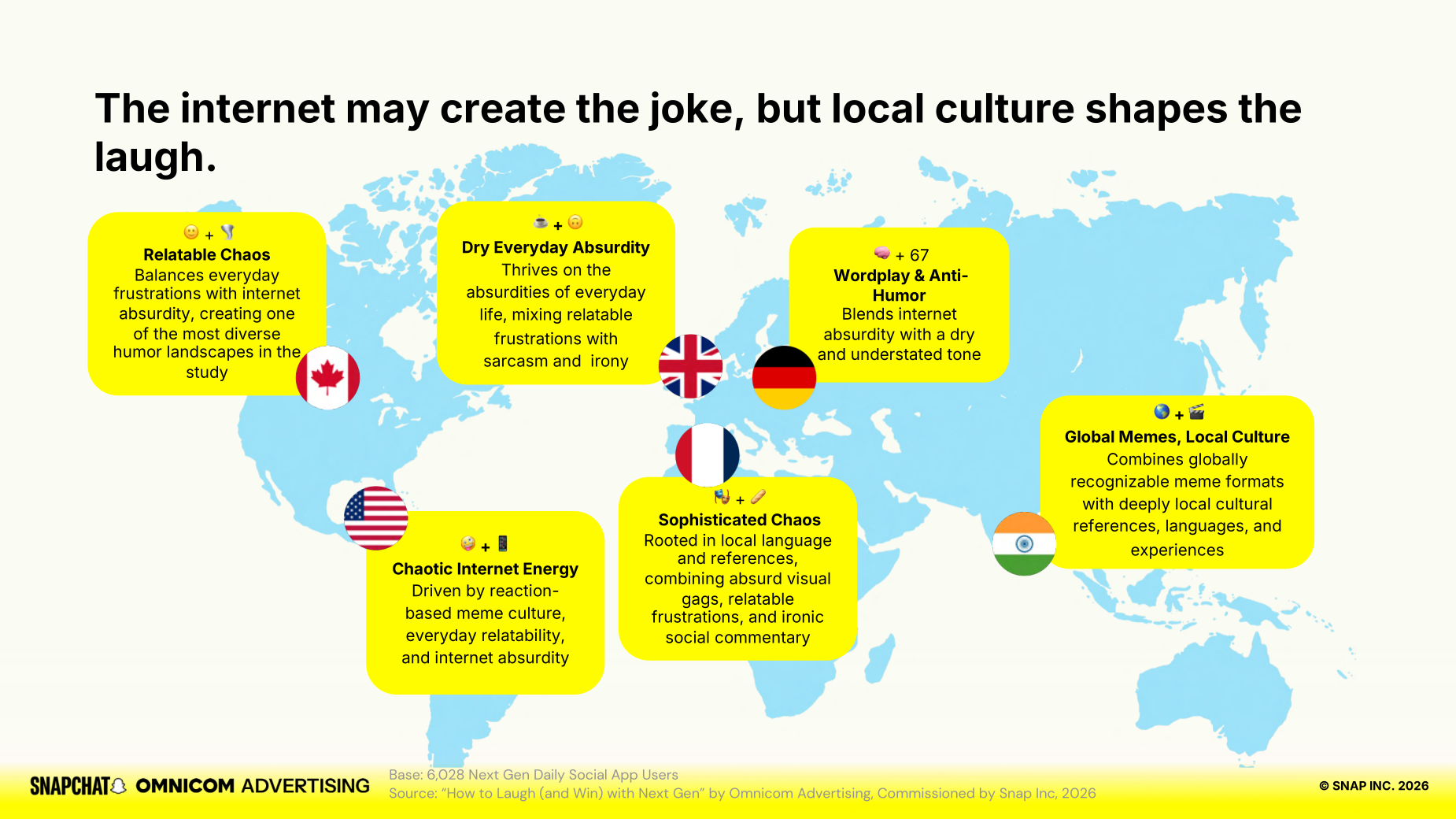
Jokes often originate as highly niche references before escalating into global, participatory internet trends. Advertisers must understand that while global platforms spread these jokes, it is shared cultural gestures and local remixes that actually sustain their lifecycle. As Laura explains, this constant evolution is what keeps the comedy alive internationally: “Memes and jokes and humour flow across borders into other markets. But every time they pick up a little bit of a new flavour, right? As it crashes into another market, it gets reinterpreted and then goes into another market or another community.” The same meme might inherit British dry absurdity or Indian chaotic energy. A brand’s quickest path to becoming the joke is failing to respect this blend of global scale and regional nuance.
The study’s second chapter transitions from observing youth culture to breaking down the structural mechanics of digital comedy. It prepares strategists and creatives to construct original humor using modern online frameworks. It identifies four foundational mechanics that govern next-gen humour: context, structured randomness, irony, and escalation. Brands should apply these principles to ensure content feels native rather than forced.
Context functions as the punchline, with 85% of young users agreeing that jokes are funnier when details are withheld. Brands must resist over-explaining their work, as 79% of respondents say explaining a joke ruins it.
While internet comedy is often not explained, 92% of audiences insist that the best jokes possess an underlying logic. The study advises that marketers should leverage structured absurdism, which stands as the most popular humour style for this cohort.
Jess points to the hyper-niche, gen AI music video about transporting steel coils as the ultimate example of this strategy. “If you told me that that was secretly made by a steel manufacturing company, I would be obsessed with that,” she notes. It is a prime example of how even the most traditional brands could abandon their corporate constraints and embrace the chaotic, ‘synthetic absurdist’ energy of the internet.
Irony serves as the foundation of modern digital comedy, meaning campaigns do not require a traditional punchline to succeed. Fully 84% of young people embrace this post-ironic approach, relying on shared online references to complete the joke. Laura explains why generations who’ve always lived online feel this way: “It's just the sheer chaos and complexity and volume of stuff crashing together across borders,” she says. “That just makes it even more impenetrable to not just people from other generations, but people from even from other communities within the same age group. You have reference layered upon reference layered upon reference.”
Digital jokes must continually evolve, as 88% of audiences believe humour improves as it builds upon a premise. Consequently, 47% of young consumers want brands to craft original jokes rather than directly copying trends.
This is precipitating the end of brand comment pile-ons. “There's also a pause in some ways of jump[ing] on the bandwagon of getting into the comments or engaging online,” says Jess. She has noticed brands figuring out what their own joke is, rather than the “comments on viral pieces of content I see where brands are just discussing it themselves, and there's no actual person part of it anymore”.
“I'm seeing more brands try to make their own jokes, try to build their own social voice and try to build their own style of humour, rather than ‘we're just gonna comment’.”
The third chapter addresses the critical timing required for brands to enter an ongoing cultural joke. It focuses on finding the narrow window where brand participation adds value rather than friction.
Brand involvement can carry risks, as 30% of young people feel a brand joining a trend signals its swift demise. Marketers must carefully evaluate whether their contribution enhances the joke or alienates the community. “There's actually even increasing resistance to brands going off in the comments too much together,” says Jess. “There's a dedicated meme that's pretty much just gen z fully telling brands to back off.”
Finding the 'Goldilocks Moment'
The Omnicom Advertising creative intelligence team came up with the phrase ‘Goldilocks moment’ that is in the study. “We quite intentionally can't measure that moment because it's so case by case dependent,” says Jess. “In terms of timing, it's not necessarily that the window has become shorter, but this generation has probably the highest brand literacy of any generation because they were raised in a tech platform advertising-dominant world. They understand what brand sponsorships are, they know that the community team is not a social media intern and there's layers of approval process for many big corporations.”
Finding your Goldilocks moment is different each time. “That comes from the team you have put into place and knowing where your audiences are and where that timing is when it comes to your audiences across different platforms,” Jess continues. “Which is why Snapchat was an interesting platform. Because they're not a discovery platform, they're very much focused on sharing and group connection. How do you build a team that can be online, reactive, understand the moment, figure out when that Goldilocks movement is that doesn't have the layers and layers of approval that so many of the global brands have when it comes to social?” That’s the challenge.
There are structural answers though. Every internet joke follows a social life cycle, moving from discovery and private sharing to real-world adoption and cultural escalation. Marketers can map their creative strategies against these stages to identify optimal engagement points. “Agility comes from really understanding as a brand,” asserts Laura. “What do you stand for? Why do you exist? What is your tone of voice that you've committed to in the world? So you're not caught in the crosshairs of all those conversations. Everyone just knows that and feels that within the brand team and ultimately your brand platform should feel like a springboard that allows you to do interesting creative things in the world, not a straight jacket that causes a massive amount of anxiety internally every time you want to respond to something that's going on.”
Each stage of the meme lifecycle creates a distinct brand opportunity, from generating the initial spark to real-world activations. Brands don’t need to own the joke entirely; helping it grow through sharing and remixing is equally effective.
The study’s final chapter explores how to translate comedic engagement into measurable performance on Snapchat. It focuses on leveraging platform-specific behaviors to foster deeper audience connection. Snapchat offers a safe space for authentic, unfiltered communication where young users express themselves without judgment. Crucially, 79% of next gen Snapchatters regularly share memes and funny videos directly with their close friends.
Humour spans all surfaces of the Snapchat ecosystem, with half of daily users sending funny content directly via private chat. Creative assets should be designed to suit stories, spotlight feeds, and 1:1 messaging alike. “I think that's the reason why so much organic brand content right now across social is just behind-the-scenes things like ‘rage baiting our CEO today’ or ‘coming up with fake things that we spent company money on’,” says Jess. Showing the people behind a brand feels more relevant in that private-messaging culture.
In the same way, creators play a vital role in transforming branded messaging into authentic community humour. Instead of treating creators as mere distribution channels, 82% of users prefer brands to co-create jokes with them from the start.
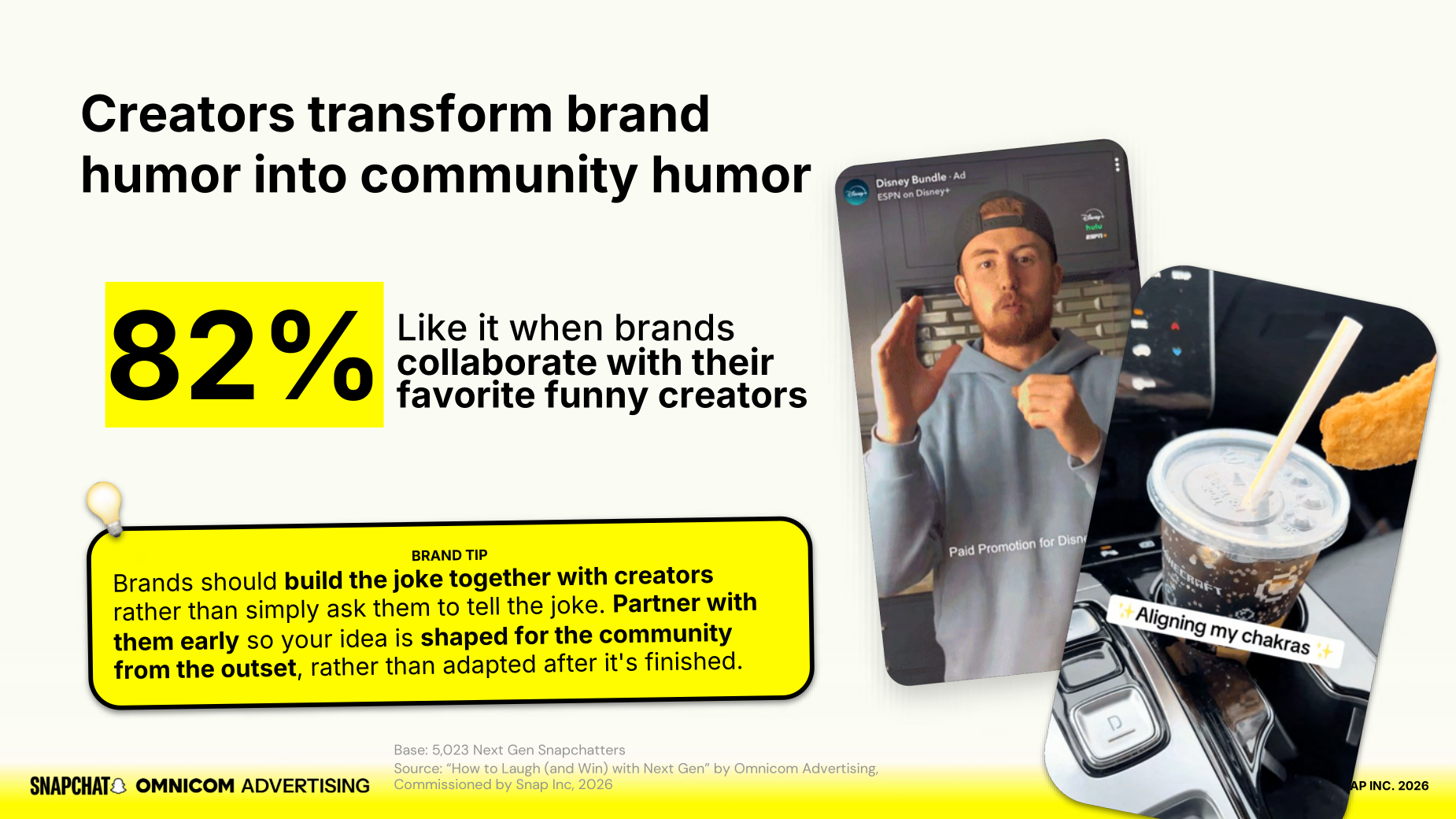
“You need to trust that a creator knows how to talk to their audience and has gotten to the stage where you're wanting to sponsor them for a reason,” says Jess. “They have built a following, they have built an engaged audience and at least on Snapchat, that audience is much more personal and much more wanting to connect with them in a real and authentic way.”
Ultimately, understanding youth humour allows brands to demonstrate cultural fluency and boost purchase consideration. But for marketers nervous about stepping onto the internet's tightrope, the trick is accepting that you can't have the reward without a little bit of peril. “When it comes to conversation and humour, the risk and the reward coexist,” says Laura. “As a brand, you just have to get comfortable with that juxtaposition.”


