


Biggest Creative Threats? Too Much Fear and Fakeness, Too Little Confidence


Emotional sluggishness, an erosion of creative confidence, and too much rationality, fear, and fakeness are the biggest threats to good work right now, according to top chief creatives.
Justine Armour, an Aussie expat who’s now the European-based global CCO of 72andSunny, said she worries some are spending too much time lamenting that good work is too hard to make.
“People fall in love with the reason why it can't happen, and fall in love with a story that it's hard,” she told LBB. “To me, that's the real threat.
“I have made great work in places where you didn't expect it, on clients that you wouldn't expect it from, but you've got to be like, 'I'm going to make that the best client there is.’
“I kind of made a career of working on the stuff nobody wanted to work on, because I was the only girl in the creative department and I had to work on the stuff the boys didn't want. I've just always had this determined, dogged belief.”
Elle Bullen, co-founder and creative partner at indie Hellions, agreed “the industry feels on edge” and such uncertainty “doesn’t create the best conditions for boat rocking”.
Though challenging budgets and a lack of time to “think, question, and craft” are genuine risks, “honestly? I reckon fear is the biggest culprit.”
“With fewer jobs, a shift away from retainers and less security, nerves can win out,” she added. “It’s understandable.
“But it makes the kind of bravery that great work needs harder than ever to achieve. When people feel threatened they protect themselves, and protected thinking is a pretty good recipe for wallpaper.”
Letting fear’s tendrils stretch can also lead to work that ticks the boxes technically, but fails to cut through emotionally. Co-CCO at Saatchi & Saatchi Australia, Avish Gordhan, observed, “We're in the business of manufacturing attention, right? The danger right now is that work is technically impressive, but it's emotionally inert.
“It can be perfectly rational. And every line of copy can ladder up to some box on a complex brand architecture framework. The danger is we create a paint by numbers creative output.
“There's a lot of effort to try and codify things, or figure out the formula to move it forward, and I don't think we are paying enough attention to whether it just feels right, the gut instinct.
“This results in a quiet erosion of creative confidence. You end up outsourcing taste to tools and to consensus. And the challenge is not immediate, but we're teaching the next generation of creatives and marketers that creativity has to always ask for permission, or it must always make complete sense, or that it must follow a recognised pattern. That's quite a dangerous precedent.”
ABEL co-founder Simon Fowler was clear -- the biggest risk to creativity: “Fakeness”.
“We’re surrounded by it now,” he said. “Fake promises. Fake products. Fake websites. Fake links. Fake people. Fake stories.”
When people are bombarded with content and trying to separate fact from fiction, scams from real promises, “they’ll only register if they can connect something with true meaning,” he said, echoing Avish’s rallying cry to prioritise eliciting an emotional response.
“Real people thrive on reality,” Simon continued. “Real culture. Real innovation. Real disruption. Real insights. Everything else is forgettable.
“Whatever we make, however we make it -- whether it’s physical, digital, social, AI-generated or whatever -- it honestly doesn’t matter. As long as it’s genuine and comes from, or connects to something real.”
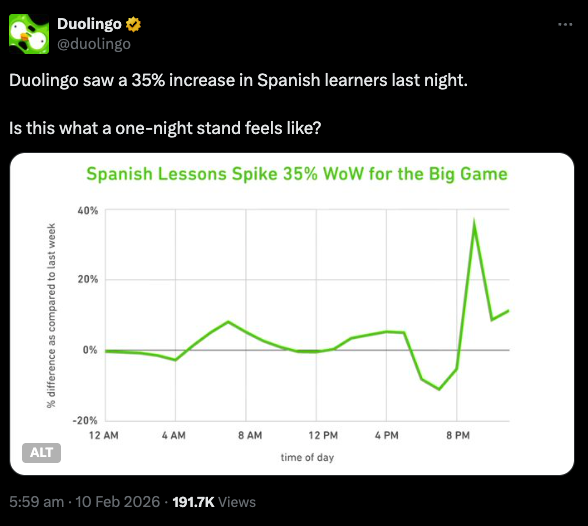
He loves ideas like Duolingo’s ‘Bad Bunny 101’, which the language learning platform rolled out in the lead-up to the star’s Super Bowl halftime show to help people learn Spanish phrases. Renowned for its social presence, the brand later reported a 35% spike week-on-week in Spanish learners.
“Less ads and more communication ideas that real people want to be part of,” Simon called for.
Avish agreed. Surprise audiences, then entertain them, he said. “The other danger is clients are so focused on what they say about themselves that we all forget the audience on the other side wasn't even interested in the fact that you were trying to say something at all.
“So I've always enjoyed ideas that create a bit of friction, that surprise in some way, that make you feel something, because as advertisers, we have a responsibility to entertain people for the privilege of expecting their attention.”
World-class work “doesn’t happen by accident. It takes thinking, challenging, consideration and energy,” Elle noted. Plus a good splash of “irrational determination” that only humans can bring. And so as AI dominates the conversation, and such threats derail and dampen the creative process, what should people be thinking more about, in order to make truly great work? The people making it, Elle contended.
“Do they have the headspace to stretch their thinking? How can we reduce some of the fear they’re experiencing? How do we create a culture that encourages boldness, even when things feel uncertain? These are things that need some great creative thinking, which conveniently enough, this industry happens to be quite good at.”
-
Read more: Justine Armour and Chris Kay Are Prioritising Performance and Playfulness
LBB AUNZ Teams Up With Alex Derwin, Elle Bullen For IMAA Indie-pendence Day Keynotes


