


How to Maximise Return on Investment with OOH


Brands and their agencies often fall into the ego trap of buying a massive ‘hero’ site, such as Piccadilly Lights, purely for the PR photo opportunity and the accompanying industry press release. But does that premium placement actually guarantee impact, or is it merely a vanity metric?
According to Hannah Walley, head of media in the UK at Kantar, the outdoor channel's foundational strength lies in its sheer, unavoidable scale.
“Out of home is really high reach," she explains. When the research company undertook a study of over 600 European campaigns, it found that the channel had the second highest reach, only losing out to TV. It’s everywhere, in the real world, and that means that it reaches people at scale.
Crucially, this physical scale is matched by genuine consumer goodwill. In an era of ad blockers and skipped pre-rolls, the public realm remains remarkably welcoming to brands that respect it. Kantar's Media Reactions 2025 report came out last autumn but it all reflects a consistent trend over recent years and Kantar believes it remains true.
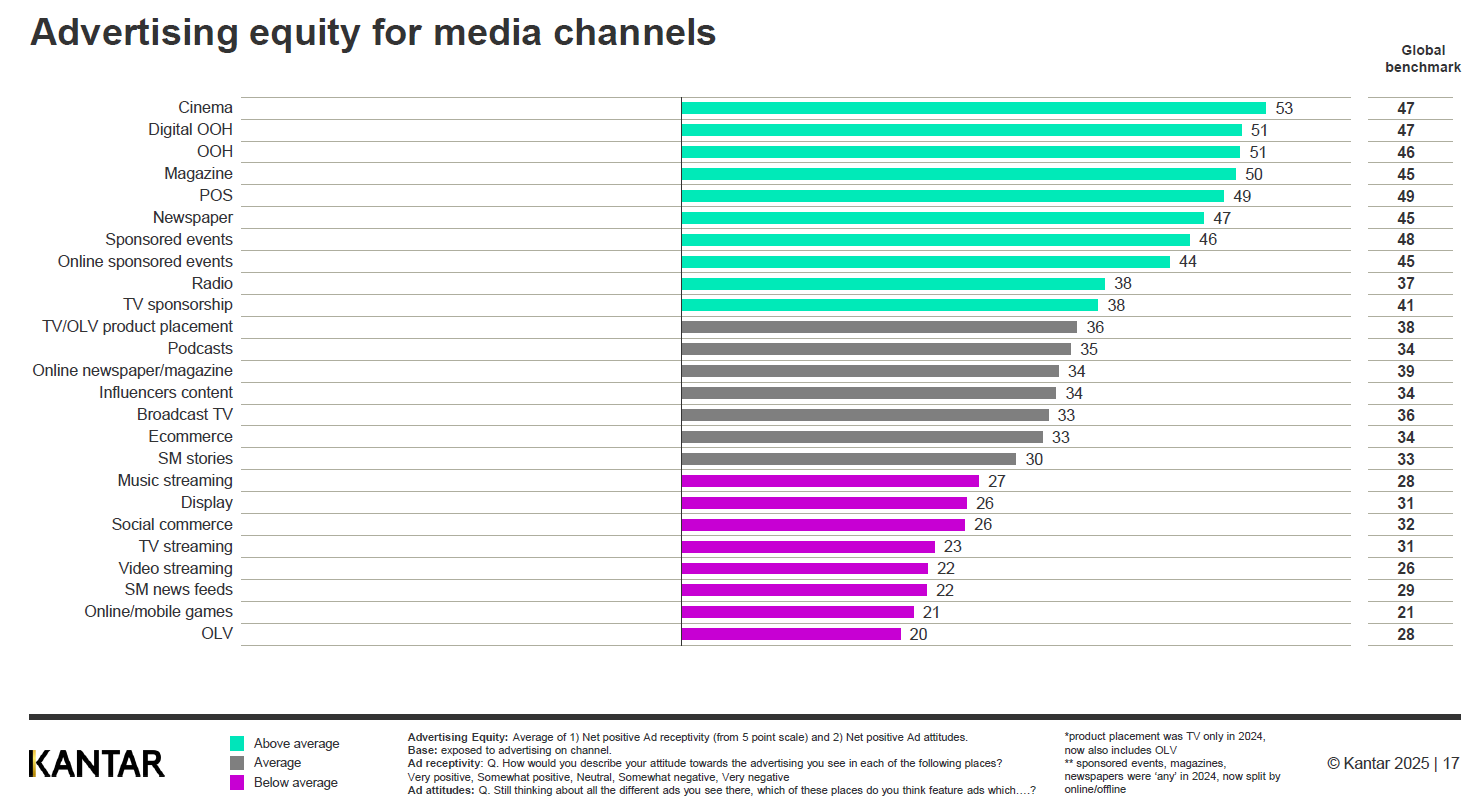
“That research showed out of home was number two and digital out of home number three in terms of receptivity to advertising for consumers," Hannah adds. "So when they see it they don't have an adverse reaction like they might do in some channels that they might skip. They are very open to seeing advertising there because it's not intrusive.” When that’s averaged out into the broader ‘equity’ as Kantar defines it, both digital and traditional OOH swap places but remain in second and third place after cinema.
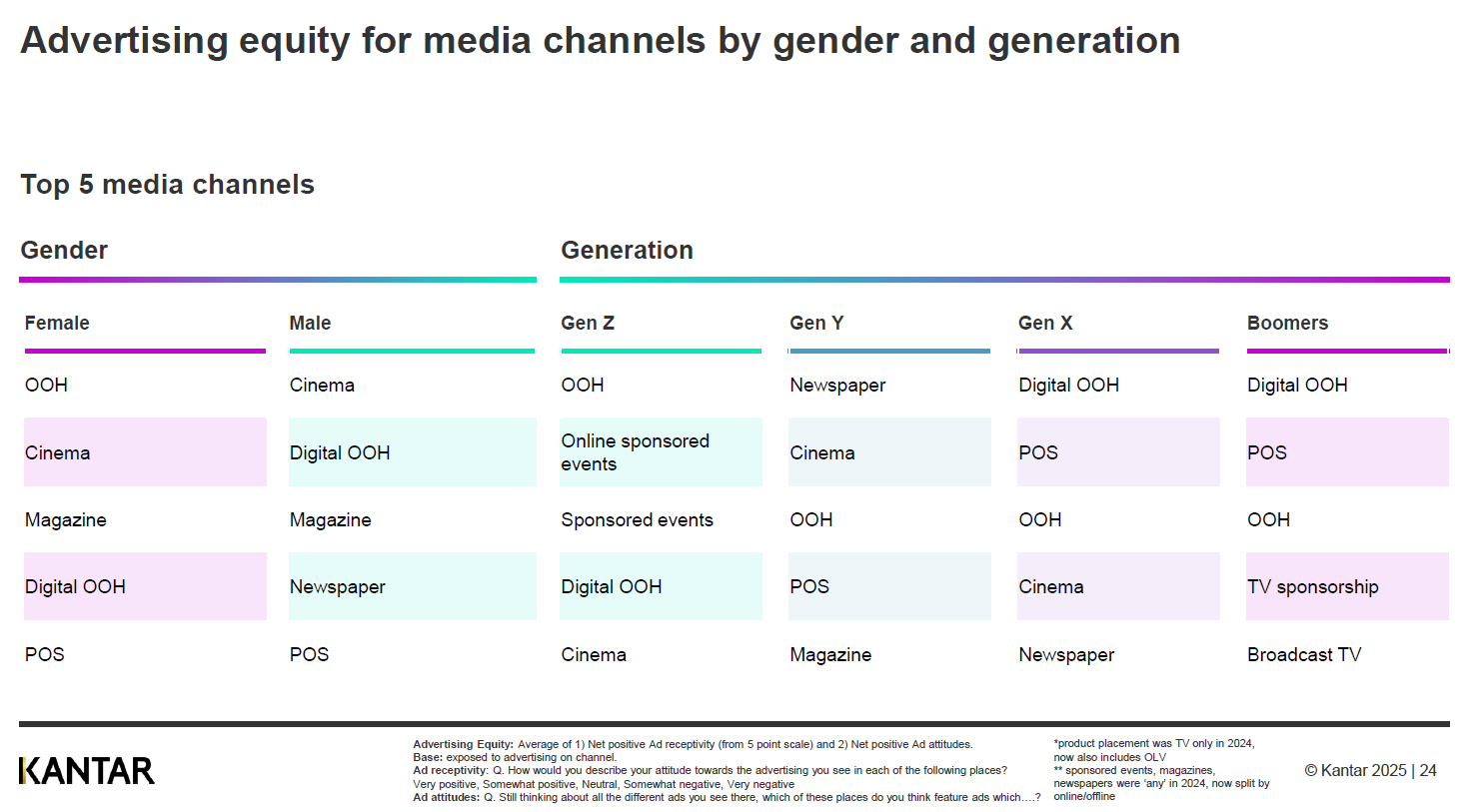
While Kantar’s data reveals a fascinating generational divide – traditional out of home is the top media channel for women and gen z to receive advertising, while digital out of home ranks highest among gen x and boomers – the overall advertising equity of the channel remains broadly consistent and high-performing across all demographics.
Despite its scale, out of home advertising isn't immune to economic pressures. Recent IPA Bellwether reports highlight a dip in out of home spend as brands tighten belts. However, Hannah suggests this data requires nuance. Budgets haven't necessarily vanished; they might be shifting towards influencers or being reclassified entirely as retail media. Furthermore, she notes that strained marketers are increasingly re-running older campaigns to cut costs rather than funding fresh creative. This economic reality makes the ability to accurately measure and prove out of home's return on investment more critical than ever to defend agency media plans. With budgets tightening and spend dipping, placing a standard ad on a premium site is no longer viable; the creative must work 14 times harder to justify the investment.
The 14x Creative Multiplier
A premium billboard cannot save a terrible ad. Buying a hero site only secures the canvas; what you put on it determines the return on investment. “We found that the creative quality has a huge impact on how impactful it will be,” Hannah explains. "We did some research recently with Global Media and Entertainment. Across nearly 500 out-of-home campaigns, they found that creative that is engaging and distinctive delivers brand awareness gains of up to 14 times that of weaker advertising.”
In a crowded, noisy public space, distinctiveness boils down to immediate visual craft and an understanding of the environment. “The first thing is having a hook to grab your attention,” she says. "What is it about visually that would make it grab your attention, something that can work well in an instant. Even in locations where there's longer dwell time at specific sites, will people take the effort to figure out what's going on? It really needs to be super simple that someone can just see and understand very quickly. I guess the key thing is that simplicity doesn't mean boring.”
To manage client expectations, planners must understand how effectiveness is evaluated. Kantar measures cross-media performance across three distinct buckets: summary awareness (combining unaided and campaign recall), brand associations (specific perceptions like quality or taste), and motivation (driving purchase consideration or brand love). While out of home can touch all three, Hannah points out that the dataset reveals a clear bias. “It massively skews towards awareness,” she explains, noting that this reflects what the medium is typically tasked with.
“You have to be mindful of the dwell time,” she notes, questioning whether a fleeting roadside glance is “really going to drive a huge amount of associations or consideration.” Roadside billboards demand an instant visual hook, but environments like the Tube completely change the rules of engagement. Hannah stresses the importance of “designing for the context,” noting that when an ad sits on the Underground opposite a seated commuter, there’s time for more nuance to unravel. Because of this captive audience, she explains that brands “might be able to share a bit more information or a unique site or placement.”
Instead, location strategy must be ruthlessly tied to the actual objective. Pointing to Kantar's recent measurement of a fast-food chain's campaign, Hannah explains that the placements successfully drove physical restaurant visits. However, she cautions planners against vanity buys: “If you only focused on the big iconic moments that aren't necessarily in the right locations to drive that footfall, then you wouldn't achieve that objective in the same way.” Ultimately, a hero site is useless if it doesn't physically or mentally meet the consumer exactly where they need to be.
To de-risk high-stakes media buys, pre-testing offers a crucial safety net before committing budget. As Hannah emphasises, securing clear brand linkage is never a given. “That's why something like creative testing is really important to make sure you're optimising ahead of spend,” she explains. In an era where AI tools can instantly predict where a viewer’s eyes will land on a poster, agencies can validate creative before going live. “Even simple AI checks to be like, ‘how does this perform on branding versus everything else that's being measured? Is it good enough to go?’” Hannah suggests. “Get the basics right first.”
Context and the Programmatic Pivot
The evolution of DOOH means media planners are no longer restricted to buying static six-sheets weeks in advance. The rise of programmatic buying has transformed the medium into an agile, highly measurable channel, stripping away the guesswork of the past.
“Programmatic is interesting," Hannah notes. “We have a way now that we can use geolocation to identify if someone's been exposed to an ad. And then also you can do time stamps based on where the programmatic was running. Because otherwise you'd assume someone's walked past this ad but five times out of 10 they might not see it or one time they might see it.”
This technological shift allows brands to react dynamically to the world around them. “It can be done in such interesting ways. When the weather's spiking then suddenly Wall's might advertise Cornetto,” she adds. “You can react to things as opposed to traditional out of home that you're booking weeks ahead. It's much more adaptable and you can play around with things based on cultural events as well.”
Escaping the OOH Silo
Finally, even the most contextually brilliant, 14x-multiplying out of home placement cannot live in a vacuum. To truly get your money's worth, out of home needs to be seamlessly integrated into a broader media ecosystem.
“Across all of our campaign measurement we looked at analysing campaigns that had say one to two channels, three to four channels and five plus channels,” Hannah reveals. “Campaigns that have more than five channels, can deliver up to three times the impact. Not just for out of home, but for a campaign holistically.”
For creatives and planners, this means building a cohesive brand world rather than treating the billboard as an isolated stunt. As Hannah puts it: “Connect to everything you're doing. So people are connecting across touch points without having to think about it. They're not going, oh I've seen that here and that's there. That's part of one campaign. It just needs to flow over someone and then they take away the message.”
The Kantar Effectiveness Playbook
To illustrate what best practice looks like in the wild, we can look to three standout campaigns that nailed their out of home execution. All were recognised at Kantar's Advertising Effectiveness Awards, which are stringently assessed based on an ad's performance in driving both short-term sales likelihood and long-term brand equity.
McVitie's: Simplicity and Iconic Assets
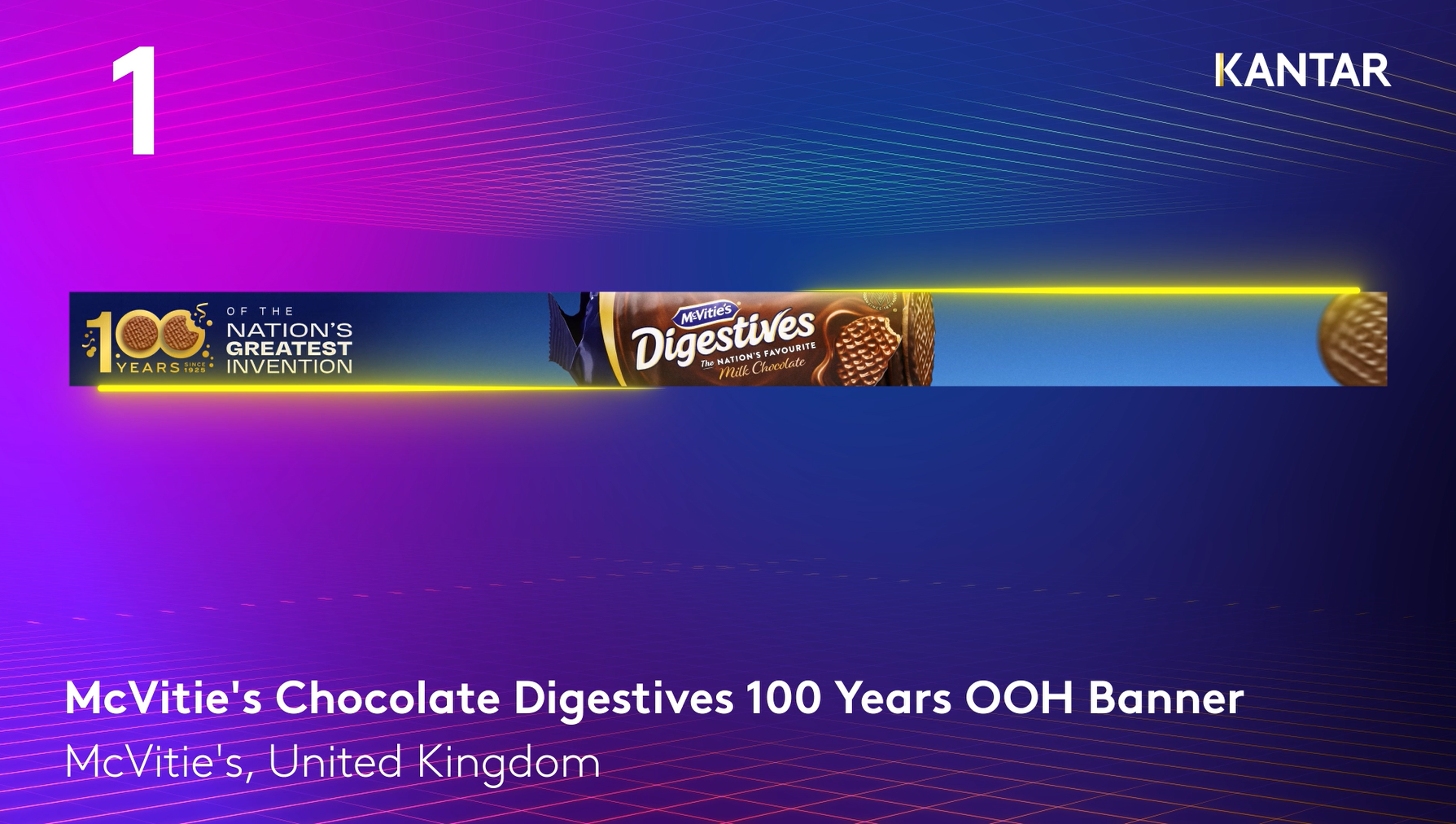
Clinching the global win against all ads tested by Kantar, McVitie's ‘Chocolate Digestives 100 Years’ banner drove success by relying on total simplicity and highly recognisable brand assets. It perfectly proves Hannah's point that a visual hook doesn't need to be overly complex to be devastatingly effective.
Savanna: Cross-Channel Humour
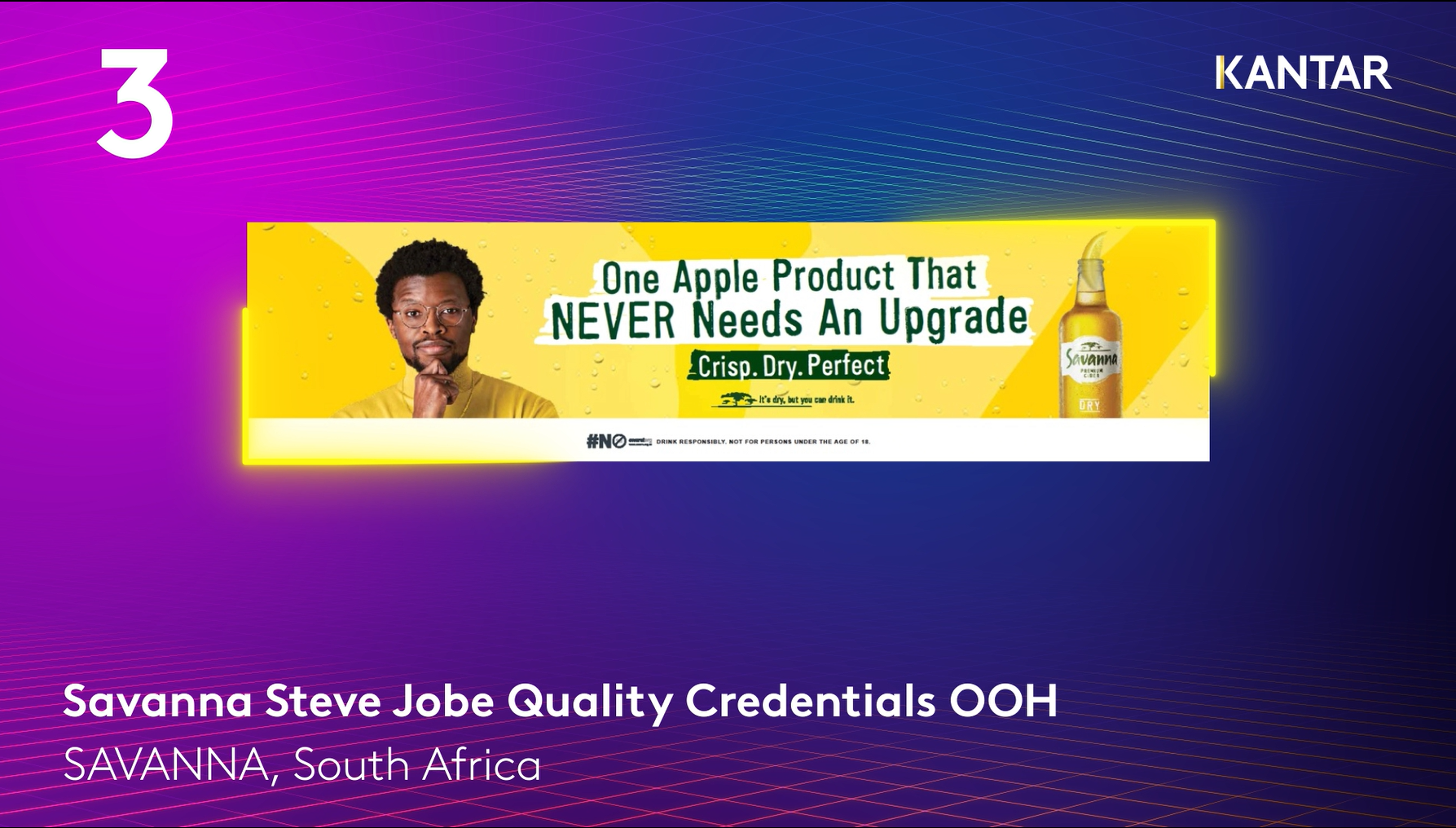
Savanna’s ‘Steve Jobe’ ad in South Africa was the top ad globally when it came to humour, cultural relevance, and cross-channel integration. By consistently using visual cues, products, and characters across different formats without falling into over-uniformity, every placement played a distinct role while strengthening the campaign as a whole.
Inch's: Contextual Relevance
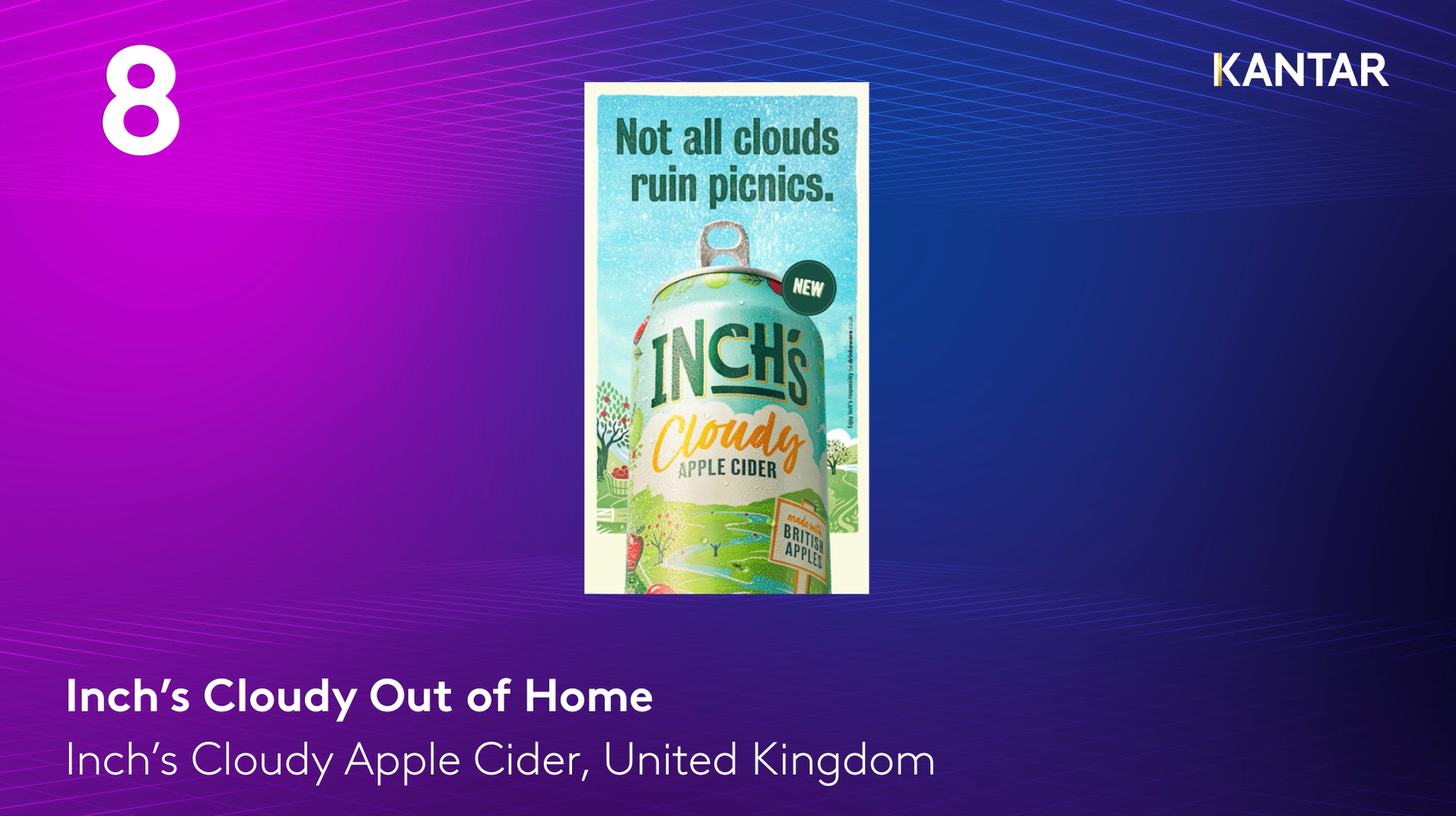
Landing the eighth spot globally, Inch’s ‘Cloudy’ ad was highly distinctive and tapped into specific summer occasions, ensuring the creative was hyper-relevant in the exact moment people saw it on the street. The campaign as a whole maintained a consistency that effectively built brand awareness.
Ultimately, the days of buying a premium hero site purely for the clout are fading. As economic pressures mount, every placement must justify its position on the media plan. But as Hannah points out, the tools to do exactly that are now at the industry's disposal.
“I think the fact that we can measure out of home better than we've ever been able to do and quantify that impact is really valuable for brands and marketers and agencies to be able to prove why you should be spending in that space,” she concludes. In other words: the canvas is there, the audience is waiting, and the metrics are sharper than ever. The rest comes down to the craft.


