


What Adland’s Tech Crowd Is Geeking Out Over


At any given moment, conversation around advertising's relationship with technology is awash with buzzwords. Never has this felt more prevalent than now.
But strip all that away and what are some of the industry's most tech-attuned minds actually into right now? We put the feelers out, looking for a candid snapshot of the exciting, genuinely useful technology catching people's attention, from post-production workflows and agentic AI breakthroughs to the unexpected joy of a tiny replica truck.
The aim wasn't to build a showcase of case studies or client work. We wanted to hear about the tinkering, experiments and rabbit holes shaping how our respondents think, work and create in 2026.
Carol Reed
Global chief innovation officer at Ogilvy Group
It's an incredibly exciting time. The pace of technology advancement is wild. I work with people who are leveraging hundreds of agents to parse through data, while others are vibe-coding incredible digital experiences in days instead of months. Meanwhile, as consumers, we are increasingly craving tangibility. CDs and DVDs are cool again.
I've been thinking deeply about this contrast. How do we balance our ability to do more with tech while preserving our humanity? What happens to art and craftsmanship in an agentic world? How do we lean into AI without losing ourselves?
George Nakashima, the American woodworker, and furniture maker (1905-1990) keeps surfacing for me. His philosophy emphasises natural imperfections, rare materials, and spiritual craftsmanship, which feels oddly relevant now. In his book, ‘The Soul of a Tree: A Woodworker's Reflections’, I keep returning to this quote:
"As much as man controls the end product, there is no disadvantage in the use of modern machinery, and there is no need for embarrassment... A power plane can do in a few minutes what might require a day or more by hand. In a creative craft, it becomes a question of responsibility, whether it is a man or the machine that controls the work's progress."
Despite being written decades ago, this speaks directly to our moment. As we actively shape what's next, especially in creativity and advertising, we need to ask: who's really in control?
We still have the choice. The question is whether we'll make it consciously, or by default.
Filip Williander
SVP, head of creative technology at Le Truc
Honestly? A tiny truck.
I've got a 1/10-scale RC kei truck on my desk running an Orange Pi, a PWM driver, and a set of animated cartoon eyes on a small display. I can drive it remotely, see through its camera, and watch it make people in the office deeply uncomfortable, curious, and full of questions. I built it because I had a question about physical presence. What does it actually feel like for something to be in the room with you? The only way to answer it was to make the thing. With where robotics is heading right now, combined with AI world models, I think we're entering a genuinely interesting moment for how brands can physically show up. Through characters, mascots, or in my case, a little truck.
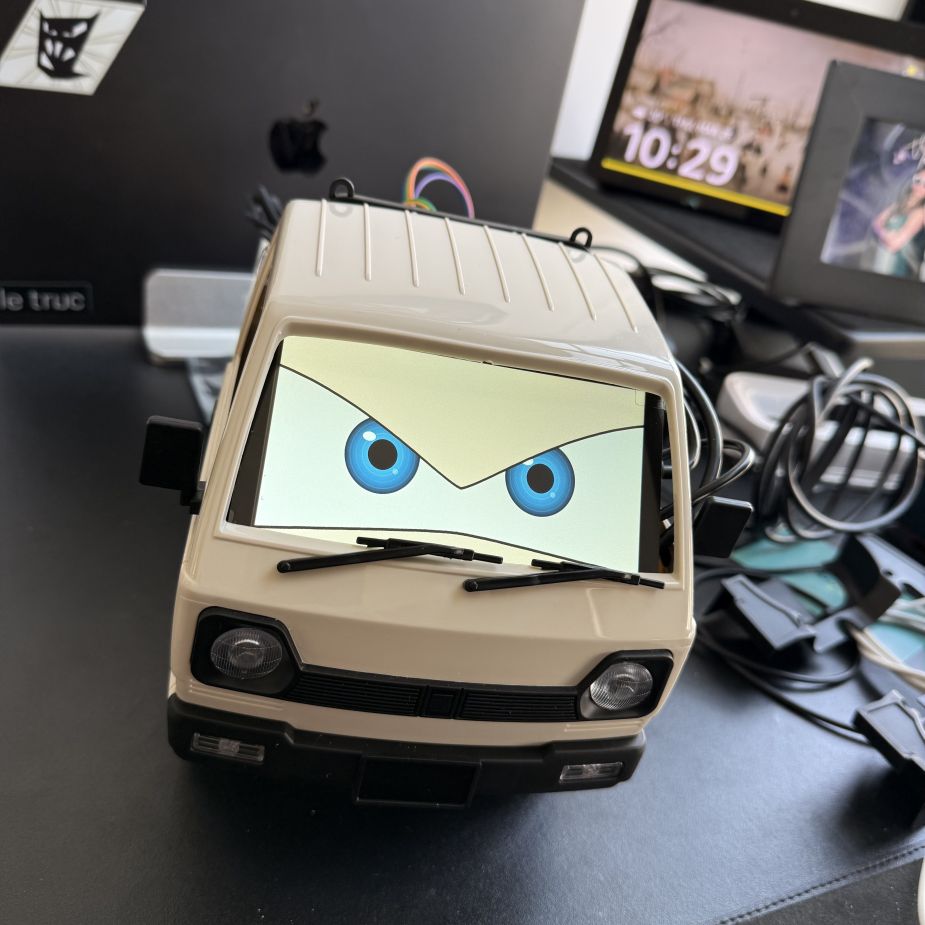
That instinct is what I keep coming back to in 2026. Not the big platforms or the flagship models. The specific weird question that you can only answer by building something.
But more than that, I've been trying to shift how I think about the work entirely. From how to why. Right now AI is the hammer, and every problem is a nail. It's the first answer, the default move, the thing everyone reaches for before they've understood the question. What I find more interesting is going the other direction: stripping a brief back to its actual core. There's that old quote, probably never said by Henry Ford, that if you asked people what they wanted, they would have said ‘faster horses’. The point holds. It's not about what the client asked for; it's about what they're actually trying to solve. Once you're honest about that, the right tool usually becomes obvious. Sometimes it's AI. Sometimes it's a tiny truck.
Peter Bassett
Managing director of integrated production at David & Goliath
It's not a single tool. It's not a platform. It's the realisation that we can build, test, learn, and adapt faster than any production cycle I've ever managed.
I've spent my career shepherding projects through the cycle of briefs, decks, demos, and approvals. In the last 12 months, agentic workflows changed the equation. We're not waiting on prototypes. We're building real things that work, then improving them in near real time.
The rabbit hole I keep going back to is the Claude/remotion flow to generate video programmatically, driven by AI. A creative prompt, some structured markdown, style references go in. Rendered content comes out the other side. Some of the joy of production goes away, but it's amazing what we can create. It's not replacing the craft. It's compressing the distance between the idea and the artefact.
That same energy pushed me toward building small, purpose-built workflow tools. Things that take the low-level repetitive stuff off people's plates so the team can get back to the work that actually matters. What's really changed is how I think about the gap between idea and execution. It can close. But only if humans stay in the cockpit.
That's the thing. The most exciting part of all of this isn't any one tool. It's that the walls between thinking and making are finally starting to come down.
Randy McEntee
Director of VFX and creative technology at 1986 Studios
The technical moat is gone.
For decades, the gap between ‘I have an idea’ and ‘I can build it’ was measured in years of tool knowledge and developer budgets. I've spent my career living in that gap, learning Flame deeply enough to bend it to my will, and understanding pipelines well enough to connect things that weren't designed to connect.
That gap just collapsed.
Claude Code, Codex, Cursor. I'm using these daily, and they've fundamentally changed what one person with a clear vision can produce. I'm building tools that talk to Flame directly. QC pipelines that validate deliverables against spec sheets automatically. Custom LoRA models trained on specific client vehicles. All of it was prototyped fast and iterated faster.
The part that genuinely excites me isn't any single tool. It's that for the first time, digital content creation applications like Flame, Nuke, and Resolve aren't isolated kingdoms anymore. Vibe coding apps are the diplomats that finally got them talking to each other.
In advertising, ideas have always been cheap. Execution was expensive. That math just changed dramatically.
Dez Stavracos
Head of production at Hornet
What excites me about production in 2026 is how AI coding assistants and chat have empowered our administrative teams. From producers through operations, our team no longer settles for processes that are bloated, inefficient, or simply no longer serve us.
Dev resources have always been finite and, understandably, prioritised towards managing, triaging, and also building our tech infrastructure. With the help of Claude, I have team members developing their own solutions to their most common, daily pain points without needing to find time in our dev team’s schedule. They no longer feel hindered by the learning curve of advanced spreadsheet formulas, or scripts for their Airtable workflows.
The eroding of the barrier between idea and realisation has made for a welcome shift in our mindset – from ‘I wish we could’ to ‘I wonder if I can’. Even when the solution ultimately involves the dev team, the timescale from idea to proof of concept has collapsed considerably.
Importantly, embedded in all of this is the team’s satisfaction. These tools have increased agency, autonomy, and in the best case, studio-wide improvements and adoption.
Augustus Cook
VP, head of brand design at R/GA
What excites me in 2026 isn’t the raw horsepower of AI. It’s the chance to put taste back at the centre of the system.
Engineering builds the machine, but creativity builds the meaning. Now that models allow anyone to make anything in seconds, execution alone is a commodity. Our value has shifted. We are getting back to what has always been our most valuable asset: our taste and curation. At R/GA, we talk about this as ‘Intelligent Brand DNA’. We are moving past static, siloed guidelines and toward code that carries character, memory, and behaviour.
For us, 2026 is a creative renaissance. It’s an exciting, messy, and ambiguous time. We aren’t interested in being frozen by trepidation. We are training our teams to use these tools to amplify their intuition, not replace it.
If this tech transforms how we think about creativity at scale, our job is to protect the nuance.
The winning brands won’t be the most efficient ones in the room. They will be the ones that feel the most human because they were built with soul.
Bobby Knapp
Principal engineer at Huge
I was one of those people who had the red badge of shame with 1,000+ unread emails haunting me. Lately, I’ve been leaning into using open AI models locally to help manage those everyday burdens. These open models like Gemma 4 and Qwen Coder, the harnesses that direct them, and the local computer and ability to run them securely, are all reaching a point of maturity to reliably deliver outputs you can actually trust on a day-to-day basis.
Now, every morning I wake up to a briefing of what emails were cleaned up, what my calendar looks like with recommendations on which meetings to take, and a bulleted list of clearly prioritised focus points for the day. In my workflows, I’m able to delegate more of the routine work and get back high-quality, adversarially reviewed results with secure, low cost resources. That lets me focus my cognitive energy and token costs on the how instead of the what. As an engineer building experiences at Huge, that shift is meaningful. It means less time reviewing syntax and more time actually innovating at the edge.
Kate Torres
Executive producer at Toaster
The tools got good. Not ‘good for AI’ good... actually good. I've been using AI video generation to prototype narrative sequences that I'd never get greenlit on a traditional pitch, and the gap between what I can concept and what I can prove has basically closed. For anyone who's spent years fighting for one more hour in the edit bay, that's not a small thing.
But speed was always the wrong metric. What's actually shifting how I think is what happens when you remove production friction as an excuse. When ‘we can't test/prove that’ stops being a valid answer, you find out fast which teams are genuinely after great work, and which ones were just using logistics to avoid a harder conversation.
I've also gone deep back into physical media. Film, Polaroid, analogue process: not nostalgia, but a counterweight. When everything can be generated instantly, the intentional constraint becomes an interesting creative move.
The question I'm sitting with in 2026: Now that the ‘making’ is easy, what are we actually saving that energy for? Some of us have been asking that for a while. Funny how long it takes a room to catch up.
Jonathan Hooker
Director of technology at Kettle
I have too many hobbies: photography, woodworking, vintage trucks, and tube amps. None of them are serious. I just enjoy making things and tinkering without any real agenda. Lately, I've been fixated on synths, and I've started building an application to control them. What's been mind-blowing to me is how fast I've been able to realise my ideas with AI tooling. I quickly went from a simple editor for one synth to a flexible framework that could control any synth. Now, with that framework in place, I've begun experimenting with different ways to visualise the synth patches (they can get complex). In years past, I probably would have only made it to the initial prototype before putting it down. These tools have removed so much of the friction that I'm on v3 instead of losing interest before hitting v1. Ideas are king. The ‘what’ has always been more important than the ‘how’, and that is more true now than ever. It might be time to revisit my back catalogue of unfinished projects!
Mathieu Zancan
Director in digital media at DAC
What my teams and I are genuinely obsessed with isn't a platform; it's workflows. Specifically, the ones that eliminate the gap between data and action. Technology choices matter, but the real advantage comes from how effectively those technologies connect: briefs becoming assets, performance data becoming insight, insight becoming action.
There's no universal stack that does this. You build around specific use cases, test, refine, iterate. That's why we invest in building AI-enabled micro-tools internally, small applications that do one thing well. Performance data gets turned into audience insights, trend analysis, flagged anomalies, and recommended next steps, fast. No single component is the answer, but orchestrated well, they free teams to spend less time assembling information and more time improving outcomes.
My favourite example right now: a tool that visualises campaign performance as heat maps at the FSA level. The granularity is remarkable; it uncovers geo-targeting insights that would otherwise take hours to find, if you'd find them at all.
Luke Hurd
Director, experience design at VML
Every once in a while, the whole industry lurches forward at the same time. We're in one of those lurches right now and honestly, it's the best kind of chaos.
People are asking what agencies are excited about, and the real answer, once you strip away the conference talk, is that everyone is picking up new skills at the same time. All at once. The ECD who's been doing this for 20 years and the junior strategist who started last fall are both learning the same new models, exploring the same new methodologies, having the same ‘Wait, that actually worked?’ moments. That compression is rare and when it shows up, seniority doesn't buy you a head start – curiosity does.
Brands now want agentic systems that do something, not another chatbot that sounds like a help centre. Spatial work is growing up past the flashy one-off activation into something repeatable, something that lives beyond a single campaign. What's possible at the actual moment someone interacts with a brand is shifting fast: at a drive-thru, through a pair of glasses, inside a lens. Production work that used to take a team of five is getting collapsed into a Tuesday afternoon prototype.
What makes this wave feel different from previous ones is access. Earlier cycles rewarded deep, narrow expertise. Right now, the agencies doing the most interesting work are the ones who are genuinely eager to learn something new every week. They're tinkering on side projects, sharing early demos in Teams or Slack, turning those demos into real pitches when nobody expected it. That's account leads. That's creatives. That's people who, two years ago, would have said this stuff wasn't their department.
That's what we'd point to if someone asked what's exciting. Not a tool or platform, but the ground-floor feeling where everyone is levelling up together and nobody is too far ahead to get bored. Exciting times!
Iain Thomas
Chief innovation officer at Sounds Fun
At Sounds Fun we’re currently experimenting with using our conversations and our meetings to generate bespoke tools on the fly for the agency. We record internal process-focused meetings, either about budgeting, business development, production, or other internal business matters. After that we use Cowork to look at those conversations and meeting notes and suggest automations and unique tools it can build based on insights it discovers in the conversations. It’s become a way to relentlessly iterate on processes so we can move faster, spend more time on thinking culturally and strategically, and manage our relationships with a more human touch.
Spencer Schrage
Managing director at M+C Saatchi Consulting
What’s exciting right now is how tech is reshaping who gets to build and scale a brand. Social platforms have evolved into full ecosystems where creators aren’t just amplifying brands; they’re building their own, often within specific communities. That shift requires a different kind of thinking, one that’s more attuned to micro-behaviours, cultural nuance, and how people actually engage in digital spaces.
AI is accelerating that even further. Moving beyond efficiency into something more generative, helping to surface insights, identify whitespace, and even shape early creative and strategic directions. I’ve been experimenting with using it to mock up environments, from event spaces to personalised experiences, just to see how far you can push ideas before they’re real.
Day to day, I keep finding myself bouncing between social platforms, travel tools, and food apps that seem to know what I want before I do. It sounds simple, but that level of personalisation is quietly setting the standard for every brand interaction.
Outside of work, a lot of that curiosity shows up in optimising everyday life, whether it’s wellness, travel, or how I consume information. The common thread is testing how tech can create more tailored, anticipatory experiences. With more access to these tools, more people can create, which raises the bar. It makes breaking through harder, but also a lot more interesting.
Junaid Ali
Operations design and enablement director at tms
What I’m really geeking out over isn’t the tech itself, but the confidence, creativity, and momentum it unlocks for teams.
At tms, that thinking is reflected in the evolution of our internal tech function into the operational design enablement team, a shift that signals a broader mindset change. The goal is to empower individual contributors with tools and systems they can apply in meaningful, practical ways to their daily work, rather than focusing on any single platform.
One of the most exciting developments right now is enterprise‑level integration. As platforms increasingly ‘talk’ to each other, teams are able to align faster, move more efficiently, and stay focused on solving the right problems. Alongside that, the rise of collaboration and whiteboarding tools has reinforced something we talk about often: communication skills matter more than ever. Listening closely, documenting clearly, and identifying the underlying challenge is what allows technology to deliver truly effective solutions.
All of this has created real energy around continuous learning – staying on top of evolving capabilities and sharing those insights internally across tms and with our clients. That’s how we make innovation visible, practical, and genuinely valuable.
Colin Jeavons
CEO at Nomix Group
The thing I keep returning to is a question nobody in the creative industry seems to want to ask out loud: if an AI agent is making the purchase decision on a consumer's behalf, what exactly is the creative for?
I don't ask that to be provocative. I ask it because I've spent two decades building search infrastructure, and I've watched this pattern before. Search collapsed the awareness phase. AI is collapsing the consideration phase. The consumer who once spent three days comparing options is now getting a recommendation in a single query and acting on it. That changes everything downstream, including what ‘good creative’ actually means.
The tools I keep coming back to help me understand intent before it surfaces. Not what people searched for. What they were about to search for. That pre-search moment is where commerce is actually happening now.
Outside of client work, I've been spending time on the policy side of this. I co-founded the International Centre for Parliamentary Studies years ago, and the pattern repeats: technology moves, regulation follows slowly, and the gap in between is where either genuinely useful things get built, or genuinely harmful ones do.
The shift in my thinking lately is this: creativity used to be about capturing attention. Now it's increasingly about building trust with systems that will recommend you, or not, before a human ever gets involved. That's not a smaller job. It's a different one entirely.
Gareth Porter
Head of pipeline at Hornet
As the head of pipeline, it’s been really interesting to see the development of agentic coded tools, because our team’s task is then to build out a robust and stable backend to make that tool sustainable and usable by a team. We’re at an interesting point where everything looks amazing and does exactly what you need, but there is still the factor of implementation.
Zooming out, the dev team is constantly updating the backend of the studio to match the ever-growing scale and volume of work that comes in. We’re always tinkering, testing, and getting demos of new tools and platforms, so the production teams can focus on doing their incredible work. For instance, we’ve been excited to roll out a software package manager, Rez, that allows us to deploy a complete software environment from a predefined configuration, customisable for each project, regardless of what the artists have installed on their machines. We’ve also implemented a system via Amazon’s AWS to fire up and deploy cloud workstations on an as-needed basis. This has been a much more flexible solution than having ageing infrastructure on premises that could be sitting idle, or worse, not be strong enough to handle the requirements of our most complex projects. The scalability of cloud workstations means we can instantly deliver the properly sized hardware artists need and upgrade when needed. Both of these have been totally custom solutions developed in collaboration with our vendors and our in-house dev team.
In 2026 you need to be adaptable to quick changes and evolving tech, and with our diverse and mighty dev team, there is a daily excitement in working together to tackle any type of technical issue. This nimble, problem-solving mentality is definitely a point of pride.


