


What's the Verdict on Andy Burnham's Social Strategy?


Armed with TikTok creator collaborations, candid walkthroughs of 'Number 10 North', and Reddit AMAs, prime minister Andy Burnham is treating political communication more like a founder-led brand rollout than a traditional press office.
By abandoning rigid, broadcast-style press releases in favour of behaving like a native content creator – pouring pints, running with Mo Farah, or hopping on videos with local influencers – Andy’s early digital output is setting a new precedent for how politicians earn public attention in 2026.
But as his entertainment-first strategy cuts through online, social media leaders from Hijinks, We Are Social, Ogilvy, and adam&eve\TBWA break down what makes his playbook so effective, the risks of bypassing traditional scrutiny, and how he can turn social 'vibes' into long-term political authority.
Sinead Brennan, head of social at Hijinks
If we were to compare Andy Burnham's TikTok with his own party's handle, you're looking at two very different approaches to social.
Burnham's content borrows from creators whilst Labour's feels much closer to a very specific era of brainrot brand TikTok, very much popularised by the likes of Ryanair where trending sounds, memes and CapCut templates drive the creative. I'd argue that approach was more than effective a few years back but feels less relevant as social moves away from churning out content to chase attention and towards truly earning it.
What I find interesting is that Burnham doesn’t feel the need to borrow from micro-trends and instead he's adopting creator behaviours. Whether it's in front of a bus with Bemi (Bus Aunty) in her typical format to talk about the £2 fare cap in Manchester, pouring a pint as he shares three things people probably already know about him (before announcing support for pubs) or hopping on the career ladder with Max Klymenko and between all that going for a run with Mo Farah. The content feels native to the people he's creating it with, with some videos helping to explain policy and others just letting people get to know the new Prime Minister.
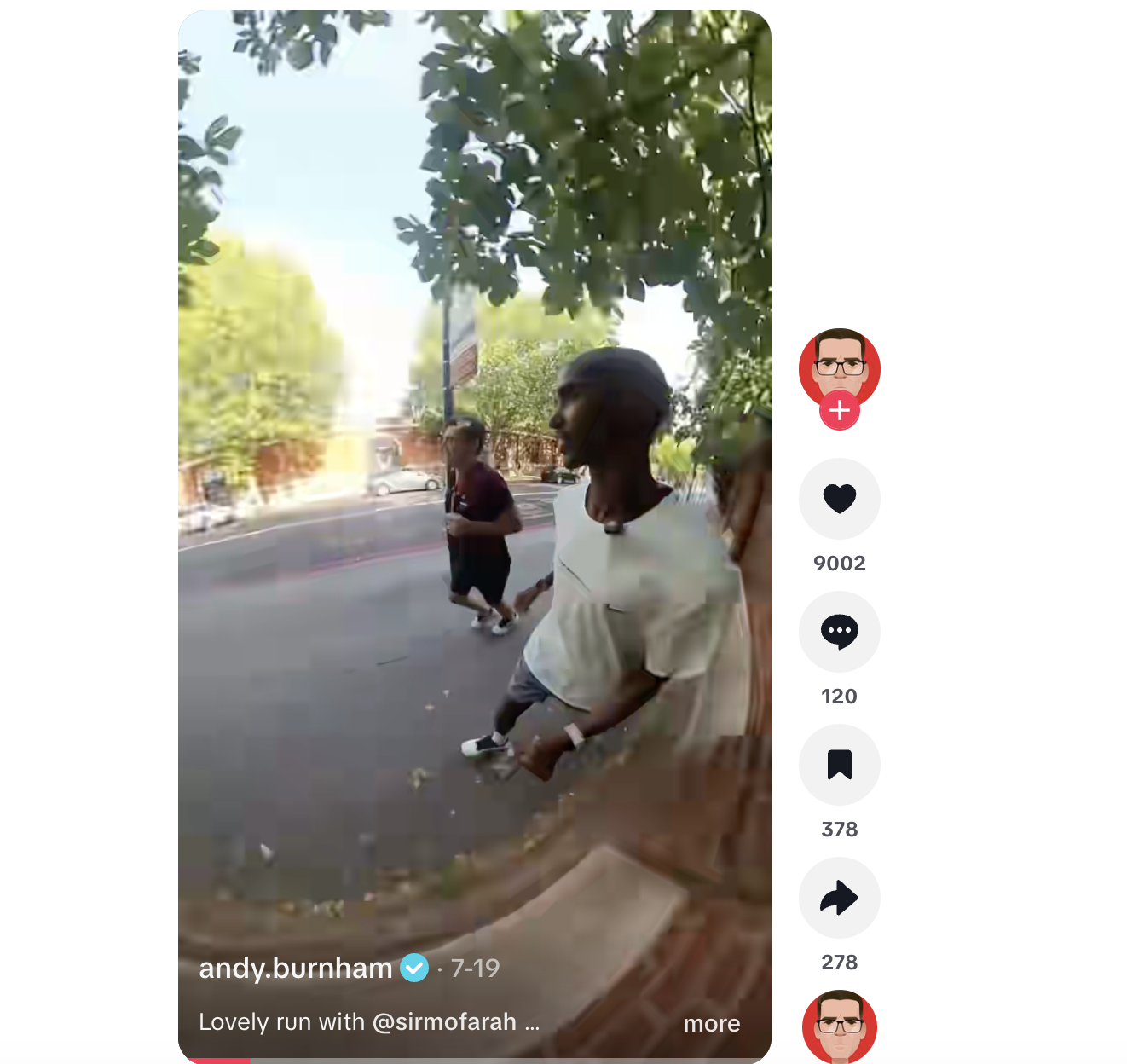
Andy Burnham goes on a run with Mo Farah on TikTok.
The social landscape in 2026 is rewarding content with intention over content for content's sake, and we've seen plenty of political examples recently where the format becomes the story rather than the message itself; you only have to spend 10 seconds in the comments to see that people know the difference.
For me, that's the biggest takeaway from Burnham's approach. Every piece of content has a reason to exist and the format is the vehicle that helps the idea travel further.
Paul Greenwood, head of cultural strategy and Insight, EMEA at We Are Social
Andy Burnham has spent years cultivating a “man of the people” identity, and his early social strategy is accelerating it. Collaborations with figures such as Bus Aunty and Career Ladder’s Max Klymenko, combined with a recurring cartoon-style image, create recognisable motifs that make both the man and his politics feel more accessible.
It is a deliberate contrast with Keir Starmer’s more rigid, institutional presence. There are echoes of Tony Blair’s attempts to reduce the distance between Downing Street and the public, but the media system has changed. Blair worked through broadcasters and newspapers; Burnham increasingly seems to be looking to bypass them and communicate directly.
That is both the strength and the risk. Creator-native storytelling can make government and policy more relatable, but it also allows politicians to establish their preferred framing before ideas face sustained scrutiny. We have seen this direct-to-audience model used in the US by Zohran Mamdani and Donald Trump, at different ends of the political spectrum.
The real test is whether this style can coexist with the accountability expected in a parliamentary system. Social media can bring the government closer to people, but it cannot become a substitute for interrogation, detail or delivery.
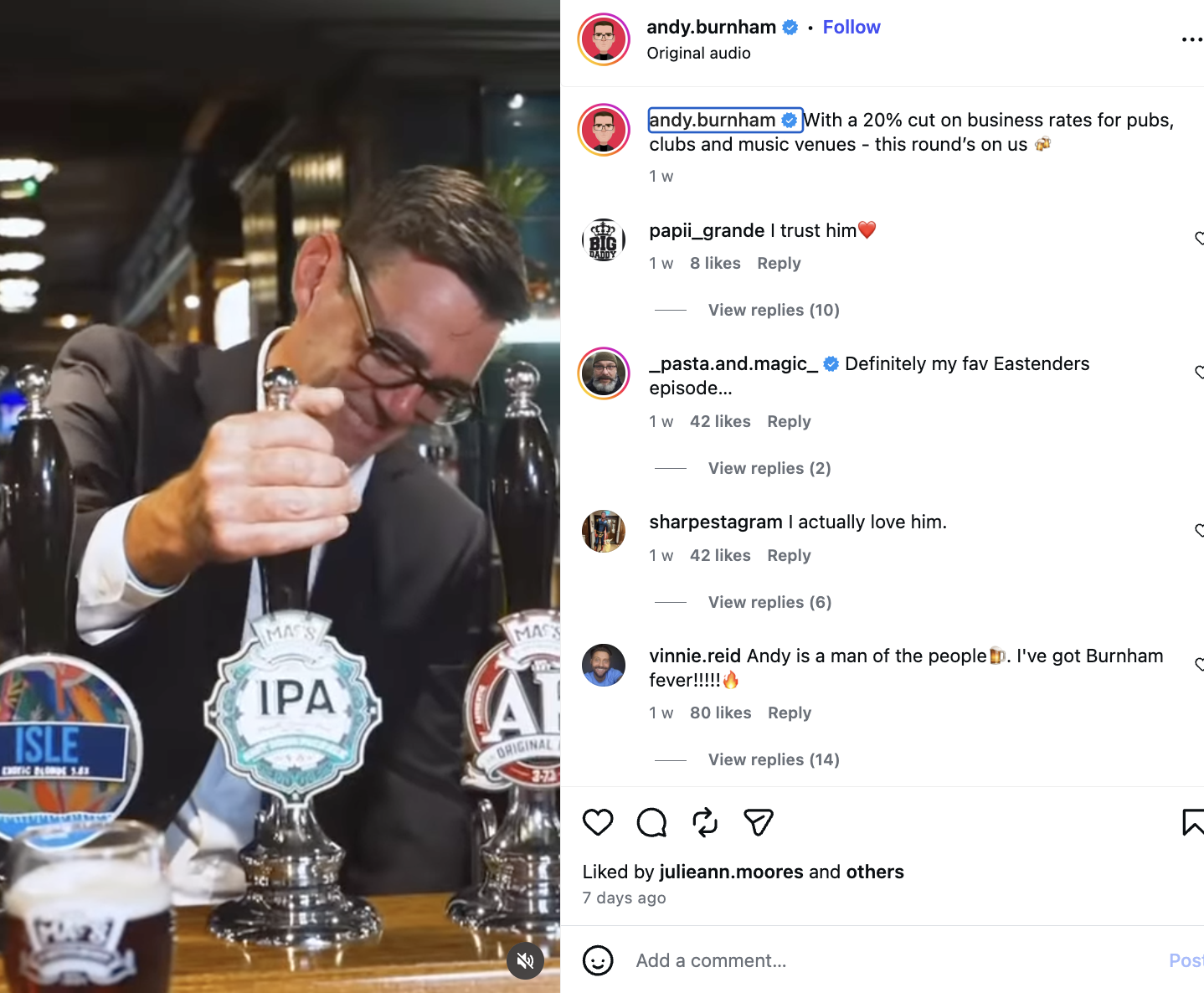
Andy Burnham pulls a pint on Instagram as he announces new investment into pubs, clubs and music venues.
Stephen Maycock, social & influence strategy director at Ogilvy
For years, governments have treated social as another broadcast channel. Take the press release, trim it to 60 seconds and publish. Burnham's team has recognised something more fundamental: people don't come to Instagram or TikTok to consume policy, they come to consume people. Rather than forcing political communication into traditional formats, they're adapting it to the native behaviours of the platform.
Where previous governments invited creators into Westminster to report on politics, Burnham has flipped the model by taking politics into creator culture. Collaborating with personalities like Bus Aunty isn't just about borrowing her reach. It’s a strategy focused on borrowing cultural credibility to deliver policy through formats audiences already choose to consume.
But it's oversimplifying the situation to say that Andy Burnham is creating a social-first strategy, I believe it's deeper and more thought out than that; he's borrowing cues from the tried and true 'Founder Story' documenting his first weeks in power like a creator with a burgeoning business.
Think Grace Beverley documenting the build of TALA, Jamie Laing rebranding Graze or AI tech leaders filming one-take mini-mic videos; audiences are used to seeing the journey, radical transparency, open Q&A's and office environments. Burnham's candid creator collaborations and No.10 North office walkthrough, felt much closer to that model than traditional political communications.
I'm interested to see where this goes next.
Judith Tulkens, content creative director at adam&eve\TBWA
If you, just like me, wanted to have a quick look at the new PM's social feeds after all the public attention over the last couple of days, you've likely stayed much longer than expected. That’s because Andy Burnham’s feed is effortlessly entertaining – and he’s using engagement tactics with the flair of a chronically online teenager.
Everyone knows Burnham has a team behind him, but the way he holds the phone himself and engages with the comment section - even negative ones - makes it feel like nothing’s been signed off by his PR advisors. Refreshing!
We always talk about how brands can close the culture gap with consumers, and that’s exactly what Burnham’s doing in social – his content borrows from celebrity and fan culture, which is unconventional for a politician, but helps him cut through online. His use of creators also helps him reach new audiences. In many ways, it’s a similar strategy that Polanski and Farage have used to deliver results at the polls – but thankfully, minus the hints of rage-bait.
Since he’s probably not planning a general election soon, the PM will have plenty of time to focus on his content calendar – and I personally can’t wait to see how he’s planning to evolve that from ‘just vibes’ to ‘vision’ – his next challenge will be letting people know what he actually stands for beyond his rankings of pub snacks and rock bands.


