


Makers Founder Sumit Ajwani Launches MakeOS, an AI Workspace Built for Producers


Creative production is becoming more complex, with distributed teams, tighter timelines and rising content demands reshaping how work gets made. Yet across much of the industry, producers are still relying on spreadsheets, email threads and a patchwork of disconnected tools just to get a single project off the ground.
Now, the newly launched MakeOS is aiming to modernise that reality. Spun out of Makers, a company that positions itself as being able to produce anything, from commercials to houses, the AI-powered workspace has been built specifically for production teams, whether freelance, agency-based, in-house at a brand or operating within a production company.
Founded by Makers founder Sumit Ajwani, who is now dedicating his time to MakeOS full-time, the platform has been designed around real production workflows rather than generic task management or finance-led software.
MakeOS brings together project scoping and planning, scheduling and budget tracking, team collaboration, vendor management, wrapping and documentation, and reusable templates and workflows within a single, centralised system.
Rather than manually building timelines, budgets, scopes of work and task lists from scratch, MakeOS is designed to help teams move from brief to plan in minutes. The platform uses AI to interpret incoming information from decks, emails and documents, generating a summarised brief, an initial budget, a draft schedule and organised deliverables.
The product grew out of internal tools Makers built over the past decade to manage thousands of productions across commercials, content, experiences and large-scale builds. What began as a collection of Google Sheets and linked documents evolved into a dedicated software platform that was gradually battle-tested across more than 1,000 projects.
“That [on Google Sheets] is pretty much how everybody runs,” says Sumit, speaking with LBB. “There are software applications out there for the largest companies. You’ve probably heard of ERPs. They’re terrible though. They’re built for finance teams. They’re not built for producers.”
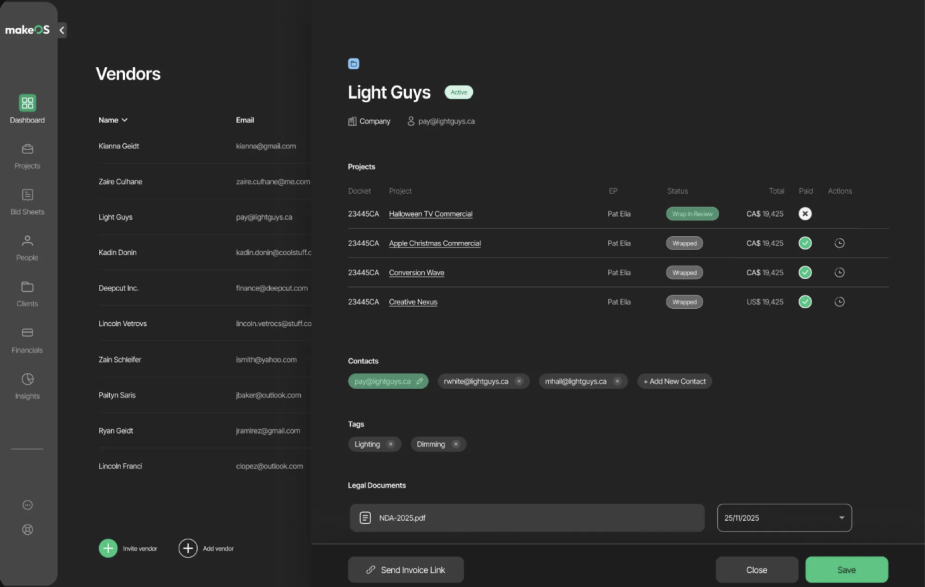
The first stage of building MakeOS within Makers was moving its own Google Sheets usage into their own piece of software. The company had a project board that would manage all its projects so the team could have a bird’s-eye view of the whole company. They started by building that as software before incorporating things like bid sheets and schedules.
“Every time we added a new piece,” says Sumit, “it was all the stuff that we were using every day at Makers. I think that means that it got built the right way, because every single thing that we moved had already been battle-tested across thousands of productions.
“What’s really neat,” he adds, “is that when we make an update or a change, it benefits everybody. Right now, that doesn’t exist. Some company somewhere has got a process that they use for talent management. Nobody else benefits from that. But creating one centralised source of truth means that everybody in the industry can benefit from those upgrades.”
The platform is also designed to address a growing industry pressure point: volume. With projects now routinely delivering hundreds – and in some cases thousands – of assets, MakeOS is intended to help teams manage scale without forcing producers back into spreadsheets and manual admin. It also supports collaboration beyond internal production teams; users can invite external collaborators into projects, similar to a Slack-style model.
Meanwhile, AI-assisted invoicing tools handle one of production’s biggest administrative burdens. When an invoice is submitted, the system reads it, identifies which job it belongs to and which budget line it should sit under, and files it into the correct place for the producer. “So you’re basically wrapping as you’re going,” says Sumit.
The aim is to reduce the end-of-job accounting puzzle and remove manual work that line producers still handle themselves today. In some cases, says Sumit, production companies are still processing paper checks.
Data security and privacy have also been built into the platform’s architecture. Each company operates within its own encrypted server environment, and AI features are used to interpret information rather than train external models.
It is launching with a monthly subscription model, with pricing currently being tested with a group of design-partner companies outside of Makers. A free version will also be available for solo producers.
MakeOS enters the market at a time when production teams all across advertising are under increasing pressure from all angles with few purpose-built tools designed specifically for how producers actually work.
“My goal when I first started Makers,” says Sumit, “was just to make producing better for everybody. Production is this thing that’s kind of pushed to the back. It’s not seen. It’s the invisible machine, and it’s more important now than ever.
“If I could do one thing in the world, it’s just help every producer across every industry get better at producing with the right community, the right skills and the right technology. We’re trying to build something that’s going to make every producer’s life better, and I think that can benefit everybody.”
Read about more global business changes here.
Read more from Addison Capper here.


