


Director and ECD Surprised Pizza Hut Australia CMO With Perfect Sting


Pizza Hut Australia’s CMO was surprised with the perfect sonic asset in the edit suite, she has revealed on the latest episode of Heard Mentality.
Sonic assets are among the most effective distinctive brand assets in a marketer’s arsenal, so Nora-Kate O’Connell wanted sound to help revive the tired pizza brand in Australia. “It's quite a commoditised category,” she said on the podcast project from Commercial Radio and Audio and LBB, requiring a level of distinctiveness that guarantees “doing a brand job,” not a “category job”.
She asked the global team if Pizza Hut had an international sonic asset. It didn’t. “I talked to [indie agency] jnr. and I said, I feel like we really need to crack a good sonic asset, so it becomes an earworm, so it does a lot of the heavy lifting for us, so when people see you, they almost hear you and it becomes multisensory.
“They came back with various ways in and each of them I was like, no, that feels replicable.” Then the trans-Tasman agency “came back with the budget for a sonic studio”, which proved a stretch for the challenger brand.
“I walked into the editing suite and they said, hey, so we also have what we think is a sonic asset. And I was like, really?
“Our director and our ECD on the work actually just started playing around and created the sting at the end, and that is what is in the ad spot now. And the minute I heard it, I was like, that's it. Don't stylise it, don't change it. That's it.”
The platform, ‘How Bad Do You Want Good?’, embraces dark humour -- someone on fire, a boy with broken arms -- and “the comedic nature of that sting has meant that it took away the darkness of the humour, because it lands the point of just reminding everyone: This is just an ad … It's just pizza. Don't take it too seriously.
“But it also meant that we could go and play into audio, and we know that in the QSR category, audio can play a really strong role.”
It was “surprisingly easy” to sell in the work “because everyone was aligned with the brief” and willing to endure some resulting discomfort. The CMO joined the business just a few months ago, and inherited a mandate to disrupt the market. The work had to push the envelope to have a shot at stealing market share from the “goliath” of Domino’s.
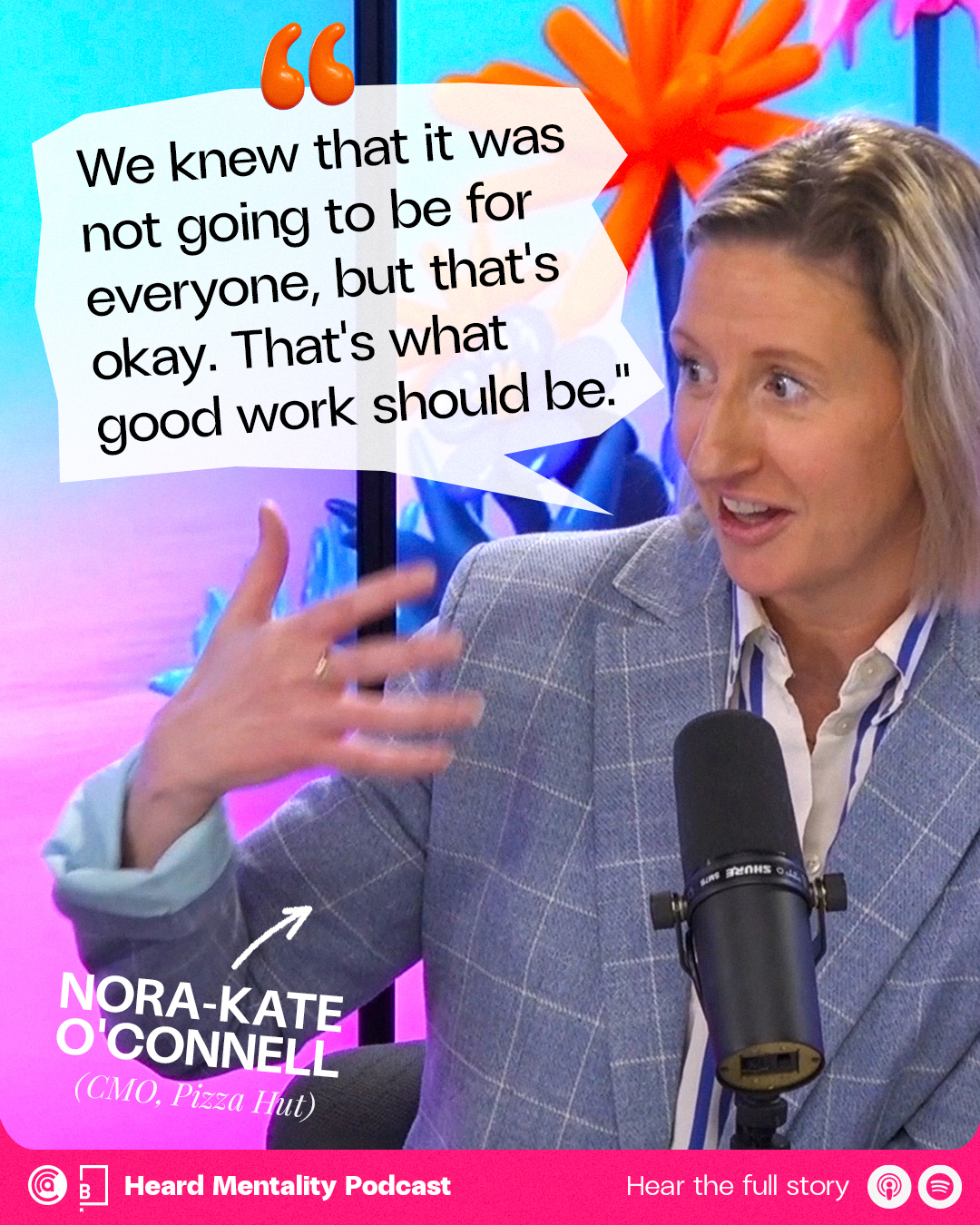
“So I knew exactly what I was walking into when I saw the response to a brief like that … [The board] knew exactly what they were anticipating and what they were going to get.
“That line, ‘How Bad Do You Want Good?’ just landed immediately. The simplicity of it, the attention grabbing of it and the longevity of it as well.”
That didn’t mean the process was comfortable. She would “wake up in blind panic in the middle of the night”. jnr. recently confessed it included some “decoys” to de-risk the risky; “there were babies in prams. There were people in water drains.”
“Every single one made you laugh, and some of them [felt] too far. And then others were like, oh, that's just on point. That is just bad enough to be entertaining, but not so bad that it's pointless.”
Evan Roberts, co-founder and chief creative of indie studio Tightknit, explained he often presents a scale of options to clients, ranging from safe to extreme. “And more often than not, most people will take the silver option.
“I often find it's a good way to help people take a leap, by giving them a few angles in [and] a varying degree of risk.”
Nora-Kate observed she is surprised that branded dark humour still feels so ‘risky’.
“If you think about content today, the entertainment is getting darker. And so I find it quite interesting that advertising hasn't followed that. Part of the reason for that is because CMOs and corporates and GMs are nervous about going there. But actually, when you think about the entertainment atmosphere we're in, our job is now to create entertainment. We need to start pushing the boundaries and pushing advertising forward.”
As the longtime executive creative director at Saatchi & Saatchi Australia, Piero Ruzzene has worked closely with Toyota to honour and evolve its proven ‘Oh What A Feeling’ sonic sting. Asked about the impact of the brand’s sound on the creative process, he said, “It's a godsend, really. It's been on such a unique journey, that sting. Obviously it started with the guy jumping by his car.
“And then over the years, it's built up so much familiarity with the audience that we've stripped all the vocals away. And it's even become a visual sting.
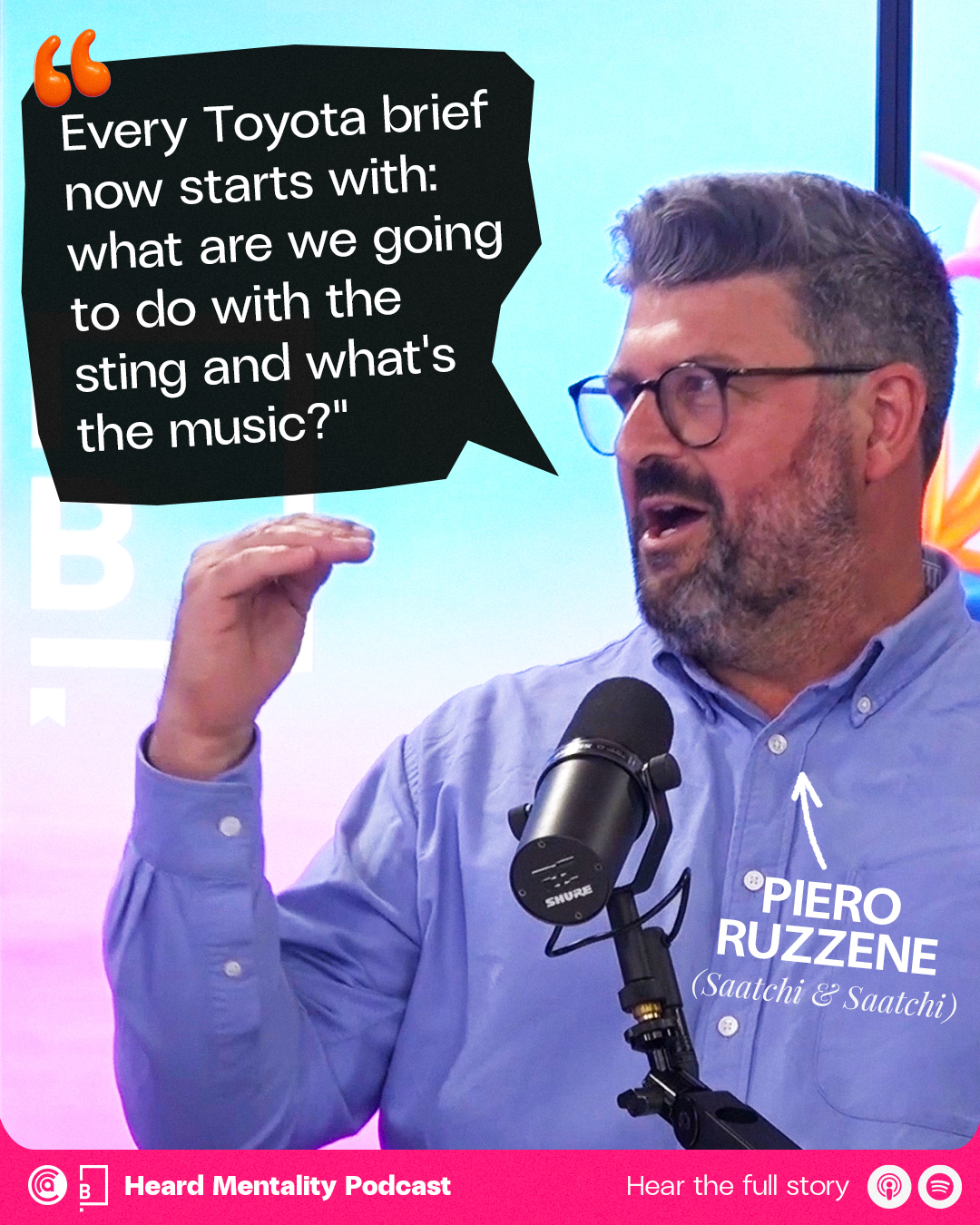
“They realised the power of sound and the fact that you can really just get into a consumer's head. So every Toyota brief now starts with: what are we going to do with the sting and what's the music? And then the music style influences the sting … it can be a banjo, it can be a trumpet, it can be something a little bit more ambient for a more serious spot.”
The brand is “very music-driven” across the portfolio, he added, from HiLux to LandCruiser.
“The sting paved the way for them to understand that music is our way to telegraph a tone, an idea.”
Evan said both Pizza Hut and Toyota’s use of sonic branding prove the value of allowing room “to play”. To Nora-Kate he said, “So holding out on that sonic branding until you saw an edit and going, ‘Okay, we'll get something’, and having faith in the process, is probably what made it so great.
“Or if Toyota had stuck to it [and] only done it one way for ever and ever, we'd hate it by now. You just would have killed it. But you can do it visually, you can do it with different instruments, there's a million ways to do it. And having that freedom is actually what gives you consistency over time without getting boring.”
Category leader Toyota was forced into challenger mode when HiLux’s dominance wavered -- leading to the iconic ‘Don’t Send a Ute to Do a HiLux Job’ campaign.
“It really ruffled feathers and it made them buy a braver strategy and buy braver work. And it worked. It got them back to where they needed to be," Piero said.
The early response to Pizza Hut’s recently-launched work has been “pretty nuts,” Nora-Kate acknowledged, including a 200,000% increase in TikTok views and a 500% jump in Instagram engagement. The work was accompanied by a new social strategy which addresses how and where the brand shows up, “so that we can keep pushing the tone as much as we want to.”
Prioritising tone meant the brand hired its script writers to act as community managers for the first couple of weeks, so “we could keep the tone on-brand” and lean into the discussion, not back away from it.
“We knew it was not going to be for everyone, but that's okay. That's what good work should be. But what we hoped was it would actually create a conversation, that people would defend the work.”
At the time the campaign launched, she told LBB, “I've seen it time and time again, especially in the QSR category -- when the GM gets behind the CMO, that's when magic really starts to happen.”
On the podcast, Nora-Kate said of the category, “It's a very fast-paced industry, and as a result, you have the opportunity to be highly culturally relevant because you are so fast. What that means is you are not going to always get it right.”
She previously led marketing at KFC, where a general manager told her, “Your retail spot is on for four weeks and then you move on to something else. There's only so much you can screw up.”
--
Heard Mentality is a podcast series brought to you by CRA and LBB. You can listen to all episodes here.
If you're a brand looking to connect with Australians, there's no better place than Aussie radio and audio. It reaches more than 15 million people every week and truly is where brands are heard. Head to cra.au to get started.
--
Catch Up on Season 2:
Creatives Should Feel Empowered to Push A Radio Idea to Breaking Point
Audio Gets People Talking About Ads At The Dinner Table: “You Get To People When They're Cooking”
Jingles Offer “Lifetime of Opportunity”, Ward Off Regulatory Risk: Jon Evans
Jon Evans Reveals The Pitching Mistake “Almost Every Creative Agency” Makes
--
Catch Up on Season 1:
Challenger CMO Bets Up to 50% of Budget on Radio to Build Brand From Scratch
How Special and Uber Eats Turned Doorbell Into DBA: “People Don't Give Sound Enough Credit”
Westpac’s Dr. Seuss-Like Song Was Accidental. It’s Now Considering “Whole Sonic Language”
Radio and Podcasts Offer “Right Amount of Wrong” to Cut Through AI Fatigue
Mark Ritson’s Challenge to CMOs: Invest More Money, Creative Ambition in Audio
Webjet, Fiji Airways Turned to Audio Because There’s “No Better Place to Tell Stories”
Marketers Should Protect Sonic Branding “Fiercely” Because “The Jingle’s Coming Back”
Sushi Hub Banks on Jingle in Hunt For $1bn Valuation: “Radio Has Always Been Theatre of the Mind”


