M.I.A, New Order’s ‘Blue Monday’ and ‘just a boy’: The Work That Made Edie Amos


Edie Amos is a London-born director drawn to stories that blend truth with imagination. Her work often explores the teenage experience, shaped by growing up alongside younger siblings whose digital-native world felt wildly different from her own.
She’s worked with everyone from Spotify, adidas and M&S to Little Simz, Ed Sheeran and Jungle and is always looking for ways to weave documentary elements into genre-blurring projects that feel emotionally grounded and visually distinct.
With roots in live music, Edie’s style leans into bold staging, performance, and playful surrealism.
Edie sat down with LBB to discuss creativity as a force of change, her work with Ted Baker as well as her latest documentary short ‘just a boy’
The ad/music video from my childhood that stays with me…
One of the ads from my teen years that’s really stayed with me is the Home Office campaign “If you could see yourself, would you see rape?”, where a boy watches himself through a window at a house party. It showed me early on how powerful advertising can be when it uses creativity as a force for change, not just to inform, but to make people really stop and think.
I’ve always loved the creative licence of pulling people out of reality and into something more cinematic and bold. I’m a big believer in prioritising craft when you’re trying to make an important point, because when something feels genuinely creative and unexpected, the message tends to stick with you for much longer.
The advert I quote the most though is the 1998 McCain chips ‘Daddy or Chips?’ because anyone that knows me knows how much I relate to that kid, I would genuinely go to extreme lengths for a plate of chips.
The ad/music video/game/web platform that made me want to get into the industry…
I was at school when M.I.A.’s video for ‘Bad Girls’ came out, and we used to play it on repeat. I loved how it felt like a whole movie – the cars, the slo-mo, the horses, the choreo – it was completely epic. But beyond the visuals, it was also the moment I started to properly understand the power of a female voice in music and film.
The track felt defiant and political, and in hindsight it was part of me figuring out who I was as a feminist, and what it meant to see women take up space on screen.
The creative work that I keep revisiting…
At the minute I’m obsessing over David Larbi’s book ‘Frequently Happy’. He is one of the most joyous humans, his daily videos always make me smile and his book is equally as heartwarming. I think the ability to distill a big idea into a short poem is incredibly impressive and as filmmakers in the business of short-form content, we should be taking more inspiration from people like him.
My first professional project…
Before I took the plunge as a freelance director, I worked in Warner Music’s in-house development team, coming up with original ideas across short-form content, feature docs, and live music formats. During covid, I developed, produced, and directed a short documentary for them. It told the story of New Order’s iconic track ‘Blue Monday’ (still the best-selling 12” single of all time!).
The film combined interviews with the band, key contributors involved in the making of the record, and cultural commentators who were part of the music scene at the time. Because of Covid restrictions, some interviews had to be conducted over Zoom, which led to a more creative solution: I screen-recorded the calls, played them back through an old television, and filmed the screen to integrate them into the edit. Alongside a heavy use of archive, these techniques helped the film feel cohesive and intentional.
It also marked the first time I used a distinctive animation style that’s since become a recurring thread throughout my work.
The piece of work that made me so angry that I vowed to never make anything like *that*…
Anything that presents itself as ‘real’ or documentary-led, but is actually leeching off a specific culture or marginalised group for commercial gain.
I’ve found my corner of the commercial industry through scripts and concepts that are rooted in documentary. When they’re done well, branded documentaries can genuinely strike a chord and be one of the most powerful forms of commercial storytelling. When they miss the mark, even slightly, the results can be catastrophic and feel icky and disingenuous.
The piece of work (ad/music video/ platform…) that still makes me jealous…
I’ve always been obsessed with visual albums – whenever I get the chance to mention Beyoncé’s ‘Lemonade’ I have to namecheck it – but another favourite and very different in style is Vincent Haycock’s ‘The Odyssey’ for Florence & The Machine. The scale and ambition are both incredible, and the vision feels truly uncompromising. I’d love to be given the freedom, time, and budget to create something on that scale.
The creative project that changed my career…
Without a doubt, my series of films for Ted Baker. Across one intense weekend, we filmed five major artists – including Little Simz, Jungle and Bastille – creating a set of high-concept live music films that celebrated the return of live music post-lockdown. I was very new into my professional full-time directing career and pushed myself more than I ever had before to prove myself. It resulted in work of a scale I’d never made before – which went on to win me a tonne of jobs off the back of it. It’s the thing I return to when work feels quiet or uncertain, because it reminds me how quickly one job can shift the direction of your career.
The biggest takeaway was also a reality check: a directing career is never linear. Things ebb and flow with the industry, luck, and life. Accepting that, and leaning into it, has been key to finding some peace and staying in love with the job.
The work that I’m proudest of…
A couple of years ago, I got asked to make a campaign film for London sneaker brand NoTwoWays. I’d been on the hunt for a commercial project for a while where I could really show my own personal style as a filmmaker – as someone who loves to bring a human story to a branded film, this was exactly that.
The film was essentially a documentary about one of the brand’s footwear designers, and we told his story, from science-obsessed kid, to ice hockey athlete, to designer. I interviewed him, and turned his story into a 60” VO script. We cast a younger version of him, used both his real parent’s voices in the film, and got to shoot on 16mm. All in all it was the perfect commercial project.
The work that I was involved in and it makes me cringe…
I try not to regret any job I take on - every project teaches you something, even the diabolical ones. If you really want an answer, probably one of the first films I made at university. It was called ‘Oedipussy’ (there’s your cringe) and starred my *actual* aunty as a mother whose son is triggered by her cooking because it reminds him of the sexual sounds in the porn he’s just watched.
The brief was sound design, so we made a very meta film about foley. It somehow got into LSFF (huge for first-year students), the production value was questionable, and I was a shocking DOP – but you can’t fault the conceptual ambition.
That film also taught me the power of using humour in your work – as someone who initially only wanted to make extremely hard-hitting documentaries, hearing a full cinema laughing along with your work was something I’ve never forgotten.
The recent project I was involved in that excited me the most…
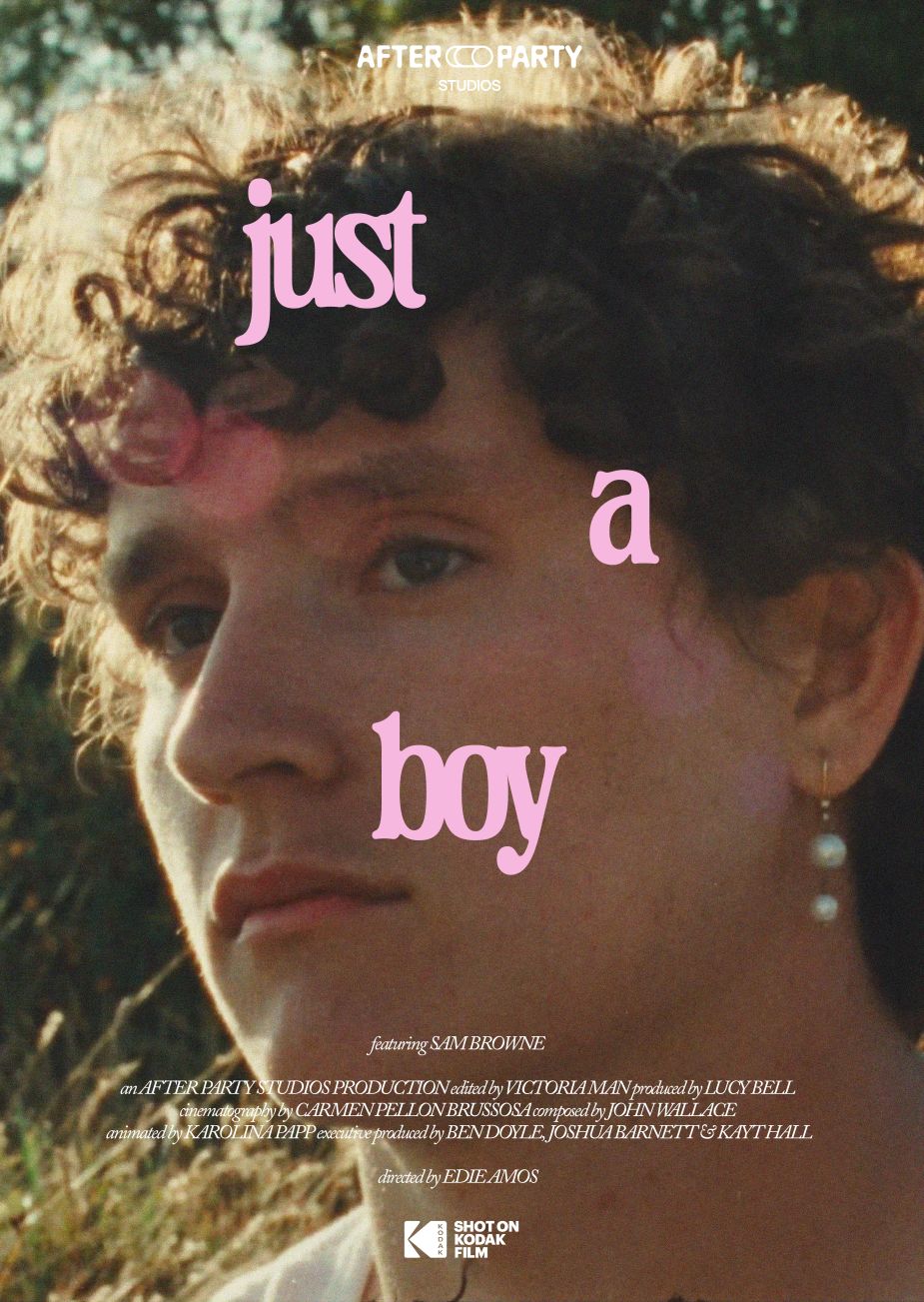
I’ve just released my latest short film ‘just a boy’, a documentary film featuring poet and activist Sam Browne that explores what it is to be a man in today’s divisive world amidst a backdrop of the manosphere.
It was a real passion project, with so many of my amazing collaborators lending a hand and it feels like the culmination of a lot of what I’ve been building towards: everything I’ve learned as a commercial filmmaker, paired with the trust and space to fully execute my vision.
It’s the work I’m most proud of to date and I am planning my next big project with Sam as we speak.