


Frame by Frame, Not Prompt by Prompt: Stop Motion in the Age of AI


When demand for content is at an all time high with advertisers having to prioritise speed and efficiency, time-consuming craft such as stop motion animation feels counterintuitive. But with so much focus on innovation and AI – leading to a trend for hyper-slick digital productions – what does that mean for stop motion, a technique rooted in care, craft and time?
Last month, crypto brand Coinbase gave Aardman’s iconic ‘Creature Comforts’ an American twist in a campaign that starred claymation animals discussing their money concerns. Even the most future-forward, high tech brands and businesses can’t resist the tangible appeal of stop motion.
What makes true stop motion so endearing, says Joey Sullivan, art director and motion designer at Pennant Video, are “those frame-by-frame decisions. The small adjustments and imperfections that breathe life into the work.” He believes this is missing in AI-generated and highly polished digital workflows. “They can replicate the look, sometimes beautifully, but at best they’re paying homage. The real magic happens in-camera, with worlds built by hand, lights adjusted by eye, and animators nudging characters millimeter by millimeter. It’s in that painstaking process where craft, art, and inspiration fuse to create something truly memorable.”
“From the Brothers Quay to Gumby, stop motion has always thrived on something AI is designed to eliminate: friction,” says Can Misirlioglu, ECD at CYLNDR Studios. “The medium’s materiality – its tactility, its labour – introduces a feeling in the audience that’s inseparable from what’s missing in the frame. That absence becomes the essential ingredient in how we connect to it.”
He says AI works in the opposite direction. “Its predictive nature fills in the blanks, smooths over imperfections, and offers a seamlessness that can be dazzling but also numbing. At a moment when AI hype is at its peak – and much of it warranted – there’s a parallel craving for art that resists polish, that withholds. Stop motion shows us less, and in doing so, enriches the experience.”
“While high-quality, AI-generated visuals are impressive, they may lack the emotional depth that comes from the human touch of handcrafted work,” adds Llibert Figueras, EP at BOL. “Audiences who have a love for craft can recognise and appreciate the artistry behind stop motion, feeling a sense of awe for the talent and skill it requires.”
“It’s not just about spotting fingerprints in clay,” says Belle Palmer, EP at Passion Pictures, “it’s the thought behind it. Why is this technique right for this story? Film making is all about connection and storytelling, so getting to the bones of why we are making the decisions that then inform how we make them is critical.”
A Tough Sell for Some
As charming and deeply human as stop motion animation is, that’s not always enough to get it over the line for some agency and brand clients.
“I’ve found that stop motion is one of the hardest techniques to get clients to sign off on,” says Joey. “It’s time-intensive, laborious, and compared to digital workflows, expensive. More often than not, to get something resembling ‘stop motion’ approved, we end up faking it; using 3D graphics to mimic the handmade feel, or dropping frames to simulate that ‘choppy’ cadence. These shortcuts might capture the style, but there’s always something missing from the final result.”
Darren Price, founder and ECD at Mighty Nice, says, “Brand managers often worry that stop motion is childish or ‘too cartoony’. Agency creatives don’t like the term ‘retro’. But they DO like to leverage the triggers that nostalgia has to offer.”
But, he says, for those creatives and marketers that are willing to embrace the process and lean in, it’s a craft that’s unbeatable in its ability to connect with an audience. “Stop-motion is all about embracing imperfections and transporting viewers back to the recent past. There’s an inherent magic to it – where life is breathed into raw materials like plasticine. Its tactile style has human finger-prints all over it. It drips in craftsmanship and patience – which is immensely satisfying to viewers.”
“Intoxicating” Craft
The ultimate draw of stop motion is in the screenless, deep focus required to create it, according to Peter Sluszka, director at Hornet. “Even with modern digital tools, there is so much traditional craft involved.”
He says that physical materials are “the most direct conduit for creativity. At its most basic, you manipulate clay, a puppet, or an object, with your hands and take a photo,” and that it is also the most linear animation process. “Rather than plot out key frames before adding in-betweens, you need to visualise everything and make decisions that work sequentially with limited ability to alter your work later.”
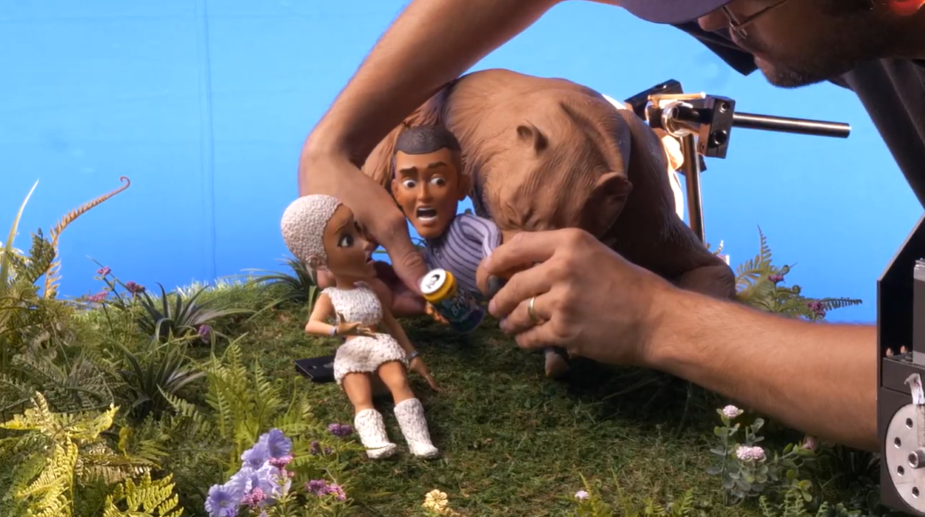
“It is painstaking, but so is any form of animation really,” notes Gavin Strange, director and designer at Aardman. “Once you’ve captured a frame, you move forwards and capture the next one. You can’t really go backwards. Of course you can reshoot, but with budgets and schedules at play, you try not to. That means each frame is a moment in time, by that animator.”
He emphasises that, as a director, this means you need absolute trust in your animator. “You leave them alone to work their magic, and you only get to see it once it’s complete. That means there’s all this unseen context and interpretation each animator will put into a shot – the challenge is orchestrating all those individual separate moments into a single cohesive animation. It’s a beautifully complex thing.”
He highlights Greenpeace’s ‘Turtle Journey’ as one of his all time favourite projects. To demonstrate the inventiveness that stop motion inspires, he recalls trying to create the dappled effect of sunlight through water. DoP Simon Jacobs sourced two panes of rippled shower glass from DIY store B&Q which he rigged with two motors. “Every time an animator captured a frame the motor would kick in and move those panes a little,” explains Gavin “Finally he shone a light behind that rippled glass and it produced the most beautiful shimmering caustics! Genius!”
Having to select from available materials you can source from stores can be a great challenge, says Guilherme Marcondes, director at LOBO NYC, “but it forces you to work backwards from what exists, towards what you wanted in the beginning.”
“Each material has its own unique characteristics, and one needs to lean into that and use its qualities to aid in the storytelling,” says Ruan Vermeulen, co-founder and director at Bewilder. “Clay can speak about vulnerability, emotional well-being, and wackiness. Wood, of strength, experience, history and nostalgia. Paper, of craft, story or sensitivity. ”
Darren says, “Using plasticine and even a plasticine style has given us huge scope for humour and exaggerated faces on characters. Clay can be smashed, twisted and tortured to create hilariously intense action sequences. Claymation has a long history of non-verbal storytelling – with characters using funny sounds instead of words for extra off-beat humour.”
To picture a performance in your mind and then build it frame by frame takes “a very particular brain,” says Belle. “It’s filmmaking slowed right down, but that’s also what makes it so distinctive. Although technology exists that can mimic a style (and sometimes that’s the right thing for the client or budget), to the right animator or director, shortcuts often aren’t what’s needed to tell the story, it’s patience.”
For Mighty Nice’s TAC campaign the team were up against an unforgiving deadline, Darren tells LBB. “We needed to shoot a frame every two minutes to keep to schedule. The clients came into the studio and were literally watching every frame be shot on a feed. The atmosphere was intense and electric so our animators needed to keep walking around the block to reset and stay in the zone. This sense of needing to be present and in the moment can be rare in these isolated, remote working times and this hands-on immediacy is so special and unique.”
Stop Motion in the Digital Age
While the essence of stop motion is inherently hand-made, naturally, it has been influenced and aided by innovations in technology.
“The integration of digital tools has changed the way stop motion is produced,” says Llibert, “allowing for efficiency while still preserving the core elements of the craft. For example, 3D printing is a complementary tool to enhance the construction process and streamline certain aspects, such as creating backgrounds or recurring elements.
“The evolution of cinematography also plays a crucial role in enhancing the storytelling aspect. The visual composition, lighting, and camera techniques can significantly impact the emotional resonance and engagement with the final product.”
Darren points to LAIKA studio’s leap forward in 3D printing, pre-visualisation and planning as a “game changer”. At Mighty Nice, we have been implementing some of these processes into our work (obviously not on the same scale as LAIKA’s films) and then when you start throwing in real-time rendered background plates, robotic cameras with pre-planned moves and animated lights there’s some really exciting potential which we are only just tapping into. We are pro craft and pro technology. However we are always looking for ways to amplify the hand of the artists, not to replace it.”
“The cameras we can shoot on now are incredible,” says Gavin. “We use motion controlled camera robots to give us swooping, sweeping, epic cinematic shots… We have an incredible CG and compositing team who enhance, extend and enrich our sets by shooting on blue screen… But while technology has allowed us to be more ambitious in the type of images we capture, at its heart it’s still the same technique. All the bells and whistles don’t mean much though if your story isn’t engaging or your characters aren’t captivating!”
“With modern camera rigs and software, pre- and post frames that have been shot can help an animator achieve their ultimate performance,” Ruan says. “Technology has definitely helped speed up the parts needed to make the machine move, but in the end, the human hand can only animate so fast, and within that animation lies the smallest imperfections, because we are human, we are not perfect.”
In 2025, you can’t talk about tech innovation in filmmaking without touching on AI. And even in this most handcrafted of techniques, animators are finding useful applications for artificial intelligence. As Guilherme points out, AI can be a substitute or an aid in any profession. “As an aid, AI can help clean up rigs and undesirable elements, or fix little glitches, blend between frames if something is missing, which is good and avoids time wasted on menial tasks. On the other hand, AI can come as a substitute when it is used to emulate a claymation look out of some rough 3D object or even hand-drawn animation. The results will never quite be the same, but for certain projects, it can be enough.”
For Llibert, AI is more of a pre-production support. “AI tools can be really useful in the early stages of construction; helping create concept boards or exploring visual directions quickly,” he says. “That kind of ‘support’ doesn’t take away from the handcrafted artistry of stop motion; instead, it gives artists more time and freedom to focus on the tactile, expressive aspects of the medium. In that way, AI becomes a collaborator, helping streamline preparation while still leaving the heart of the process in the hands of animators.”
As Darren underlines, “Stop motion’s always been a medium that’s taken a long time and been expensive. AI is reducing the time and cost in post-production, so maybe this will help with the unseen laborious chores in pre- and post-production, helping make more magic rather than take away jobs.”
AI “Will Never Replicate the Joy of Creation”
On stop motion’s future, the team at BOL predicts technology to continue making certain aspects of the process easier – whether that’s streamlining repetitive tasks or helping refine details – freeing artists up to take bigger risks and explore ideas that might not have been possible before.
“Rather than replacing stop motion, these tools can push it into new territory,” Llibert says, “especially when combined with contemporary creative approaches like cinematic filming or mixed media. So I see a future where stop motion remains both a uniquely analog craft and a genre expanded by machine-driven imagination. Stop motion survives not because it can’t be replicated, but because it insists on the value of imperfection in an age chasing perfection.”
“Could AI one day mimic stop motion convincingly enough to replace analog methods?” Can asks, “Absolutely. But that’s not the point. What matters is the human hand – the imperfections of mind and motion, the sideways thinking that emerges in the act of making frame by frame. Each gesture carries tension and irregularity. That friction is the source of interest, and it can’t be automated away.”
Gavin believes the craft will become “even more powerful and alluring. It’s a wonderfully human-centric art form that needs lots and lots of people to come together to make something really special. I got into this industry because I wanted to be like those filmmakers, designers, artists and musicians before me who wanted to create simply because they could. I choose human intelligence every time.”
“For anybody who cares deeply about process and the experience of making stop motion,” Peter says, “AI – even as it becomes an expert mimic of all techniques – will never replicate the joy of creation for artists engaged in making tactile work.”


