


Singapore Government Empowers Young People to Stay 'Uninfluenced' on Drugs


Ogilvy Singapore and the Central Narcotics Bureau (CNB) have launched the second year of ‘Uninfluenced’, a three-year public education effort that empowers youths to stay resilient against the many influences that can shape their attitudes towards drugs.
First launched in 2025 through an immersive escape-room experience ‘The Trip: What Happened in Larspura’, and an integrated paid campaign that explored the peer, social and cultural influences which make youth more open to trying drugs. ‘Uninfluenced’ now turns its attention to the permissive attitudes and conversations that can make drug abuse appear less harmful, normalised or even socially acceptable.
This year’s campaign focuses on helping youths recognise how permissive drug talk can show up in everyday interactions, from casual comments and jokes to rationalisations that make drug abuse seem less harmful or more acceptable. It encourages youths who may otherwise stay silent to speak up when they encounter such views, showing that all it takes is one voice to challenge permissive thinking and empower others to do the same, with the end goal of building a society resilient against drugs. By translating a subtle social behaviour into something visible, physical and interactive, the campaign seeks to make the issue of permissive drug talk easier to recognise and challenge. In doing so, it moves anti-drug education beyond warning messages alone, giving youths relatable ways to identify risky narratives, question them and respond with confidence.
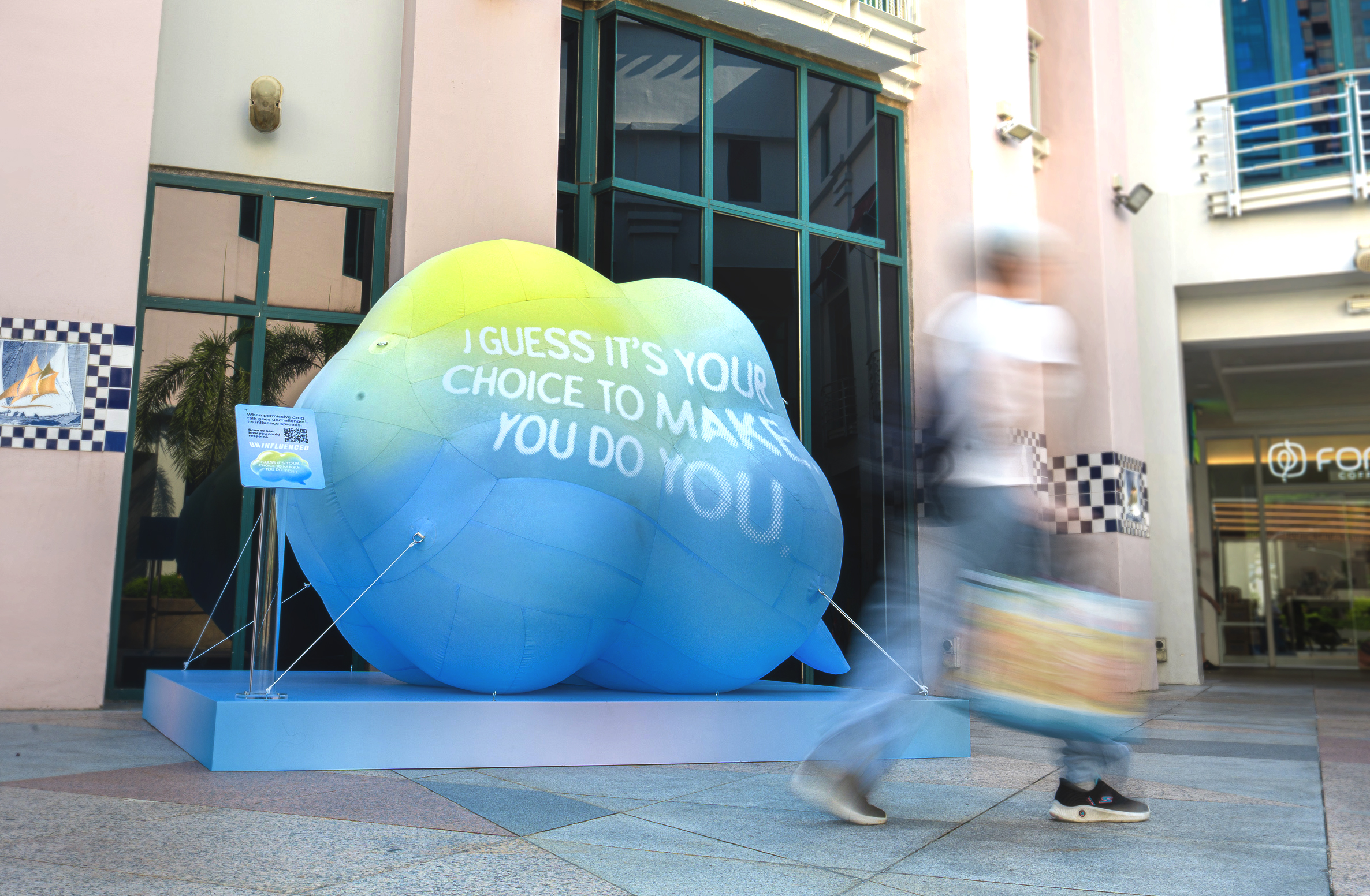
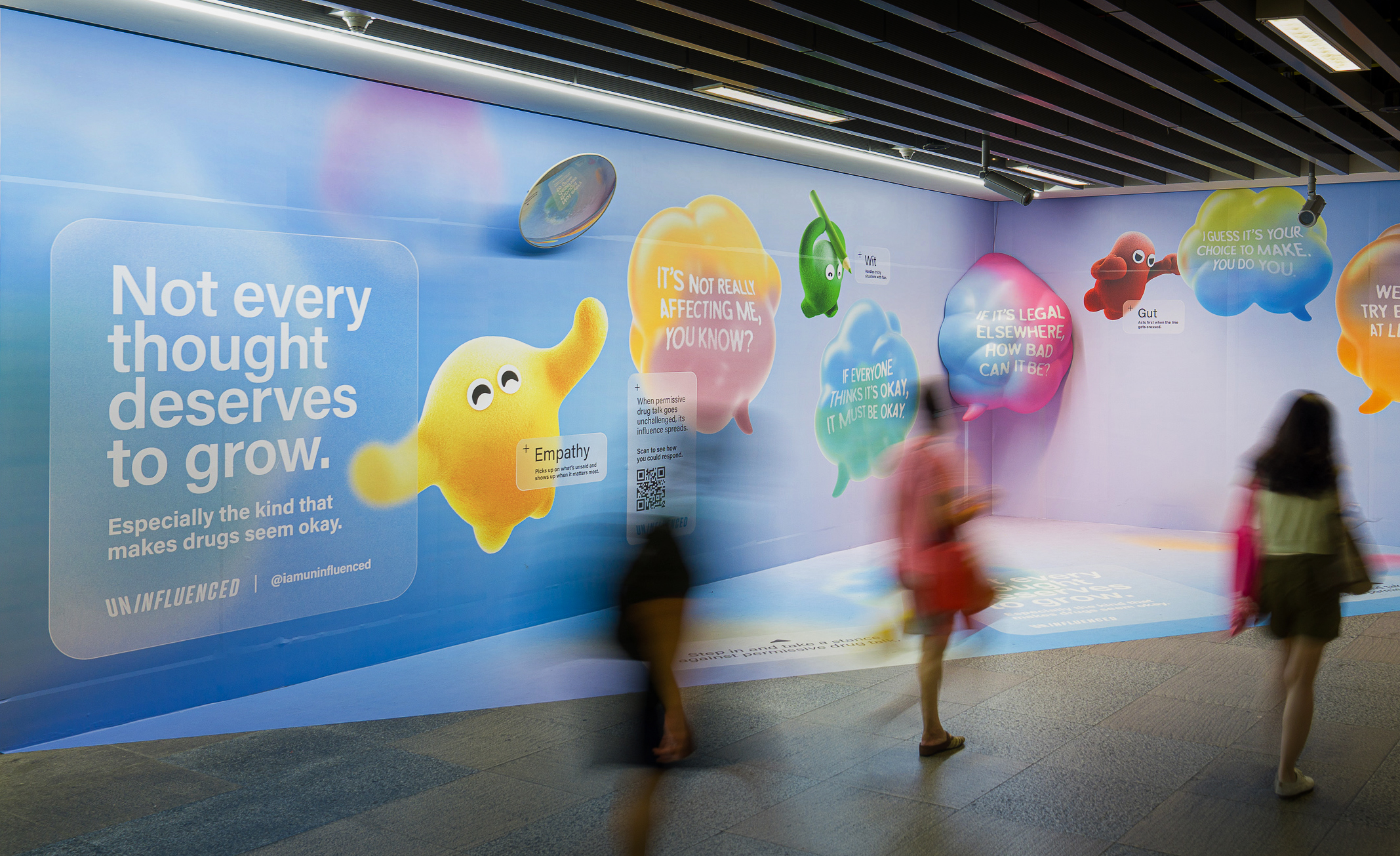
To bring this issue to life, the campaign kicks off by visualising these permissive attitudes in the form of vibrant, eye-catching statements in floating 3D speech bubbles. Each 3D speech bubble introduces various permissive statements that are commonly used to rationalise or normalise drug abuse. These 3D speech bubbles appear as inflatables, ads on MRT platform screen doors, extensive wallscape installations and bus stop shelter ads, provoking youth to explore more. By scanning a QR code accompanying these 3D speech bubbles, an interactive augmented reality (AR) experience unfolds on their mobile device, inviting them to take down these permissive speech bubble.
The AR experience also introduces a short quiz where members of the public can discover the ‘Uninfluenced Pal’ – Gut, Wit, Reason and Empathy – that they identify with most. Each character represents a different way of navigating and responding to permissive drug talk. Through the quiz, youths can discover their dominant influence type and learn how they could effectively speak up against permissive drug talk, helping them critically engage with such conversations and better protect themselves and their peers. The campaign extends across paid media, on-ground activations in
Institutes of Higher Learning (IHLs), content partnerships, social media and digital experiences. Always on content will continue to live on the ‘Uninfluenced’ website and social channels, sustaining the conversation beyond the initial launch and providing youths with relatable prompts, perspectives and tools to navigate permissive drug talk in everyday life. Across these touchpoints, the campaign aims to help youths recognise that speaking up can make a meaningful difference: one voice can challenge permissive thinking, and inspire others to do the same.
This will continue into the next phase of Year Two from October, which will focus on equipping youths with the skills necessary to start conversations, call out permissive thinking and encourage their peers to stay uninfluenced.
At the IHL pop-up activations, visitors are introduced to the concept of permissive thoughts, invited to uncover their own ‘Uninfluenced Pal’, and encouraged to practise responding to risky drug-related narratives through gamified experiences. A key highlight is the “Takedown Battle”, where participants work together to burst speech bubbles carrying permissive messages in a larger-than-life game. The journey concludes with a collaborative group activity where youths learn and practise different ways to respond to permissive drug talk across a variety of everyday social situations, helping them build the confidence to speak up when it matters.
“The conversations youths encounter can shape how they perceive drugs over time. CNB’s ‘Uninfluenced’ campaign seeks to equip them with the awareness and confidence to think critically about these messages, and to respond constructively when they come across views that may normalise or downplay drug harm. Through this year’s campaign, we hope to make these conversations easier to navigate and encourage youths to play an active role in looking out for one another,” said Ms Kaye Chow, CNB’s deputy director (partnership and outreach), DrugFreeSG Office.
For Ogilvy, the creative challenge was to take permissive drug talk, which can often be brushed off as casual remarks, and turn it into something youths could clearly recognise, question and respond to.
"Permissive drug talk is powerful precisely because it doesn't feel dangerous — it hides in jokes and casual rationalisations. Our challenge was to give those narratives a form young people could see, confront and pop. CNB understood you can't lecture this generation — you have to meet them on their terms. Through AR, gamification and our four Pals — Gut, Wit, Empathy and Reason — we gave permissive thinking a shape, and its audience a way to answer back. Staying uninfluenced isn't about being the loudest voice — it's about trusting yours," said Troy Lim, group creative director, Ogilvy Singapore.
Through AR, gamification, character design and live participation, Year Two of ‘Uninfluenced’ continues CNB and Ogilvy Singapore’s efforts to transform preventive drug education in ways that are culturally resonant for youths. By focusing on the everyday narratives that shape attitudes, the campaign aims to show that staying uninfluenced is not just about saying no to drugs but also about challenging permissive thinking before it takes root.


