


Putting the Dynamic WSL Branding into Motion


When the Women’s Super League officially broke away from the FA last year, it was more than a structural shift for the two divisions in English women’s football – it was the beginning of a new era.
Though the WSL has been under the FA (The English Football Association) since its inception in 2011, by August 2024 control of the top two women’s divisions were officially handed over to a club-run company. From that point the brand brief no longer needed to answer to FA-governed frameworks – it needed to speak directly to fans, culture, and commercial potential. “Coming off the back of [England’s] first Euros win, there was a moment of: hang on a second, we could be here,” says Ruth Hooper, WSL Football’s chief marketing officer. In the year that England won its second Euro title, that dream materialised. “We set up what is now an independent, standalone commercial entity. Our vision is women’s football transformed.” That transformation needed a brand fit for the world’s most elite women’s league, and an agency like Anomaly, with design running through its core, to build it.
From the start, the design brief wasn’t just about logos or colours. It needed to reflect a fanbase that looks very different from men’s football. After much exploration together WSL and Anomaly found three audience segments. Ruth lists them as:
- “The core fans who’ve been with us for years;
- “Secondary fans who follow a lot of football but engage with the women’s game when they can; and
- “Free fans, who never followed football before but are attracted to the women’s game because it feels for them.
“Designing a brand that speaks to all three has been crucial.”
Co-creation with supporters from across these three categories was essential. Clara Mulligan, chief design officer at Anomaly, adds, “We brought fans into our office, showed them work in progress, and got under the skin of what makes them tick. It had to be about authenticity and aesthetics, not just aesthetics. Fans can smell it when it’s inauthentic.”
Motion First: From Gameplay to Graphic System
The WSL’s new identity is rooted in how the game itself is played. Research revealed that women’s football is faster, more fluid and higher scoring than its male equivalent.
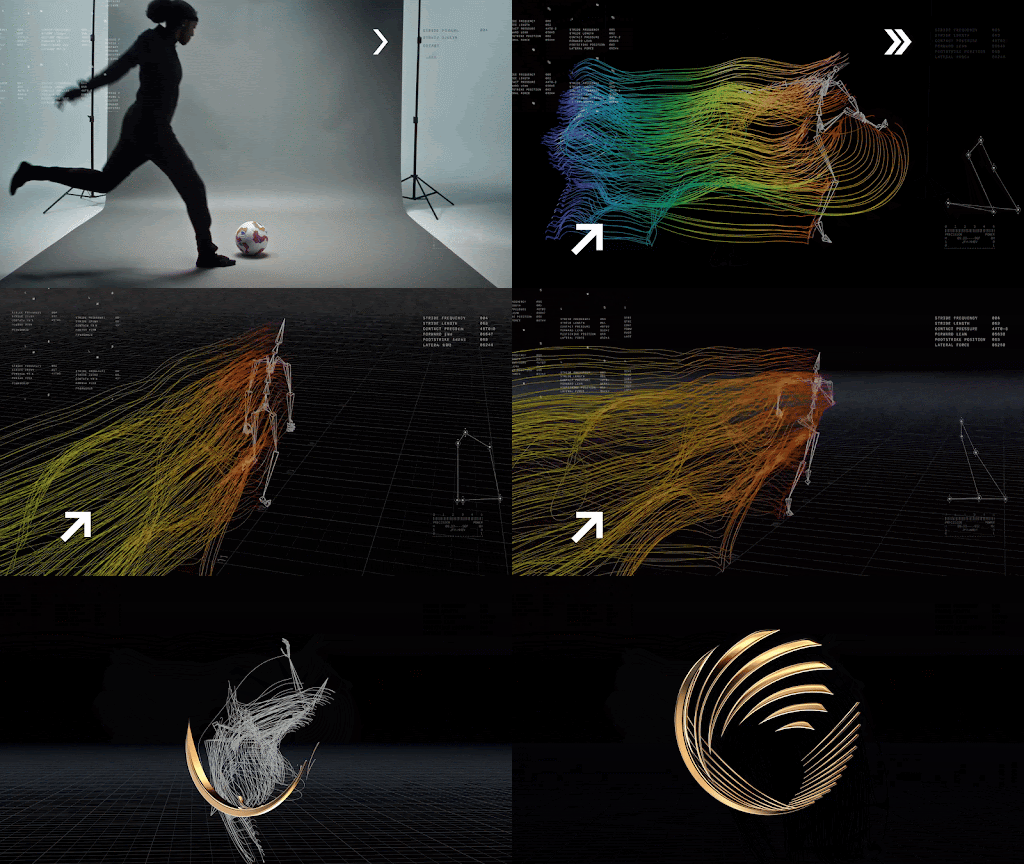
“We wanted to visualise that,” Clara says. “The identity is created from the movements of players. We tracked players, captured motion data, and turned that into an emblem, a wordmark, a graphic system and a toolkit – literally patterns of movement from professional players. Our system is biometric-based design. It’s grounded in evidence, turned into a beautiful visual experience.”
Ruth expands, “We always designed motion first. In motion you start to see cues — this is about athletes moving. Some content even uses athletes to create movement patterns that then bring the marks to life.”
Driven by Culture and Driving Culture
The brand also needed to operate beyond the pitch. “We’re trying to create a global brand that lives at the intersection of sport, entertainment and culture,” Ruth says. “The women’s game has a greater impact off the pitch, so that was key to how we designed it.”
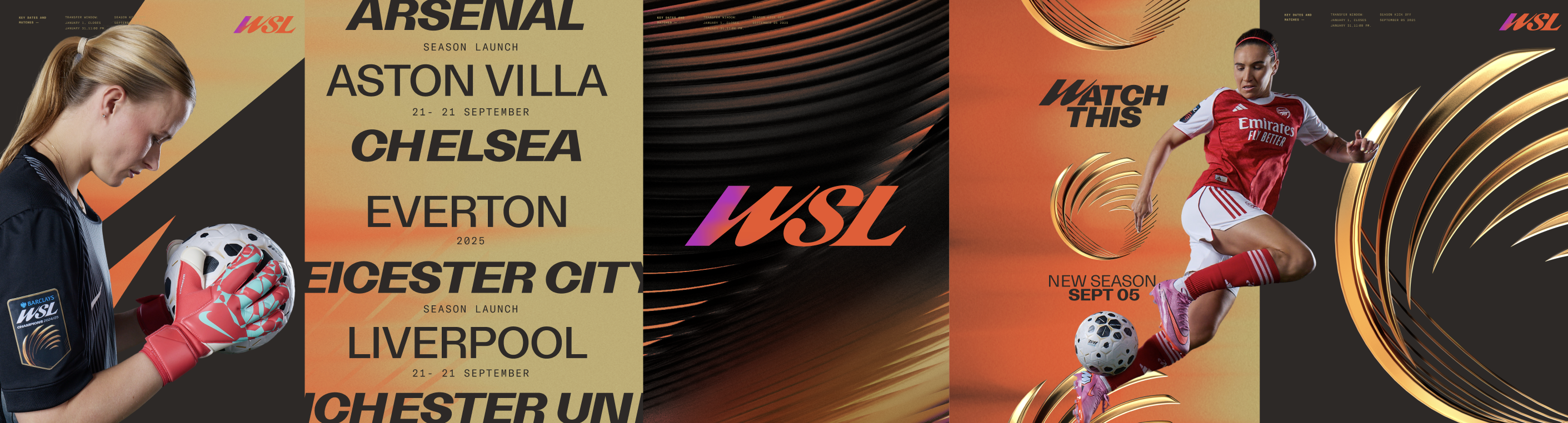
That thinking extends to tone of voice. The new platform, ‘Watch This’, is, in Ruth’s words, “an unapologetic celebration of everything that’s epic, unique and wonderful about the women’s game.”
Clara expands, “It had to come from the culture of football in the widest sense — and describe not just what’s great about women’s football, but what’s great about the WSL. It’s the top league in the world, so the language needed to reflect elite physicality and competition, while remaining open and accessible.”
Watch This: The Campaign
That philosophy has already been put into action with a high-profile launch campaign. WSL Football and Anomaly revealed a new integrated campaign designed to drive excitement for the 2025/26 season.
‘Watch This’ celebrates everything that makes the women’s game unique, epic and unmissable: thrilling competition, world-class players, passionate fans and all the drama in between. It’s both a call to arms and an invitation to witness the athleticism and power of female athletes, alongside the culture that surrounds women’s football.
The campaign showcases stars including Mariona Caldentey, Hannah Hampton, Lucy Bronze, Jessica Naz, Katrina Gorry, Missy Bo Kearns, Jordan Nobbs, Neve Herron, Josie Green and Lucia Lobata. Its hero film is voiced by Ian Wright, one of the women’s game’s most visible champions. Running across TV, VOD, social and OOH, the work lands just ahead of the new Barclays Women’s Super League and Barclays Women’s Super League 2 seasons, which kicked off on September 5th, following the Lionesses’ UEFA Women’s EURO 2025 victory.
The timing is no accident. The BWSL official YouTube channel had become the second most-watched women’s sports property globally last season with nearly 40 million views. Clubs saw a 154% year-on-year increase in TikTok views, and Instagram engagements rose 35%. The campaign aims to harness that momentum and translate it into unprecedented support for the domestic leagues.
This launch follows the rebrand of the leagues in May, when WSL Football unveiled its new name, emblems and dynamic identity – now rolling out across kits, balls and stadiums.
One of the simplest but most powerful decisions was to consolidate naming. There were three brands – the company, the Women’s Super League, and the Women’s Championship. “Only the WSL had equity,” says Ruth. “So we consolidated. We’re now WSL Football, one brand with two products. It’s made everything so much more seamless and easier for fans to find.”


