


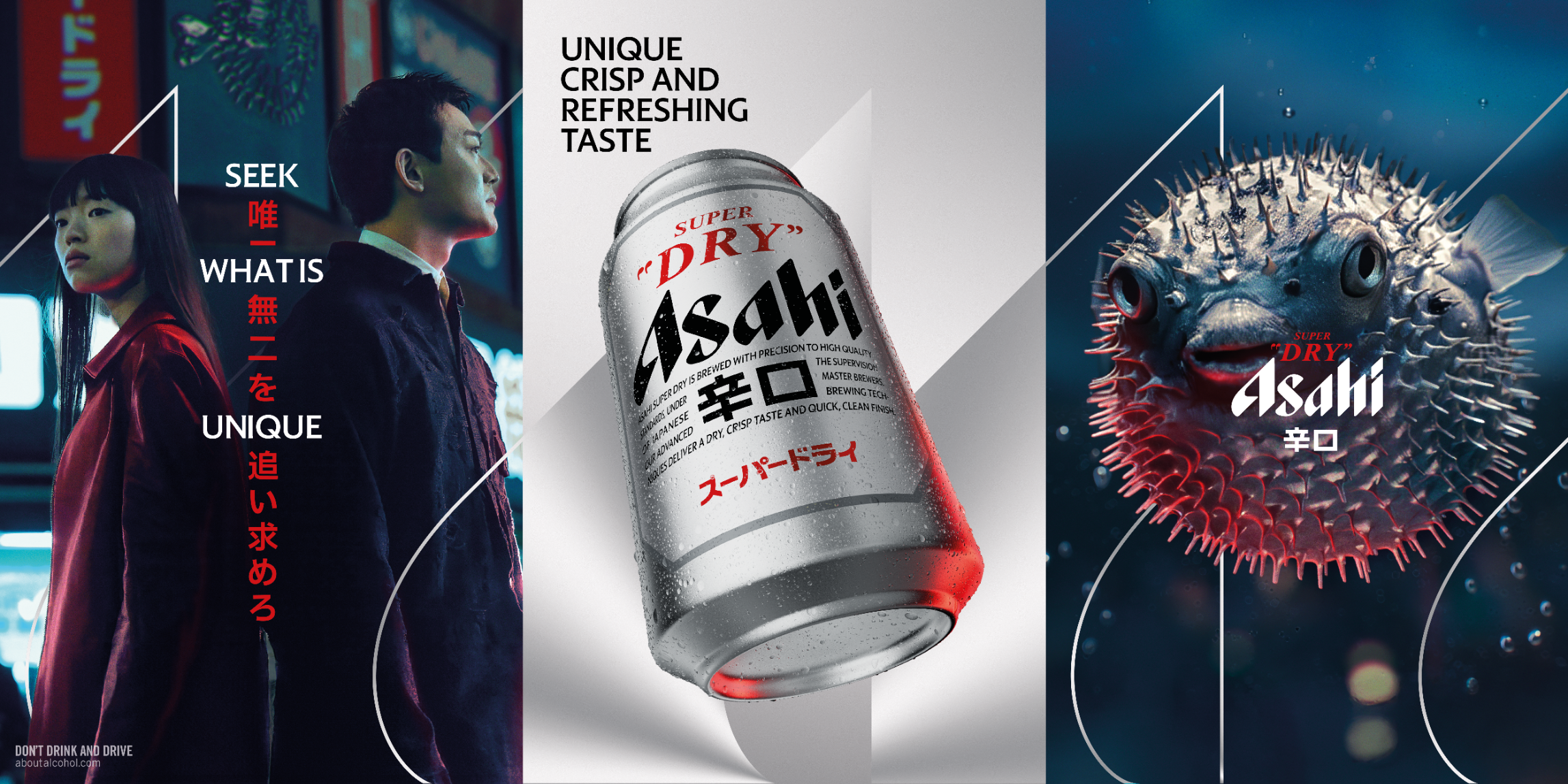
Singing Puffer Fish Urges Beer Lovers To ‘Seek What Is Unique’ in Asahi Super Dry Global Brand Platform


Asahi Super Dry, Japan’s No.1 beer brand, is embracing the unique, premium and undeniably Japanese nature of a night out in Tokyo in a new global brand platform.
Created by Havas London in collaboration with Havas Creative Network agencies in Asia, Australia, and North America, the campaign introduces a new global brand platform and tagline, ‘Seek What Is Unique’. The new platform reflects the beer’s distinctive brewing process and unique crisp and refreshing taste profile – otherwise referred to as its signature ‘Karakuchi’ taste – along with the brand’s Experience Seeker audience, who crave something a little more interesting.
When Havas London first pitched for Asahi Super Dry’s global account in late 2024, the brief was clear: define a platform that could capture the beer’s distinct ‘karakuchi’ taste and carry it across cultures.
For Mark Whelan, chairman and UK group chief creative officer at Havas UK, that starting point was deceptively simple. “The language of ‘Seek What Is Unique’ has carried through,” he says. “There’s something almost philosophical around this idea – when you try to find something different, when you stray from the path, there will be a reward at the end of it.”
“When they talked about who they wanted their audience to be, it was people who want to find new experiences,” he continues. “Not necessarily being fans in a traditional sense, but on a night out they want to discover new things, try new food, go to new places. Those two things came together, and we really liked the language of ‘Seek What Is Unique’.”
Havas built the strategy around the contrast between Asahi’s precision brewing and its modern Japanese aesthetic — a space that celebrates curiosity and discovery. “We were talking about making this a platform so that every piece of work we develop, be it a film or a collaboration or an experience, is true to that idea,” Mark adds.
That philosophy shaped the campaign’s tone and ambition. From the first conversations, ‘Seek What Is Unique’ was imagined as both an invitation to explore Tokyo’s hidden corners and a metaphor for Asahi’s global outlook — premium, Japanese, unique.
It’s brought to life today via a 360 campaign spanning all of Asahi Super Dry’s touchpoints, from social and digital media to TV, cinema, OOH, on- and off-trade activation and global partnerships.
The platform launches with a visually stunning 90-second hero film shot in the heart of Tokyo and directed by award-winning duo Alaska, through production company Iconoclast. The film follows a couple of friends on a night-time quest through the iconic Japanese city. Showcasing Tokyo’s blend of modern aesthetic and traditional roots, the couple navigate neon streets, narrow alleys, and skyline rooftops before they finally discover a modern bar with a unique musical act – a singing puffer fish.
Alongside the brand platform, a new design system has been created for Asahi Super Dry, bringing global consistency across its brand world. Inspired by the contrasting nature of Asahi Super Dry – with its relentless craft and precision, and bold, modern Japanese style – the design system constantly flexes this tension throughout. The new brand world encompasses Asahi Super Dry’s visual identity including a new colour palette, graphic system, tone of voice and product photography.
The ‘Seek What Is Unique’ philosophy became the creative compass for the campaign’s hero film. Mark describes how the idea evolved into a cinematic quest through Tokyo’s backstreets, where “you might end up somewhere unexpected”. The puffer fish that greets the protagonists in the final scene became both a literal surprise and a metaphor for the brand’s crisp karakuchi bite – unexpected, bold, and memorable.
“There was a lot of consumer research, and consumers preferred this. It’s great that the thing that was in our hearts, instinctively, was the thing that got validated,” says Mark. “It helped us tell the story of a stylised version of Japan’s truth. If you go to Tokyo, you can go through a doorway in what looks like a nondescript building, and then you’re in the most amazing izakaya. You can walk around the corner and find a store selling crazy vintage gear. You can go down here, turn right, and go through a box, and there’s another surprise. This notion of discovering unique experiences is so true of Tokyo and of Japan. What we wanted to do was stylise and dramatise the story of seeking something unique and where you might end up. And obviously, do that in a way where what you discover in this particular film is somewhat unexpected. You’re in a bar, which may be expected, but then the central entertainer…” OK, well, you might not find an actual singing puffer fish in Tokyo, but it has an emotional truth.
When the directing duo Alaska took on the project, it was clear that they understood the vision. “It was just dripping off the page,” Mark recalls. “These wet streets, neon signs, and hidden promise – they really captured it.” He credits the filmmakers with transforming a “descriptive script” into a vivid world of movement, reflection, and playfulness. “That’s the magic when you collaborate with people like these,” he says.
Long before the cameras rolled, Iconoclast executive producer Kaiya Taffel and the teams at Havas faced the project's most consequential decision: whether to build Tokyo on a set or film it authentically on location. “Our biggest decision started when we were bidding,” Kaiya recalls. “Do we do the set-build thing, or do we do the location thing, which we knew would be more challenging? We decided it would only work if we did this on the streets of Japan and made it 100% authentic. That was the right decision.”
That early commitment shaped everything that followed. From the initial treatment through pre-production, the team’s goal “really didn’t stray too far from what everyone intended to make,” she says. Scouting took them deep into Tokyo’s backstreets, searching for ‘izakaya’ bars and ‘konbini’ convenience stores that would capture the city’s texture of discovery. Even those seemingly everyday spaces proved complex to secure. “Finding a konbini was actually quite difficult,” Kaiya explains. “They didn’t want to shut down their shops, because they want their customers to have the reliability of knowing they can go there all the time.” The clue is in the name; convenience is their utmost priority.
It wasn’t just locations that demanded forethought. Japan’s production tempo was slower, more deliberate, and ultimately more exacting than what the UK teams were used to. “They’ll lock the wardrobe two weeks before you shoot,” Kaiya says. “Everything is curated and premium – they don’t rush anything.”
That patience paid off. “It was so respectful,” adds Mark. “The culture of collaboration was baked in from the start, and the producers on both sides made sure everybody was cool.”
When filming began, the team dove into three consecutive night shoots across Tokyo – an experience that tested stamina and rewarded precision. “Normally that would be pretty challenging,” laughs Mark, “but because your jet lag is so all over the place, it’s literally irrelevant – all bets are off.”
Working alongside local production partners Nakama, the team embraced the Japanese way of working. “They weren’t just a service company – they were creating it with us,” says Marco Laver, half of the directing duo Alaska. “Everyone came together to make something really special, not just to execute a commercial.” That spirit of collaboration ran through every frame, from art director Tayio and stylist Takumi to Havas producers Katie and Ella, whose coordination bridged continents and working cultures.
The atmosphere on set mirrored the story’s theme of discovery. Alaska’s direction combined playful spontaneity with obsessive craft, balancing handheld energy and stylised lighting to evoke a dreamlike version of Tokyo. “It was so respectful,” Kaiya recalls of the production culture. “Every location, every crew member, there was mutual understanding – it felt like we were guests capturing the city’s rhythm.”
For Mark, the result was proof of what happens when instinct meets discipline: “They were next level,” he says. “Honestly, I’ve been doing this a long time – but that was something special.”
With a couple at the centre of this adventure, casting them right was crucial. And Marco remembers the moment that he knew they’d made the right decision. “When I saw Natsumi [the lead actress] looking up at the camera for the first time and saying, ‘Seek What Is Unique’ in Japanese, I thought, ‘Oh shit.’ The way she delivered it felt like a Tarantino movie in Japan was about to start.”
The resulting campaign is live from today in Australia and the UK. Other global markets will follow in 2026, including APAC, where the brand film will launch in-market with an alternative ending.
As the team looks back, ‘Seek What Is Unique’ stands as much more than a campaign launch — it became proof of concept for the creative partnership between Havas, Iconoclast, and Alaska. For Mark, it validated the instinct that first won the pitch. “It makes you want to go to Tokyo,” he says. “It’s an invitation to discover, to do more, to learn more.”
Kaiya reflects that the process “never really strayed from what everyone intended to make”, while Marco describes it as “a little movie for people to enjoy — with hidden things you can discover watching it again and again,” such as a reflection of the central characters in the motorcyclist's visor, or a clock in the izakaya shaped like a puffer fish that counts the hour as their time comes to an end.
For the agency and brand alike, it’s the beginning of a long-term journey. “It’s Japan’s number one beer,” says Mark, “but for so many people outside Japan it’s still something new. Hopefully they’ll see this and think — ‘I want to try that’.”


