


The Value of Enjoying Your Creative Process with Chalermpol ‘Tam’ Bowonruttanapran


Chalermpol Bowonruttanapran, or ‘Tam’ as he likes to be called, knew he wanted something different from a young age. While classmates aimed to become doctors, engineers, or pharmacists, Tam found himself captivated by commercials, especially “the funny ones because they made people happy”.
That passion led him to study advertising at Bangkok University, hoping to create films that entertained people rather than just pushed sales.
After graduating, Tam began his career as a copywriter intern at Yell, and over the past 16 years, has worked with both local and global brands, earning international recognition along the way.
“I learned that being a creative is not just about humour. It is fun, challenging, emotional, and demanding all at once,” he tells LBB, “and that complexity is exactly what keeps me excited about this job.”
Below, Tam dives into his logic-first approach to creating work, finding creative solutions that serve a purpose, and the weight that comes with his role.
Person
I consider myself a very rational person. I rely heavily on logic, structure, and clear reasoning. At first, I wondered whether this mindset might limit my creativity. Advertising often feels like it should be free, emotional, and imaginative. But over time, I realised the opposite. Logic doesn't kill imagination. Instead, it guides imagination to reality.
Many brand briefs today begin with real problems that need solving. Clients are not simply looking for visually impressive ideas, but for ideas that can help address those problems or communicate clearly in order to achieve specific goals. Having a structured way of thinking helps me identify what truly matters and find creative solutions with purpose.
Another trait that has stayed with me throughout my career is observation. I am naturally observant, not only when it comes to work, but also in everyday life. When I see people doing something, I instinctively ask myself, why? Why does a particular trend exist? What draws people to it? What emotional need does it fulfill? And how can those insights be translated into ideas that people genuinely care about.
Product
I usually judge creative work by asking three simple questions: why was this made, what was it made for, and what kind of impact is it expected to create? This is always my starting point. From there, I look at whether the idea communicates clearly and can be easily understood. Ideally, it should also make people feel something. When an idea can trigger emotion and encourage engagement or action, that is when it becomes truly powerful.
That said, I always leave space for ideas that are bold, unconventional, or even a little bit crazy. Ideas that stay in your mind the moment you see them, or make you laugh out loud. Even if they do not follow logic perfectly, those ideas often create strong memories. For me, they still deserve room in the creative process.
When it comes to my own work, there are several projects I am proud of. One that immediately comes to mind is ‘The Birds and the Bees 2.0’, a campaign that helped Thai teenagers better understand proper sexual education. We took the most searched sexual education keywords online and transformed them into a branded video. The project won a Social Insight award at the Adman Awards.
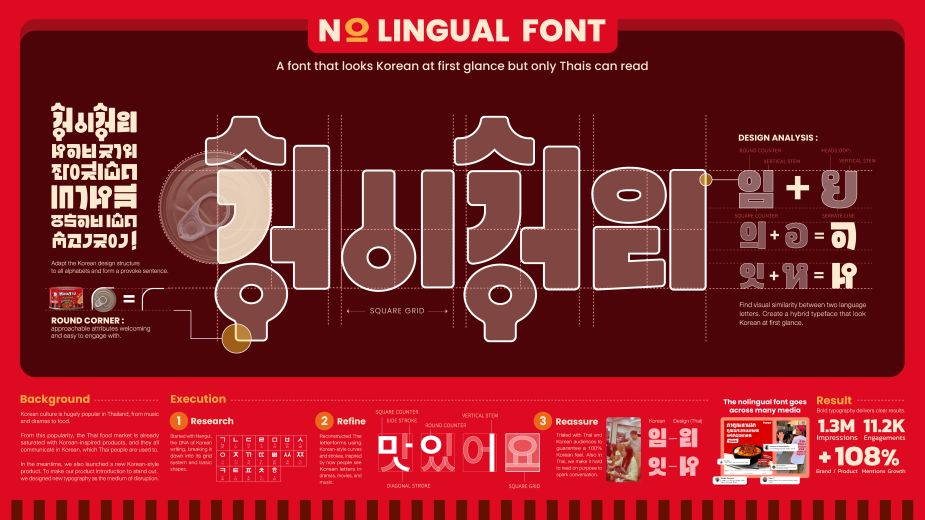
Another highlight is ‘Nolingual Font’, which promoted a new product, Fried Baby Clams with Spicy Sauce Korean Style. The idea was built around typography that looks Korean at first glance, but can only be read by Thai people. The project won several awards in design categories. However, what I value most about this work is the design process itself. It involved research and surveys to ensure that the typography communicated exactly what we intended, proving that even design-led work can be grounded in insight and strategy.
Process
Before any idea takes shape, I do my homework. I dive deep into all available information, looking beyond the brief to truly understand the people I’m speaking to, what they think and how they feel.
One of my favourite approaches is exploring social voice online.This means reading real comments on social media and paying attention to what people openly share. Those unfiltered expressions feel honest and human to me. I find them charming, and they often become a strong source of inspiration for ideas that people can genuinely enjoy and engage with.
When facing complex projects filled with overwhelming details, I gather the team and ask a simple question: “If we are already confused, how can we expect anyone else to be interested?”
We then strip away the noise. If we leave just one thing behind, what is the single message we want people to remember? Once that answer is clear, the direction usually reveals itself naturally.
Press
Creative work comes with unavoidable stress. The fear of not being good enough, of ideas failing, or of missing deadlines. I choose to use this stress as a driving force, constantly pressuring myself to ask if the idea is truly strong enough to solve the problem.
However, too much stress can be harmful. That is why, even under tight timelines, I prioritise managing stress for myself and my team. I believe we must create space for rest and laughter. After all, if we aren't enjoying the process, how can we expect to create work that brings joy to others?


