


The Rise of Stop Motion: Why We’re Craving Analogue Media in the Digital Era


Apparently, AI will soon come for all of our jobs. It can do them better than us, anyway, with fewer errors and far less effort. But post-production studio, Stone Dogs, has noticed a trend quietly brewing in tandem: brands and agencies are increasingly hungry for work that feels human – imperfections and all.
The explosion of AI-generated content on people’s feeds (which, had it been welcome, would not have earned the term ‘slop’) can at least partially explain why hyper-polished CG is being swapped for stop-motion and handcrafted techniques. One of the few mediums where constraints create beauty, its charming miniature worlds and physical presence offer a counterweight to the limitless, airbrushed, digital realm. As Stone Dogs co-founder Brian Carbin observes, it’s “a reminder that audiences respond to tactility and craft.”
Two projects from last year illustrate this point: a campaign for Transpennine Route Upgrade (TRU), created through T&P, Passion Pictures, and director Tom O’Meara, and a Department for Energy Security and Net Zero (DESNZ) spot, from M&C Saatchi, BlinkInk, and directing duo, Andy & Adeena (Andy Biddle and Adeena Grubb).
Above: Transpennine Route Upgrade (TRU)’s ‘Evening Out’
What makes TRU stand out is that “you can immediately feel the love poured into every frame by Tom O’Meara and the team,” according to Brian. Instinctively, viewers pick up on the labour and physicality that went into it, evidence of care that makes them feel something before the narrative has even begun. The unbelievable level of detail in increasingly intricate miniature sets, for example, blow audiences away. “The tiny scale of some sets is mind boggling,” says Brian, “but still the constraints force inventive solutions. Even on the day with everything planned, ideas happen on set that make it magical.”
Tiny imperfections – fingerprints on a model, the wobble of a frame – are also left in as a marker of the crew’s handiwork, and it’s why the Stone Dogs team is always careful to keep the grade and finish as close to the captured footage as possible. “It feels honest. It feels made by humans. And that’s powerful.”
Above: Behind the scenes of Transpennine Route Upgrade (TRU)
Andy, one half of the director duo that worked on DESNZ, agrees that agencies are still hankering after the magic of these handmade projects. “On my last animation, the client was excitably running round the studio like a kid in a toy shop. Will AI take that fascination away? I doubt it, but if it's cheaper and still does the same job it might change the face of advertising.
“Who knows what the next few years will look like. There’s no denying that AI is getting better and better so maybe it will create the exact results people want soon. For now we crafters will carry on fighting the good fight!”
Adeena adds, “All we can keep doing is emphasising the craft, and we will hopefully always have our BTS videos with real people which AI can’t take from us (yet).”
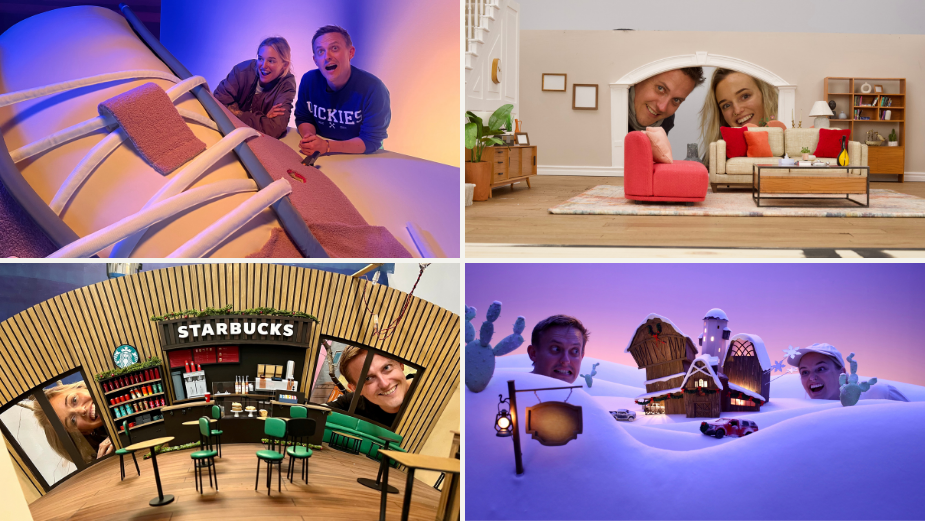
Above: Andy & Adeena on set
That’s not to say that crafters want to banish technology from the process (though director Tom describes recent AI storyboarding experiments as “a bit crap to be honest”). It actually plays a growing role in bringing their analogue techniques to life.
“Tech didn’t replace the craft, it amplified it,” Brian explains. “Our work often functions like invisible support in helping make the miniature worlds feel seamless and alive. Last year, we used a mix of: 16-bit EXR workflows for clean, flexible grading; detailed online clean-up to support the physical animation; stabilisation and rig removal that let animators push performances harder; and colour pipelines that protect the handmade textures.” Tools have also become more streamlined, and workflows have become more efficient – all without compromising on charm.
These advancements mean that the work can be more ambitious, with character animation growing more expressive, and clients getting braver with their storytelling and scale. The DESNZ film exemplifies this trend, with Stone Dogs compositing and texturing the mouth, eyes, brows, and facial expressions within a compressed shoot and post schedule.
Above: Department for Energy Security and Net Zero (DESNZ)’s ‘Warm and Fuzzy’
Brian shares some insight into the process behind the scenes: “We did this work on animatics to guide the voiceover that was then sympathetically composited, keeping textures and lighting. The campaign had genuine heart, which Andy and Adeena really brought to the fore – it communicated something important in a way that felt human, accessible and optimistic. That’s the kind of work we love: projects where the craft and the message are perfectly aligned.”
For this kind of character work, “access to 3D printing has been a huge help,” the co-founder continues. “Faces, expressions, eyes and set pieces are all possible. Motion control to create complex moves in miniature scale has also made huge leaps.”
Yet more powerful tools have also given rise to a new challenge, namely the expectation to be able to achieve a paradoxically handmade-but-perfect look. The Stone Dogs team navigated this by:
- Learning through experience what post techniques work and what gives the best results in the fastest time;
- Establishing grading looks early or keeping it as close to what the director saw on set;
- Understanding the use of grade to preserve tactile detail and focus instead of flattening it;
- Keeping a close line between animation, production, agency and post.
These hybrid workflows blending traditional miniature worlds with clever VFX and digital finishing will likely characterise the future of stop motion and enhance what’s possible within the medium. Brian comments, “We’re already seeing more 3D-printed elements that slot into handmade sets, more creative camera moves made possible by virtual previs, smarter digital clean-up and stabilisation, and a rise in premium stop-motion for social formats.
“The tech isn’t replacing the handmade element; it’s reinforcing it.”


