


From LinkedIn Post to Radiohead-Approved Film: The Respite Association’s ‘Member of the British Empire’


“All my films are full of careful, thoughtful and deliberate decisions. Not this one. This one was assembled in one conceptual moment.”
Scrolling through LinkedIn, director Rob Sanderson read a post that birthed a fully-formed film in his mind. It hadn’t been written by one of his connections, but with hundreds of comments and thousands of likes, its popularity had pushed it onto Rob’s feed.
Above: The Respite Association ‘Member of the British Empire’
Isaac Harvey MBE was the author, a disability advocate living with limb/pelvis-hypoplasia/aplasia, which inhibits the development of his limbs. The post in question told the story of his unconscionable change of fortune, with the UK showering him with its highest honours in one year, quietly forcing him to leave his family home in another.
For context, his mother, who is also his primary carer, was due to be away for three weeks, and social services were failing to provide adequate support in the meantime, deeming four visits a day enough for a person who cannot feed, hydrate, or relieve themselves alone. Not only was Isaac left with no choice but to move into respite accommodation, social services had also begun to ignore him.
“As I read it, I felt it. I felt the desperate lack of power and self determination,” Rob recalls. “Living in a liberal democracy we rarely feel that complete lack of self determination very often, and when you do it's trivial and fleeting. Isaac managed to make me understand what it was like to live in that moment, day after day.” Compelled and inspired, he reached out – across LinkedIn, Instagram and email. The wheels of ‘Member of the British Empire’ for The Respite Association had begun to turn.
A Swell of Memories and Fears
After initial contact had been made, Rob began “rattling off a treatment” to capture what he had visualised when reading Isaac’s vivid prose. “Isaac’s a really articulate guy, and because of his disability, he dictates his posts, which gives his writing a real intensity, immediacy and rawness,” Rob highlights. “It hits you very conceptually and with incredible emotional clarity.”
“I could see his eyes in the darkness, alone on the floor. It seemed natural to me to show what was at stake, the jeopardy of his isolation and the relationships he was losing,” Rob continues. Describing Isaac as “a thinker”, Rob wanted the entire film to take place in his head, using slow motion, light, and colour to lift the audience out of the current timeline, and plunge them into “a swell of memories and fears” that flood Isaac’s mind in a single instant.
That simultaneity mirrored the way the film came to Rob. “The film came to me conceptually, it wasn’t constructed piece by piece; the opening visual arrived at the same time as the final image,” he explains. “I think it’s really important to the film that you can hold it all in your mind at once. It’s important that you can still see Isaac on the floor when you see him skydiving and meeting the King.” Even the film’s title, ‘Member of the British Empire’, hits that discordant note. Rob goes on, “I think that when you can achieve the dissonance of hope and hopelessness, of joy and fear, of exhaustion and resilience, you can start to understand Isaac a little.”
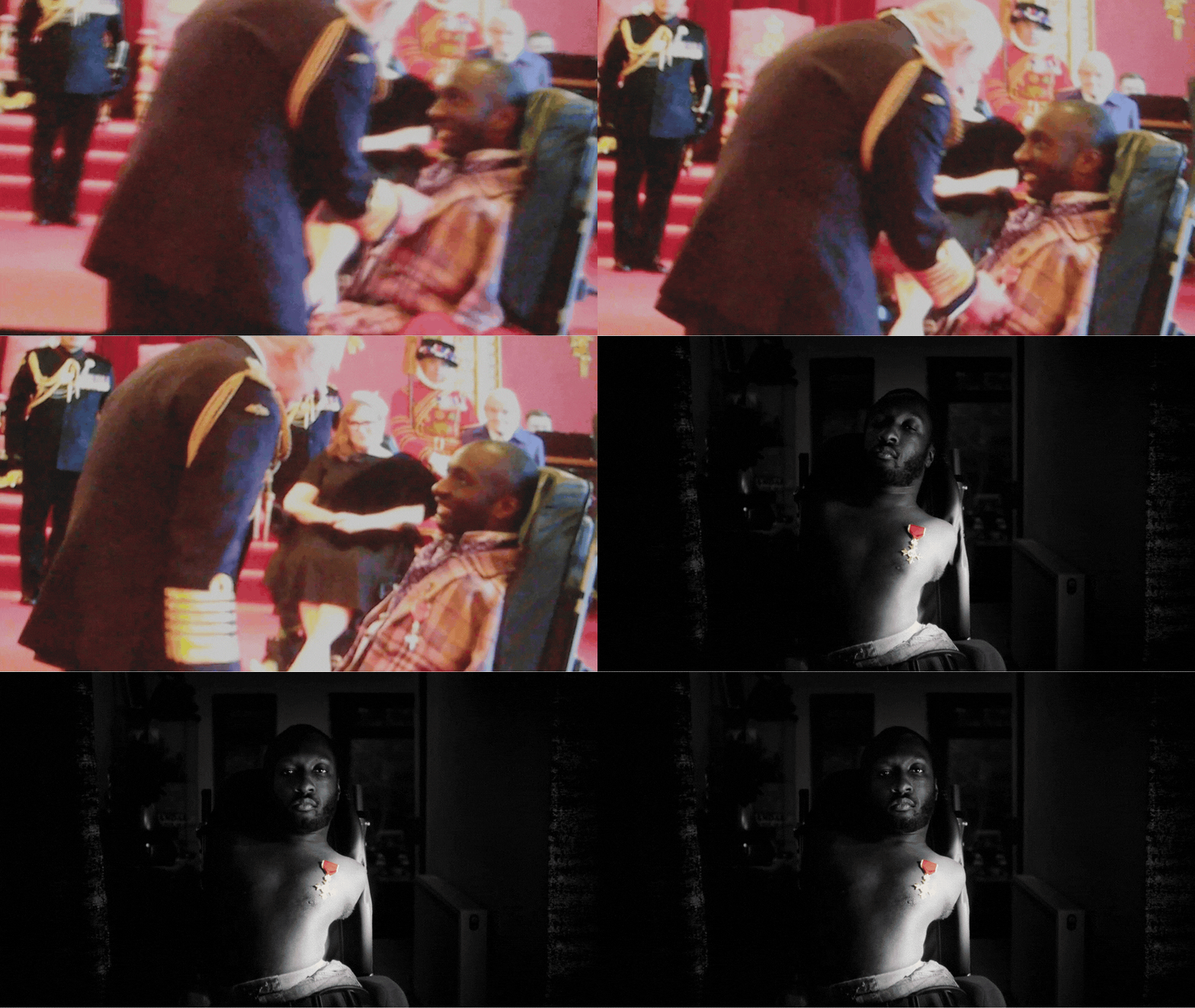
Within a few hours, Rob had sent his treatment back over to Isaac. He remembers him leaving only one note – “a typically magnanimous Isaac note” – that the people working in the system should not be given the blame. That lay with the flawed system itself. “So we tweaked things to show ’the system’ as a faceless bureaucrat, and to focus on Isaac’s emotional response to the process instead of giving the system a human face,” says Rob.
To do more than just spread awareness, the pair wanted to tie the film to a tangible cause and selected The Respite Association, a charity Isaac wished he’d known about when he was struggling. Rob remarks, “To me, they are a perfect charity, no huge infrastructure taking a slice of donations. Just genuine people, motivated by kindness and empathy passing donations to those that need them. They do plenty besides that as well, providing camps for young carers and somewhere to stay when carers need it the most.”
The Busiest Man in London
“When it came to the practical side of pre production, know one thing – Isaac is basically the busiest man in London,” Rob emphasises, pointing out Isaac’s commitments in and out of the country on top of the time he had to devote to resolving his living situation. There was only a short window in which to get the shoot done, and Rob was yet to gather a crew.
“Then Partizan came along,” says a relieved Rob. In talks with managing director, Jenny Beckett, about a separate topic, “she said those words that most people don’t mean: ‘If there’s anything I can ever do…’. I emailed over the treatment, she put Charlie Scannell (producer) on it, and within what felt like moments, he’d done my entire to-do list and assembled the team without compromise.”
Charlie chimes in, "After reading the treatment and chatting with Rob and Issac, I immediately realised how important this story was to tell. Rob had such a clear vision of the film’s direction, and his thorough preparation made it much easier to find the best team to collaborate with and deliver the best film possible. Issac and his family are some of the most inspiring people I’ve ever met, it was a real pleasure to work on this project from beginning to end."
When Directing Becomes Watching
It was the scenes when Isaac was alone on the floor or with the council worker that required the most acting and multiple takes. On the floor, he had to capture the fine line between feeling utterly defeated and defiant, while with the council worker, he needed to channel apprehension and resilience all at once.
But the scenes alongside his mother and brother, feeding him and bathing him, were a joy. For Rob, it’s those genuine shared smiles that are the most impactful element of the entire film.
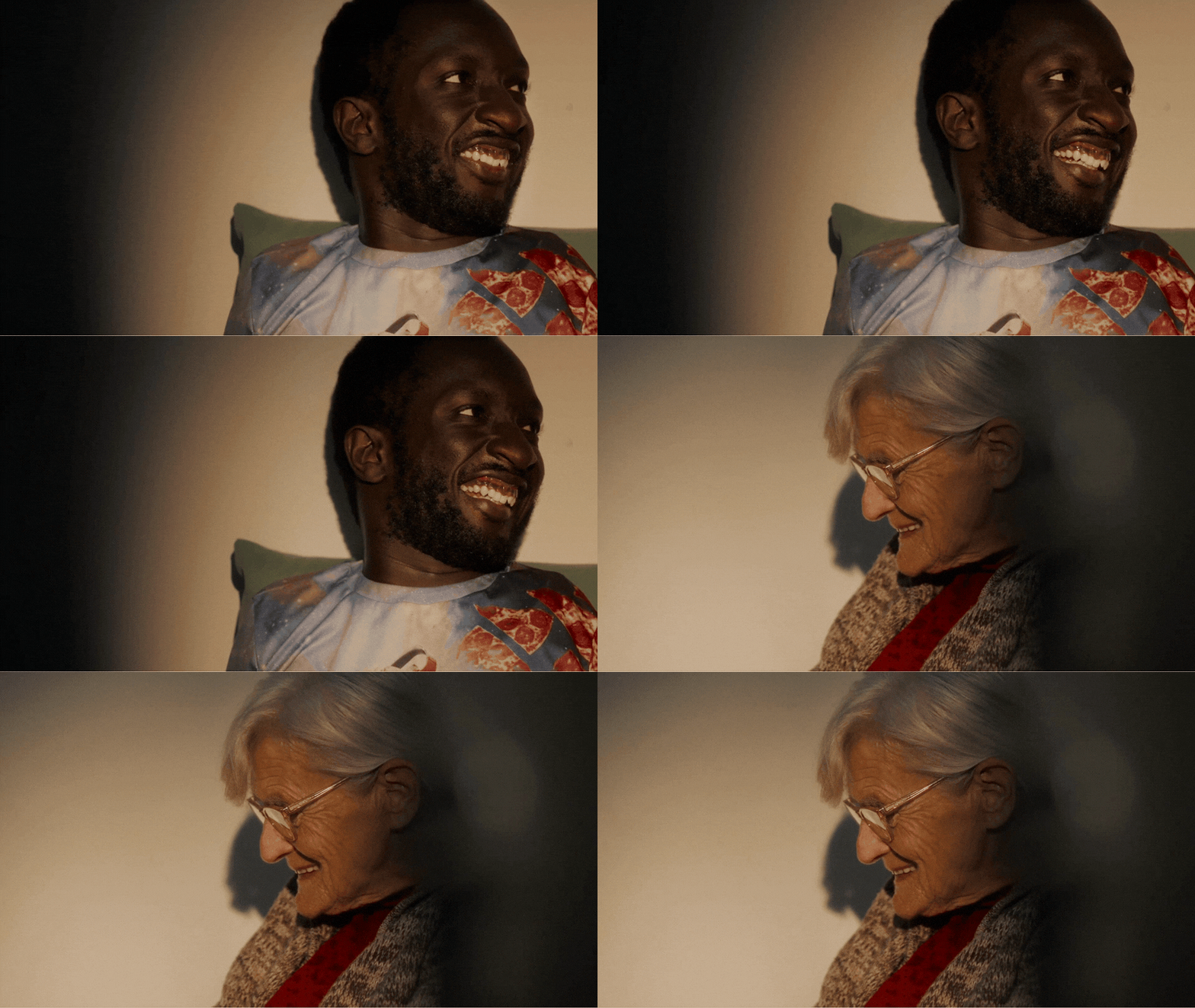
“They really are an incredibly happy family. I wanted to capture everything between them on long lenses, set back from the action to make each moment feel like a complete memory being watched. I guided their actions and I guided the mood, but they love being around each other – they are a family that bring each other joy in every moment,” Rob smiles.
“When directing becomes watching, it’s a real pleasure.”
Enter, Radiohead
Radiohead’s ‘Exit Music (For A Film)’ feels like the perfect track to intensify the emotions of film, but it wasn’t the immediate choice. ‘The Humbling River’ by Puscifer, with its darkness and drive, initially stood out to Rob, “but it has an American vocalist and I really wanted to root this film in the UK, reinforcing that this was a film about a situation in England,” he says.
Pivoting, Rob set his sights on a Thom Yorke track which Leland music supervisor, Dhamirah Coombes worked tirelessly to secure his permission for. The Radiohead musician agreed early on, but roadblocks appeared with other rights holders.
“Dhamirah told me that Yorke’s team had been really responsive to the film and encouraged me to look at Radiohead's back catalogue. I hadn’t considered it originally – I had concentrated on older, less commercial tracks that I thought would be easier to secure the rights for – but on her recommendation, I dug through the back catalogue and tentatively requested ‘Exit Music (For A Film)’. I think within a day or two we got a very straightforward ‘yes’.”
In the end, the roadblocks with the original track were cleared, and Rob received a belated email offering it to him. “To find myself choosing between two god-tier tracks wasn’t a problem that I’d seen coming,” he jokes.
Bottled Lightning
From Rob’s perspective, the high point of this whole process arrived months after ‘Member of the British Empire’ was already made. With satisfying circularity, it came when Rob was reading another of Isaac’s LinkedIn posts.
“By the time Isaac wrote about the film, time had passed and he'd had time to reflect on everything. The way that he wrote about it was without equivocation: he simply presented the film as a representation of what he had been through. To have him simply accept it as an accurate representation made me feel as though we’d completely nailed it, we’d bottled that lightning,” shares Rob.
“To capture an emotion, an emotional state, one so personal and esoteric… It never felt challenging to me while we were making it, but as soon as he endorsed it in such a matter of fact way, that was when I first thought, ‘What if I’d missed the mark?’.”
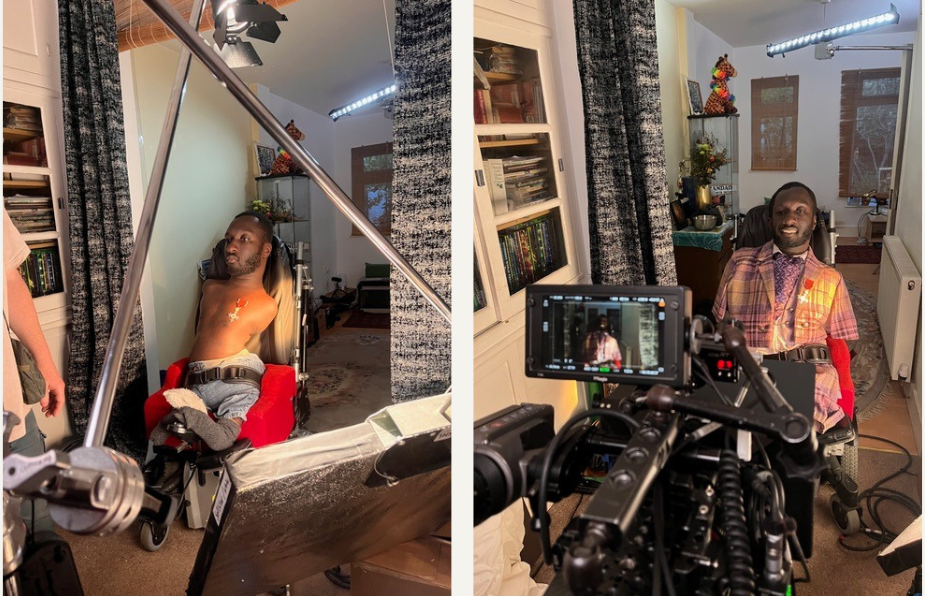
Above: Isaac on set


