


Making the Familiar Fantastically Unfamiliar – The James Haworth Effect


James Haworth has built a reputation for turning the mundane into the magnificent. Best known for expertly reframing everyday moments with cinematic polish, unexpected humour, and a touch of the surreal, James has a magic touch when it comes to comedy. So, when Specsavers Canada approached him with a follow-up campaign starring real-life astronaut and Canadian living legend, Colonel Chris Hadfield, the brief felt tailor-made for his sensibilities.
Set against the backdrop of ordinary Canadian life, the campaign gently bends reality, as the viewer sees Colonel Hadfield wandering through scenes in full flight suit, delivering space-age insights with bone-dry comic timing. It’s a tone that’s unmistakably James Haworth: relatable yet elevated, character-driven yet visually precise.
And while directing a national treasure and non-actor might seem like a creative gamble, James describes Colonel Hadfield as “genuinely one of the best actors I have worked with”. It’s just one of many anecdotes from a career that spans dry humour for Specsavers, absurd horror for ATCO, and playful reinventions for brands like McDonald’s and Walmart.
Here, talking to LBB’s April Summers, James opens up about finding comedy in nuance, why he always leaves room for the unscripted, and how long-term creative partnerships lead to career-best work.
LBB> Your work often blends comedy with strong visual craft. How would you describe your directorial style? What do you look for in a script before you sign on?
James> Well it’s hard to pin down, because it’s malleable, but I’m drawn to things being just a hair left of centre. Nothing too outrageous, but just different enough to be entertaining and attention grabbing. That can come from casting, wardrobe, or art direction, as well as the scenarios themselves. I pair that with a classic approach to camera work and craft. I like relatable everyday people in atypical situations. And supporting that, I like everything to stem from the characters: what would they wear, where would they live, how would they speak to each other etc.
It depends on the project but it has to be flexible because I see scripts that ground themselves in a particular genre. On the flip side of that coin, sometimes there is no genre. I shot a campaign for McDonald’s (‘Friends Wanted’) which was not advertising food. Instead, what McDonald’s wanted to tell people is that they were hiring groups of friends. After chatting with the good folks over at Cossette in Toronto, we shot really loosely; hand-held, breathing cameras and a very flat, low contrast look. That campaign resonated with viewers and was loved by a lot of people – and I am still proud of it today.
Here is the thing about my style and how it relates to comedy… I will always shoot the script that is agreed in the final pre-production meeting, but comedy is subjective, and I ensure that we go off-script too. I cannot remember a film I have made in the last few years where a bit of unscripted dialogue or performance hasn’t made its way into the edit – so you need options. For that reason, I often shoot two cameras as this gives us coverage, in terms of lensing and angles, while also saving time. That time gives me the option for the wiggle room in the scripts to be shot.
And finally, I often work with comedians, and that is probably the strongest glue that holds the body of work together. My reasoning for this is simple. We want funny, so let’s work with people that understand funny. Comedians understand comedic timing, nuance (those cogs turning), they understand that what is not said can be funnier than what is. When needed, they can adlib properly… the list goes on and on.
LBB> For your latest work with Specsavers Canada, you work with a real-life astronaut! How early were you brought into the ‘Your Eyes Go Through A Lot’ project? And what initial ideas did you have to incorporate typical James Haworth comedy?
James> I am fortunate enough to have a long-standing relationship with Specsavers. I shot last year’s campaign where we first saw Chris. So, Jon and Bertie, the creative team, and Angus, the agency producer, were kind enough to contact me about three months before we actually had the go ahead from the client for this campaign. I had an initial script with three scenarios in it. Jon, Bertie and myself noodled a lot, of course, and a couple of the scenes did shift as we crafted the films. We wanted the tone to be dry and relatable, but also fun. I always had one eye on the serious message of how important it is to go for regular eye-health checks, and you see that in the films.
LBB> I’m curious, was the astronaut metaphor already baked into the brief, or did it evolve through collaboration? How did you balance making it cinematic but still grounded in relatable humour?
James> In 2024 we made the first campaign starring Chris. By the time I received that script, he was already booked and the space metaphors were part of the creative. The format for this year’s main script – three vignettes which are relatable up front, and then a more serious payoff when we are in-store – is a classic problem then solution, and ensured the balance of cinematic, comedic, and serious. The goal was to ‘make the everyday beautiful.’
I liked the idea of mixing up the film styles a bit throughout, as if we are dipping into the many varied lives of Canadians, with Chris as the glue that binds the films together. We did pepper in a few space jokes but I didn’t want them to become too on the nose, so they are subtle and conversational. Chris is wearing his flight suit in these everyday scenes amongst the public, which adds a level of absurdity, and we worked with cinematographer Doug Koch (who recently shot legendary Canadian director David Cronenberg’s last two movies) to ensure the right look.
LBB> Of course, Chris Hadfield isn’t a trained actor or comedian, so what was it like directing him? And how did you shape the performance to land both the credibility and the humour?
James> Good question, and I have a surprising answer to it. I mentioned that Colonel Hadfield was already enlisted in last year's scripts. When first working with him I did wonder how he would be on camera, as any director would, but I need not have lost any sleep. Put simply, Chris is genuinely one of the best actors I have worked with. I’ve heard that line before about a non-actor celebrity, but he genuinely is. He totally gets it. Whatever I asked of him, he delivered it first time, every time.
As you might imagine, he is uber-focused on the job at hand. I guess that comes from being an astronaut and fighter pilot amongst other things. He does his homework and is 101% prepared for the shoot, which is really important because, when shooting comedy, you always need a little wiggle-room with the scripts on the day. If an actor knows and is comfortable with them, then that leaves us free to concentrate on the performance and try different things. Then it’s easy to change lines, or a reaction, or a stare. Things happen, further ideas always flow on set, and so whilst I will always shoot the script, and because humour is subjective, I like to play. Specsavers have always understood this, and it makes for great work. That is one of the reasons, I suspect, that Specsavers advertising has been so good, for so long. I am happy to be bringing a piece of it to Canada.
LBB> Specsavers has a long legacy of humour-led campaigns. How did you aim to evolve or localise that tone for a Canadian audience without losing what makes it so effective globally?
James> The comedic style is very in keeping with what Specsavers has created in the UK. Plus, I’m British, so I get the humour. The Brits and the Canucks have an almost identical sense of humour (we even spell it the same way), so there really wasn’t much localisation in terms of the craft. The big Canadian draw of course, is Chris himself. He genuinely is a national treasure: he commanded the International Space Station; performed an untethered space-walk whilst installing the ‘Canadarm’ on the Space Shuttle; was a test and fighter pilot, has written six best sellers and that is just a small part of his make-up. He truly is an inspiring human being that has done so much for humanity, including Optical Coherence Tests in zero-gravity for use down here.
LBB> Is there a moment in the final spot that makes you laugh or smile every time you see it?
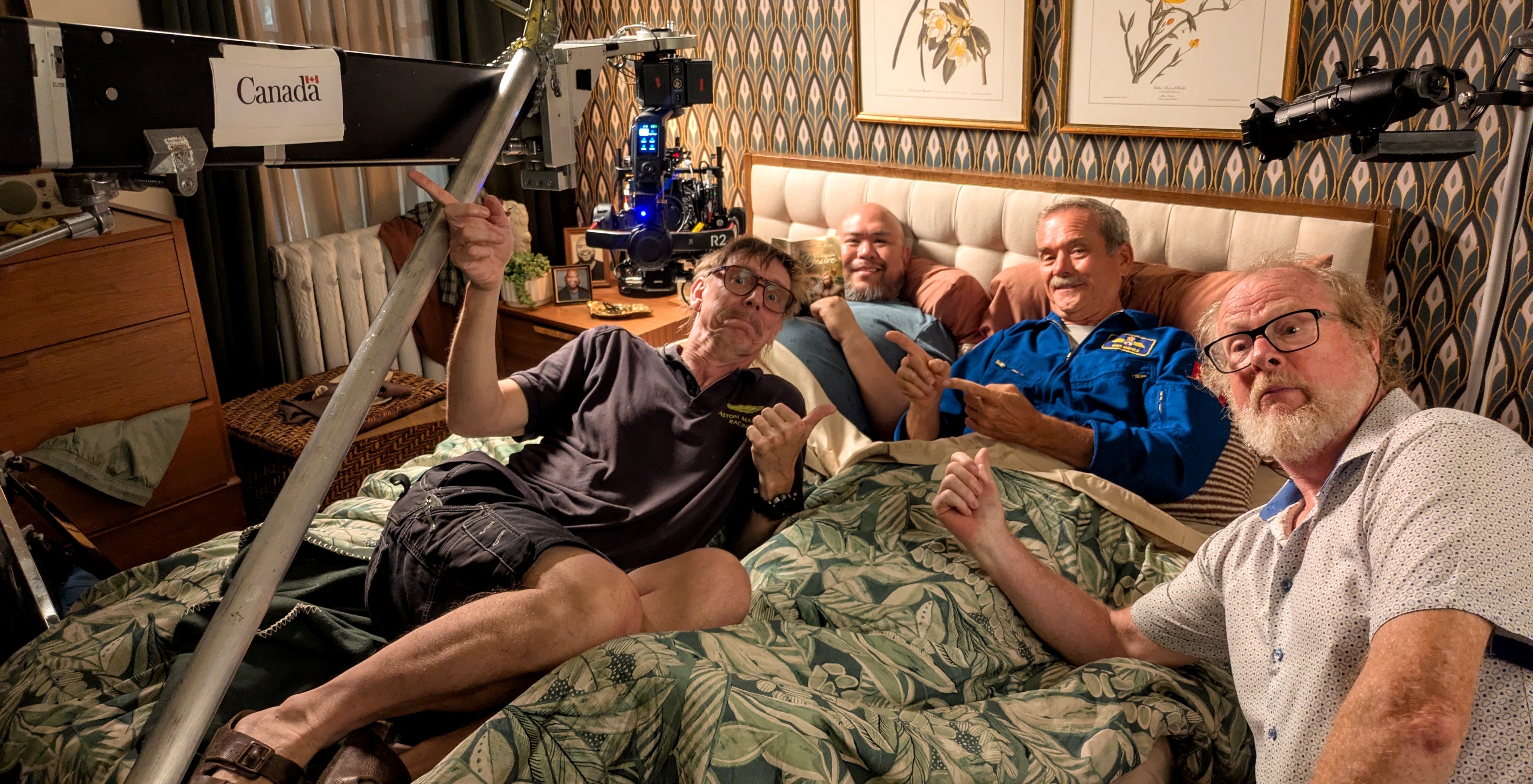
James> For me, it is the bed scene. I love Chris’ delivery of “I’ve seen true darkness out there…” It definitely leaves you wondering what he might have seen, and the reaction of his co-star reading an easter-egg romantic novel.
There is a little story attached to the scene as well. As Col. Hadfield had installed the ‘Canadarm’ with the Canadian logo on the International Space Station, on the shoot I thought we would make Chris feel at home. We had a crane arm for the camera, so it made sense to emulate the ‘Canadarm’ for him, on-set. It was a bit rudimentary, but with some imagination, it was exactly the same… I know I can’t tell the difference!
LBB> Specsavers is just one of several repeat collaborations you’ve had with brands. What do you value most in those long-term creative relationships, and how do they influence the kind of work you’re able to make?
James> It’s true. .I have worked on long running campaigns for brands such as Walmart, McDonald's, Pizza Hut, Churchill Insurance and a few others.
It stands to reason that if a client comes back for a second round, then they are happy.
’The Difficult Second Album’ is a phrase that comes to mind when a second round appears in my inbox. Because I give 101% to everything, how do we make the next better?
I try my best to do this by moving things on incrementally. It helps a client’s confidence in allowing the campaign to grow, and I feel you have to, otherwise you lose the audience. It could be that things get a little more absurd as a campaign grows.
For Walmart, I randomly suggested using Pattie LaBelle in a script for pies and thought it would never happen. I talked to the ECD, he liked it, so we reached out to Pattie, and she said yes. Suddenly we’d shifted the campaign enough to see Ms. Pattie (she asked me to call her that) standing in a front doorway asking to be paid for the pie. Remembering nothing is off the table, pushing, crafting lines, crafting the look – all of it is important.
LBB> You also recently directed Scary Furnace for ATCO, delivering a different type of comedy to the Specsavers work. What drew you to this project, and how did you approach balancing the horror-style aesthetic with a playful, comedic twist?
James> Yes, that was part of a series of films where household items came to life and verbally abused their human owners. This is a good example of emulating a genre – the whole campaign was based on a haunted house – so with a furnace being in a basement, the tropes were easy to find. Creaking doors, the camera ‘Dutching' as the actor rushes down into the darkness, some 1970’s horror angles. Very fun to do.
It isn’t just the scripts that draw me to work either – it is also the people behind them. I had previously worked with some of the ATCO creative team at McCann on a project for CoffeeMate where we had a bunch of live raccoons in a kitchen. It went great (apart from the raccoons constantly falling asleep on set!), and so they came back with ATCO. The relationship with a creative team is uber important to me because when there is harmony, a deep sense of leaving nothing unturned, collaboration both ways, and trust, that is when good work can become great. I treasure those working relationships.


