


Just like Any Good Curry, AI Needs a Rich Base to Work From


Most of the curries we love, especially from those wonderful independent Indian restaurants, start in the same place - with a paste. Complex spices are expertly blended by experienced hands to create a unique base from which it all begins, culminating in a richer, deeper flavour.
That was our starting point on the latest TV ad for Patak’s.
From day one, we knew the film had to feel real.
Real people. Real kitchens. Real food. Real light.
Made by a talented, very human group of people.
But one idea in the script pushed us beyond what the production budgets could comfortably support.
The idea that nearly got 'simplified'
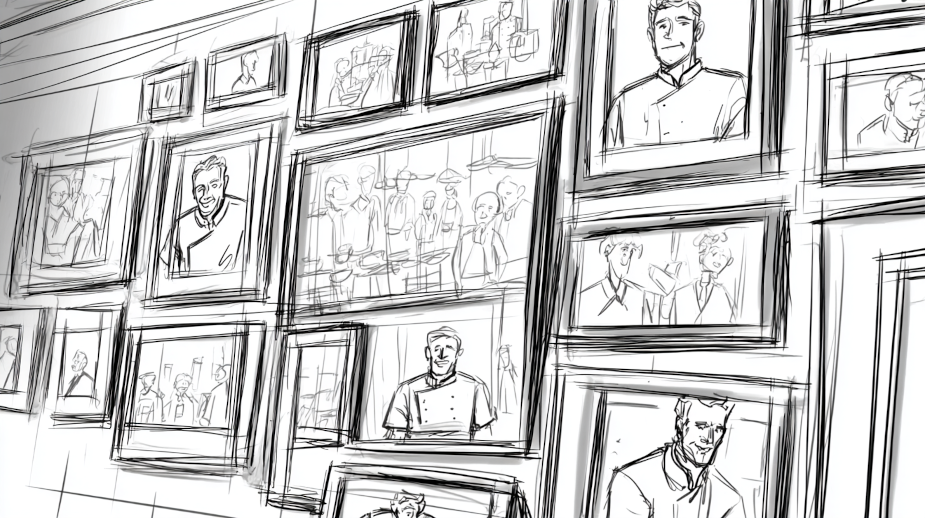
There’s a moment built around a picture wall. The kind you see in Indian restaurants everywhere. A quiet celebration of heritage and generations. Recipes handed down rather than written down.
We wanted these images to live.
Traditionally, that would have meant casting younger versions of our lead, sourcing multiple locations, and staging several additional shoots.
A lovely idea. Also the exact sort of thing that usually gets toned down once budgets and processes kick in.
This is where the ambition could have died. Not through lack of creativity, but through perfectly sensible conversations about cost, risk and feasibility.
Using AI for the right job
This is where multiple AI platforms came in, very deliberately, as a tool.
As director Michael J. Ferns puts it, “AI is a brush, not the painter. A lens, not the eye behind it.”
Using real photography of our actor, Bhav, we worked with AI to generate moments from his earlier life. Cooking as a child with his parents, cutting his teeth as an apprentice and
eventually holding the keys to his own restaurant.
Those images were then brought to life as short films and placed into the frames on the wall.
No recasting. No additional shoots. No break in emotional continuity.
What AI actually unlocked
AI didn’t invent the idea. It didn’t direct the performances or decide what mattered emotionally.
What it did was remove a structural barrier between imagination and execution.
It helped to deliver an ambitious idea that would otherwise have been diluted or quietly dropped because the process couldn’t accommodate it.
The result is a film that is real at its core, with subtle augmentation used in service of storytelling.
Protecting good ideas from compromise
AI won’t save weak thinking. And used badly, it can absolutely flatten ambition by optimising purely for speed, volume or cost.
But used well, in the hands of experienced creatives, it does something far more interesting. It protects good ideas from compromise.
The question of “should we be using AI?” has long since passed.
For Ourselves, we use it to keep the creative bar as high as we can when budgets and processes may dictate otherwise.
If it turns into just another efficiency lever, we’ve missed the real opportunity.


