


The Power of Quiet Leadership: Women Are Changing What Producing Looks Like


Traditional production culture tends to reward intensity. It is more or less ingrained in the biz. Whoever has the loudest voice, makes the fastest decisions, or appears to be the most stressed, tends to reign supreme. Historically, these are qualities associated with someone who is working the hardest—but has that become an inaccurate and outdated belief?
Constant urgency should not be (and is not) proof that someone is working hard. In reality, especially in the production world, this approach is actually a hectic and counterproductive interruption to many people’s workflow. As we usher in 2026, production company FARMUSE raises this question by embracing a somewhat radical approach they are calling ‘quiet leadership.’
Here, LBB’s April Summers speaks to Michelle Nicholson, co-founder and EP, and Dayna Rochell, head of production, about the benefits of quietly reading on-set situations to create a streamlined steadiness amongst the crew, and why everyone, regardless of gender, should lean into more calm and considered collaboration.
Being a Boss Doesn’t Have to Mean Bossy
Quietness is not a trait one would necessarily associate with leadership. Especially in North America. From politicians to business owners, one quick peruse of the most dominant leaders in the US and it would be fair to surmise that not all leadership is subtle.
But, given the decibel at which many leaders insist on operating at, what if, in 2026, there is a demand for a different type of leadership? Could this be the year of quiet leadership? And if so, what does that look like in practice?
“For me, it’s about connecting as a team, showing up, participating and supporting in a genuine way,” Michelle tells me. “It’s presence over performance. Listening before reacting. Creating steadiness in moments that tend to lean toward urgency.”
Sounds pretty idyllic to me, especially when you consider the fact that producers are looked to as the ones responsible for building bridges, finding solutions and putting out fires. If they are also already grappling with tight schedules and diminishing budgets, steering away from frantic urgency sounds like the right (and somewhat obvious?) call.
Trust is paramount to productivity on any set, so how have producers like Michelle and her right-hand head of production Dayna Rochell, been building it?
“Trust on a set comes from honesty, clear communication, and genuinely supporting the people you work with,” Dayna explains. “I try to ask questions like 'What does the department you need look like?', 'What do you need from production to make this work?' so that everyone feels heard and supported. Trust unlocks collaboration and creates an environment where people feel supported and inspired to do great work.”
Building Up Trust
As Dayna and Michelle – and any producer, in fact! – knows, productions rarely go without a hitch. It’s normal for issues to arise due to the fluctuations and ever-evolving budgets, schedules, and resources. For this reason, calm communication of realistic expectations pairs best with an established sense of trust in the producers. “We might not have the exact pre-light the director wants or the most efficient fitting, but that’s okay. Building trust means staying flexible, focusing on solutions and showing the team that you’ve got their back," Dayna says. "When people see that you’re adaptable and working in service of the creative, they trust you to lead the project effectively.”
Although heightened stress naturally often results in raised voices and heightened tension, this is why the value of thoughtful production and quiet leadership benefits everyone involved. And FARMUSE have seen the fruits of this approach time and again.
“There’s a misconception that producing is just frantic box-checking,” Dayna adds. “Thoughtful production is the opposite, it’s calm, strategic and collaborative. It’s understanding what the visual needs are, anticipating challenges and making choices that support the artistic vision while still being responsible for the production.”
Because, as Dayna points out, “When a producer does their job well, the work is strong and the team feels supported enough to enjoy the process.”
Production Rooted in Details
Michelle and Dayna have not opted for quiet leadership as a simple rebellion. While it can be perceived as radical, it has in fact been informed by their diverse experiences of the industry, and driven by a desire to dismantle specific parts of traditional production culture that, to them, feel broken or outdated.
“We’re not driven by ego or adrenaline,” Michelle points out. “Our work is grounded in communication, care, and trust. People feel safe to ask questions, take creative risks and speak honestly. When people feel valued and heard, the work is better — even when the answer is no.”
Built with intention, and rooted in craft, FARMUSE cares about how their people feel when they walk onto set. "Our culture is rooted in the details from prep to delivery. We're ultimately responsible for the entire experience from call time to wrap, crew to client. We’re in this together."
Dayna corroborates this, explaining how 'The FARMUSE Way’ is all about showing up intentionally, taking a moment to regulate and stay grounded, in order to lead with that same energy.
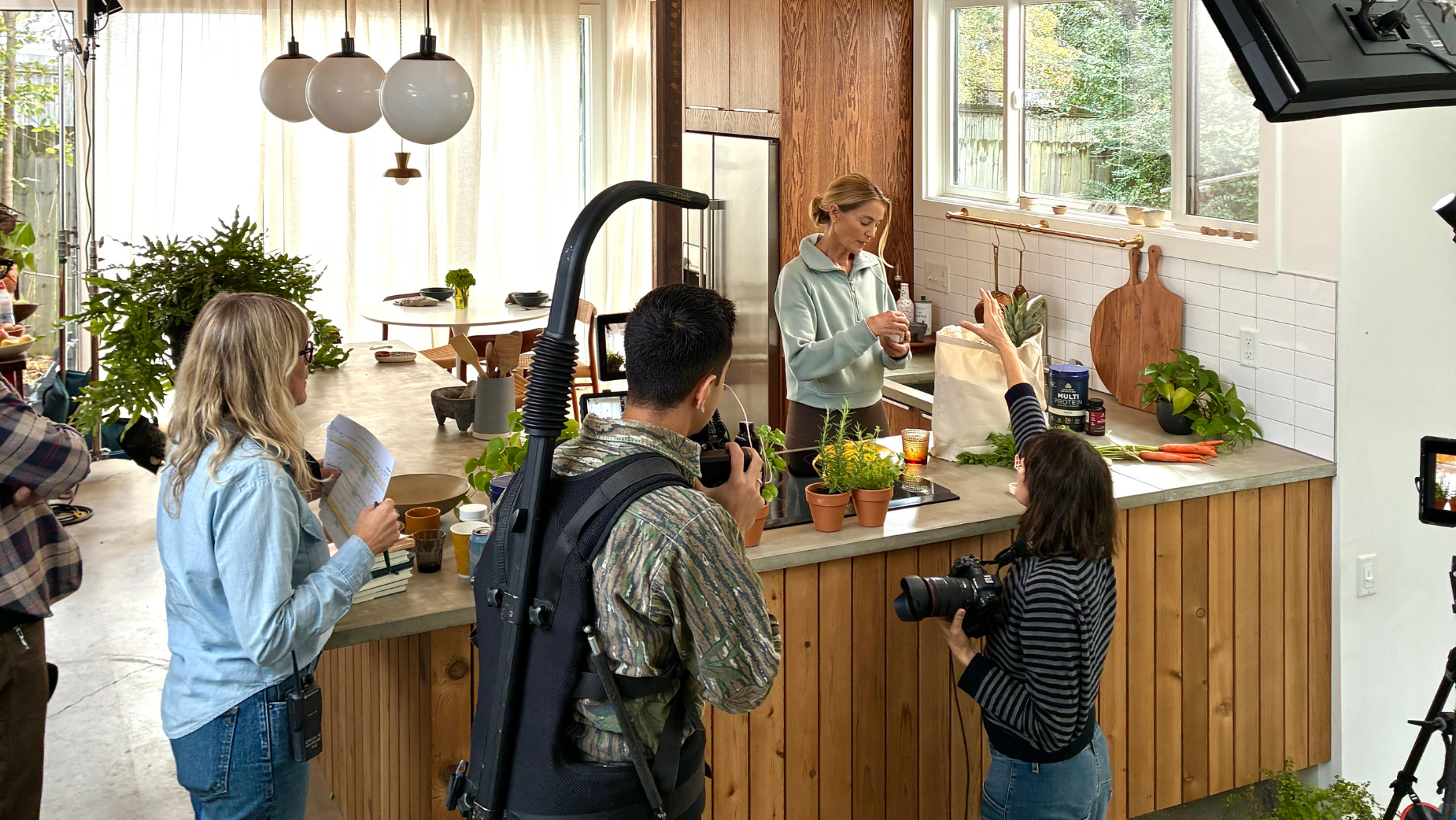
“From pre-production through post, we approach every project with clarity and calmness,” she says. “When production leads with that energy, it changes the entire tone of the set. People communicate better, creative decisions feel less frantic and the work becomes more collaborative. Productions can be high-pressure environments but they don’t have to feel chaotic. When we’re thoughtful about our communication and pace, we create a space where people can do their best work.”
Who Run the World?
In addition to traditional production culture rewarding the loudest voice in the room, it has also, historically, rewarded men. So what happens when leadership is redefined, by veering away from dominance and volume, instead steering towards attentiveness, emotional intelligence, and steadiness? For Michelle and Dayna, this reframing has been essential to carving out space in an industry that didn’t always recognise quieter forms of authority.
“Women have had to create space by redefining what leadership looks like. We’ve spent years leading in ways that were powerful but often overlooked – building consensus, holding steady under pressure, guiding teams with care – qualities the industry didn’t always recognise as leadership. We built our own lanes by proving that listening and supporting is just as essential as calling the shots.”
In doing so, they’ve helped demonstrate that production doesn’t need to be fuelled by friction to be effective. “It doesn’t have to be a power struggle, it can be a collaborative ecosystem. One rooted in shared responsibility and collective ambition,” Michelle adds.
Crucially, this approach is not presented as gendered by nature, but as a learned way of working that others can adopt. “Women bring an attunement that subtly shifts the room,” Michelle says. “On set, that looks like the ability to read situations quickly, sense when energy is off and intervene before tension turns into disruption. It shows up in asking the right questions early, checking in with departments before problems escalate and offering support ahead of urgency.”
When paired with trust and instinct, that attentiveness becomes a practical leadership tool. “Women often trust what they’re picking up on, the dynamics of a team, the pacing of the day etc. and act on it, with intention,” Michelle continues. “Whether it’s adjusting the schedule, re-framing a conversation or creating space for someone to feel heard, it reduces friction, increases trust and allows teams to stay focused on the work rather than managing stress. The result is a healthier set and a stronger outcome.”
In that sense, quiet leadership isn’t a rejection of traditional production models so much as an evolution of them, one that centres presence over performance, and proves that calm, considered leadership doesn’t diminish authority. It strengthens it.
In an industry long conditioned to equate urgency with excellence, FARMUSE offers a different proof point. One where leadership is measured by clarity, trust and care. Quiet leadership, as Michelle and Dayna show, is all about stepping in with intention, and creating the conditions for better work, and better working, to happen.
See what else FARMUSE has been working on here
Read more from April Summers here


