


David Kerr on Reuniting with Rowan Atkinson to Engineer the Chaos of ‘Man Vs Baby’


David Kerr approached ‘Man Vs Baby’ with both familiarity and fresh jeopardy, as returned to the mischievous world he helped create, as the show prepares to land on Netflix on December 11th.
The character of Trevor – the well-meaning, accident-prone housesitter first introduced in ‘Man Vs Bee’ – were already in place, but the dynamic this time was entirely different. No longer battling a CGI insect, Trevor is tasked with protecting a very real, very unpredictable infant, plunging David and Rowan into a new flavour of chaos that required extraordinary planning, meticulous visual comedy, and cutting-edge VFX innovation.
The ‘Johnny English Strikes Again’ director speaks to LBB’s Olivia Atkins about the engineer-level precision behind great comedy, the trust that underpins his collaboration with Atkinson, and the moments on ‘Man Vs Baby’ that pushed their craft further than ever.
LBB> How did it feel returning to the world of 'Man Vs Bee' for this new chapter, 'Man Vs Baby'?
David> Getting Rowan back into the housesitter’s jacket was made easier by the fact that 'Man Vs Bee' had been a hit with audiences worldwide, so Netflix were rooting for its return. And working with many of the creative team from ‘Bee’ was like bringing the band back together.
When I embarked on 'Man Vs Bee', Rowan’s character, Trevor, was entirely new; he wasn’t Mr Bean, Blackadder or Johnny English, we had to build the character from the ground up. I spent hours with Rowan and writer Will Davies, discussing exactly what made Trevor tick and how he’d behave in any situation.
As we developed the script for 'Man Vs Bee', we followed the time-honoured adage for creating comedy: first, put your character up a tree; second, throw rocks at them.
The “tree” was the house where Trevor would sit. The proverbial rocks were mostly thrown by the bee.
The story had very clean lines: ‘Man’ and ‘Bee’ locked in a mortal battle that escalated across nine episodes.
On 'Man Vs Baby', there was a totally different character dynamic. For starters, Trevor wasn’t going to try to kill the baby. His struggle was how to look after it. So the tone was shifted from the get-go. But Trevor’s character was consistent, as was his role as a housesitter.
The biggest change – and challenge – was Rowan’s co-star. A six-month old baby is a hell of a lot less predictable than a CGI bee.
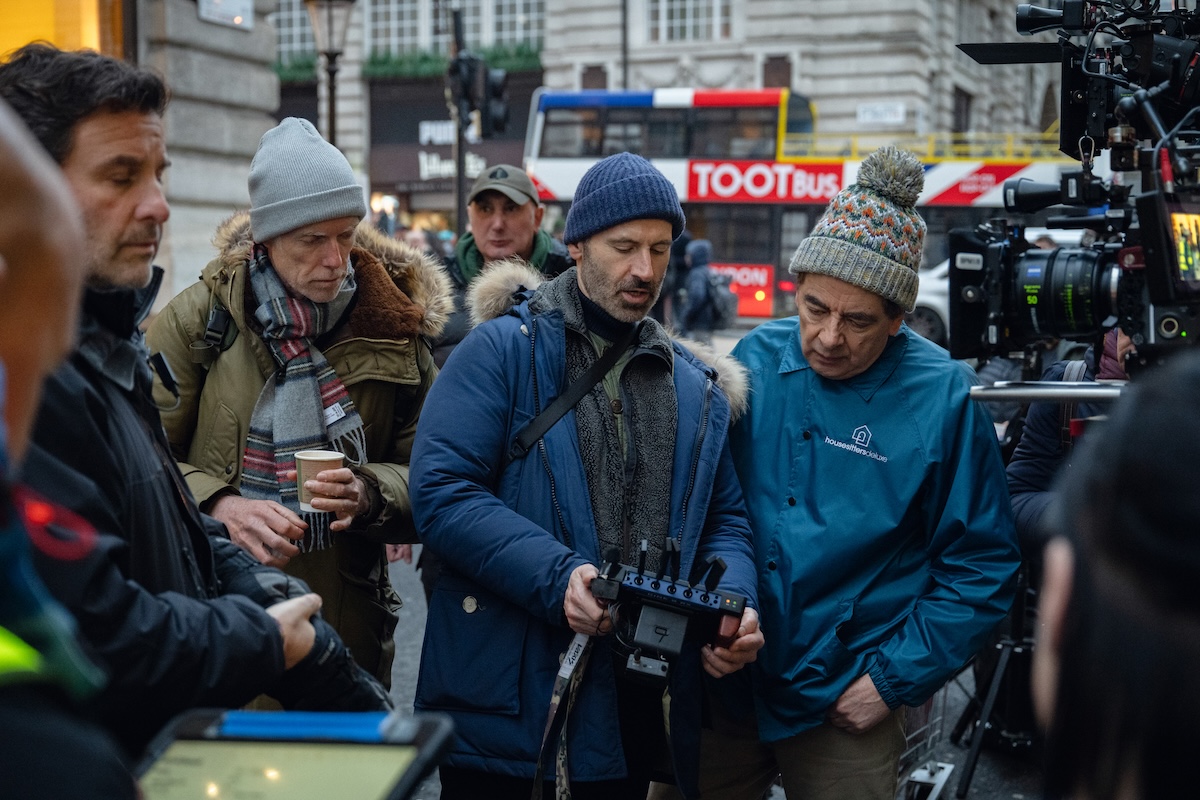
Courtesy of Ana Blumenkron/Netflix © 2025.
LBB> You’ve collaborated with Rowan Atkinson several times now — how would you describe your creative relationship, and have you developed a kind of shorthand between you?
David> Our creative relationship is about as tight as a Christmas jumper at the end of a four-course dinner. We’re on a similar wavelength in terms of what we find funny. But we’ll go head to head debating the best visual delivery of a comic idea.
When Working Title hired me to direct ‘Johnny English Strikes Again’ for Universal, Rowan’s character had already carried two hit movies, so I wasn’t arriving into a situation where I’d be telling Rowan how to play it. It was more a case of proving I could bring something creative to the party and building a world where I could help Rowan to do his best.
In pre-production on each of our projects, I’ve drawn up detailed storyboards for almost every scene and talked Rowan through them, so I could discuss why I wanted to position the camera in a specific place at any given moment. Detailed work in prep frees us up on shoot days to allow us to focus on performance.
At this stage, we’re not usually interested in improvising five alternative versions of a scene. We’re more focussed on trying to perfect the idea we’ve agreed on.
But the quest for perfection can mean shooting multiple takes of the same shot – with Rowan, who often describes himself as a “glass half empty” actor – sometimes feeling he hasn’t quite nailed it. This is where Rowan most needs my honest, frank feedback. And to occasionally suggest an idea which unlocks an extra detail in his performance; but mostly, simply to reassure him that he has absolutely delivered and we can move on.
When it comes to the edit, we explore performance takes exhaustively. Even when a scene is working, we play around with shot order and pacing, to see if there’s a better version to be found.
This kind of relationship depends on mutual trust. Because often in the edit, things get worse before they (hopefully) get better. We certainly understand each other’s tastes when it comes to constructing a joke, so there’s no question we’ve developed a shorthand. But we’re not complacent. We constantly challenge each other.
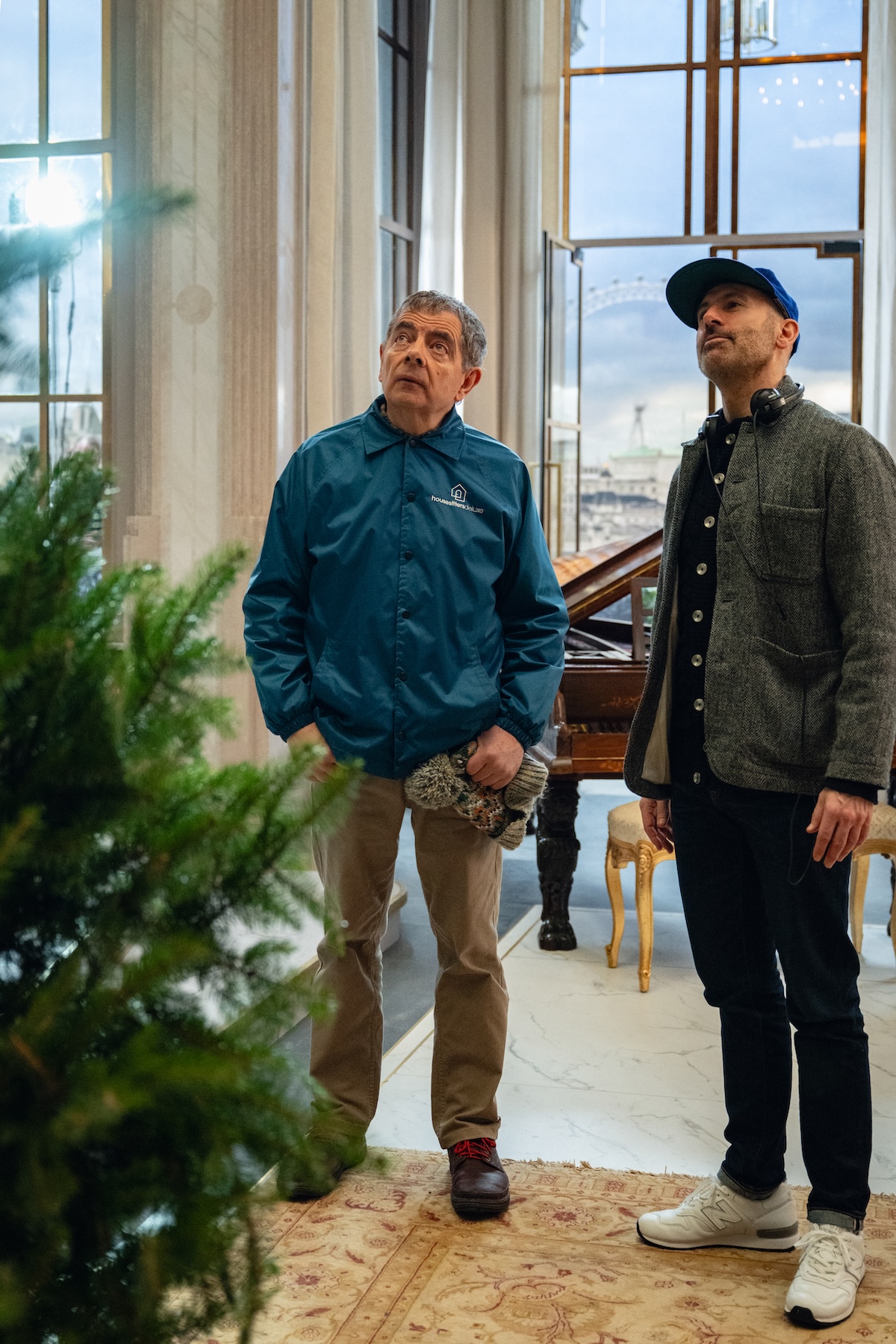
Courtesy of Ana Blumenkron/Netflix © 2025.
LBB> Slapstick comedy can look effortless, but you’ve said it’s often approached with an engineer’s precision — can you talk about that process and how you and Rowan build those moments?
David> Slapstick, sadly, has become a bit of a dirty word. It’s often seen as comedy of a lower order than something that’s verbally witty. Much like “farce” is used as a derogatory description, when good farce is incredibly intricate in its construction and execution.
With visual comedy – which is how I’d describe most of my work with Rowan – it’s all about clarity and precision. Giving the audience the visual information they need to discover the joke. And that starts with set-up. Sometimes that means seeding the presence of a key prop a few scenes before it pays off comedically.
For instance, in 'Man Vs Baby' (*plot spoiler), Trevor is being given a tour of the penthouse he’s hoping to housesit by Petra, the imperious property manager. Trevor has to hide the baby he’s sitting before embarking on the tour. So, in a bit of a panic, he stashes it into his backpack, along with the baby’s bottle, and leaves the backpack in the hallway, hopefully out of sight.
Halfway through the tour, we cut away to the backpack falling over, and hear a gleeful giggle from the baby within, along with a slightly ominous note in the score.
We then see Trevor and Petra arrive in the living-room, where Petra is explaining some of the house rules. Petra has her back to the open doorway which leads to the hallway.
We see Petra from Trevor’s point of view as she talks. Behind her, and unseen by her, the baby’s bottle rolls through the frame in the background. Trevor notices this and is horrified, but has to mask any reaction. Then, a beat later, the baby crawls through the back of the frame, in pursuit of its bottle. Again, Trevor sees this. This time, Petra notices Trevor looking and turns behind the hero to see what he’s looking at. But the baby has just cleared frame when Petra looks, so she never sees it.
It has taken a lot of words for me to describe a scene that plays out visually in a brief sequence of shots where every frame is calibrated to deliver specific information. The scene was meticulously storyboarded. And the set was designed to platform the joke. I had to think about how wide the doorway would be; what lens size and framing would best support the gag; how distant from Petra the baby and bottle would be (to keep them in relatively sharp focus; how long it would take for a bottle to roll across the floor through frame; and whether the bottle would roll adequately on carpet, or whether we’d be better to leave the marble floor – with less rolling resistance – exposed. I had to think about how long it would take a baby to crawl into and out of frame. And I had to use these projected timings to inform the lines Petra would say, so that she had just enough dialogue to cover the background action.
A sequence which unfolds very simply on screen was the product of many weeks of planning.
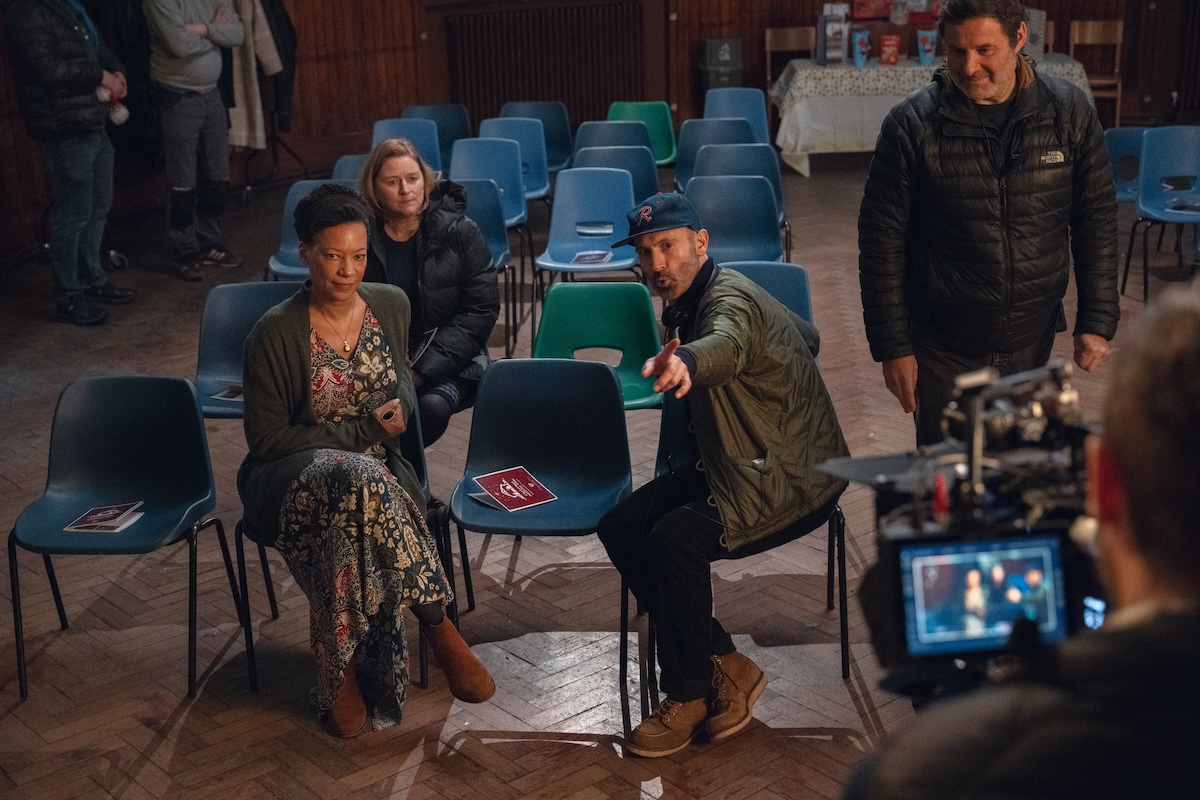
Courtesy of Ana Blumenkron/Netflix © 2025.
LBB> This series introduces an AI baby into the chaos — what were some of the challenges or unexpected moments that came with bringing that to life?
David> It was WC Fields who said “never work with children or animals.” Well, in 'Man Vs Bee' the co-star was an animal, albeit a CG one, and in 'Man Vs Baby', the co-star wasn’t just a child, it was a six-month-old baby. And a six-month-old isn’t going to take direction. Baby is going to do whatever baby wants to do at any given moment.
Now think about schedule. For very humane reasons, a baby isn’t allowed to be on set for more than two hours a day. But that’s not ideal when the baby appears in almost every scene.
We cast a pair of identical twins as the hero babies. We cast an additional pair of identical twins as back-ups. The back-up babies were a couple of months older, so more capable of crawling. But they were about the same size as the hero babies. So we could shoot with them and do face replacement in post.
We also had a jelly baby, which is a very lifelike and articulated latex moulded model of the hero babies. Which was very handy in rehearsal to get the action locked down before bringing the live babies onto set. But, although it looked uncannily lifelike, it wasn’t quite good enough to stand close scrutiny on screen. So there are no shots in the show featuring the jelly baby.
From the outset, I was hoping to get as much as possible of the baby performance in camera, on set. But I knew I couldn’t rely on that.
I began detailed discussions with our VFX supervisor, Rob Duncan of Framestore, because we’re at a moment where AI tools are being deployed in various ways but it’s still very new tech. And what we attempted to do is right at the cutting edge of what’s possible.
We wanted to have a full CGI baby that looked totally indistinguishable from the hero baby, but would have exactly the action or expression any specific scene demanded.
So we started with a performance capture session. Essentially pointing five cameras at each of our hero babies for a couple of hours in the hope of capturing a full gamut of expressions, waking, sleeping…
Framestore then applied machine learning to the resulting footage, essentially creating a library of expressions and actions, with the potential to adapt what we’d captured into further options for expressions and actions that the babies hadn’t actually delivered.
None of us knew how well this approach would ultimately work. All of us were keen to avoid the “uncanny valley” look where imagery is almost convincingly human, but in falling short, is deeply unsettling.
There’s a sequence in the show where Trevor is struggling – and failing – to stop the baby crying. And the idea is that this goes on for hours – with Trevor trying various approaches to placate the inconsolable baby.
We’re all familiar with actors needing to cry to deliver a scripted beat. Some can do it with ease (I’ve worked with Olivia Colman many times and this is one of her superpowers). Other actors need help from a tearstick or eye drops.
A six-month-old baby can’t be asked to cry. Nor can he read the script. So, when we came to shoot the sequence, the hero babies weren’t in the mood to cry. They were perfectly placid. Which, in most scenes, made them dream casting.
We shot the sequence with Rowan acting like he was dealing with a relentlessly screaming baby. Even though the baby was utterly calm.
In post, we drew on our databank of baby expressions to build the performances. Despite the brilliance of Framestore’s VFX team and animators, it wasn’t a case of getting instant, effortless results. It was a slow process. Often, there’d be a detail that let a shot down: a mouth shape or an eye blink that didn’t look plausible. But we had a creative dialogue, a lively back and forth to develop the shots and I think we landed in a great place.
One thing I learned was that the most successful fully CG shots are ones where we had a reference for the expression or action we wanted from the CG baby. Even if it was captured on a different set or different lighting conditions. The human eye is so adept at spotting the minutiae of facial expressions that the more authentic you can be, the better.
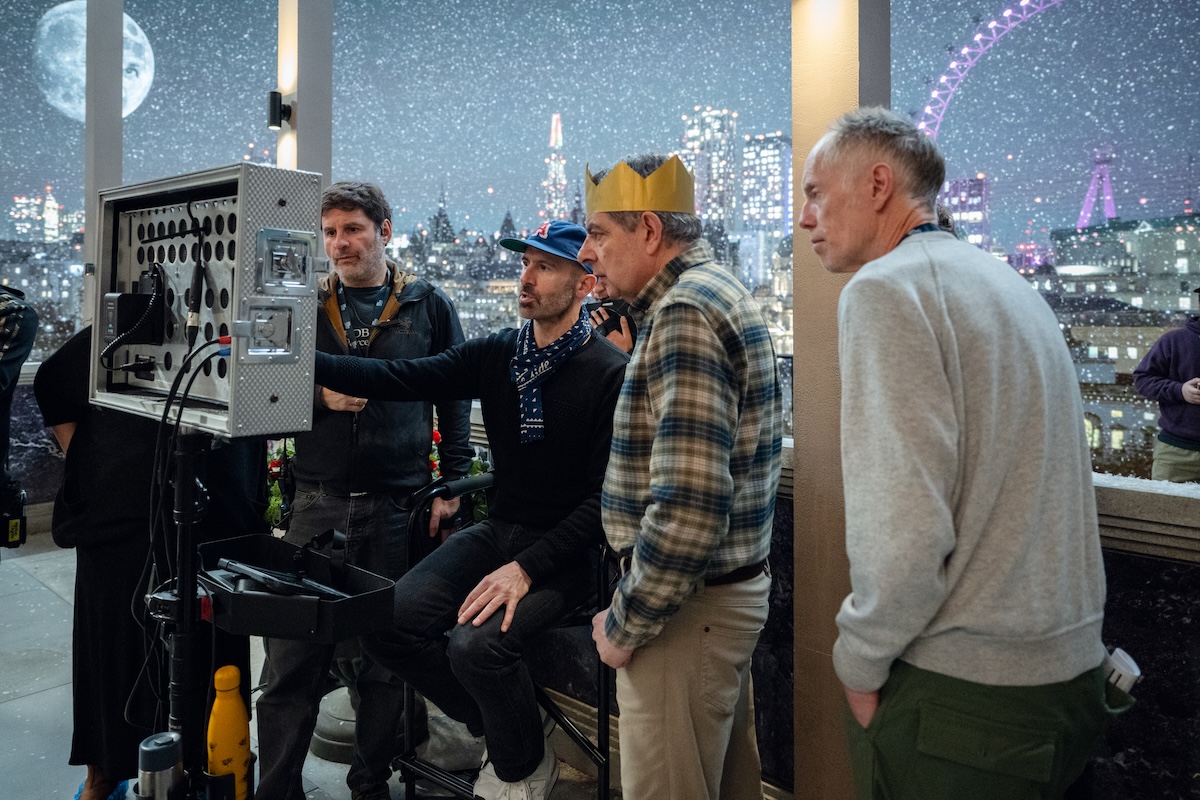
Courtesy of Ana Blumenkron/Netflix © 2025.
LBB> How did you balance the physical humour that audiences love with the emotional or human side of the story this time around?
David> In both 'Man Vs Bee' and 'Man Vs Baby', Trevor’s trying to do the best for his beloved daughter, Maddy, who lives with his ex-wife, Jess. His main motivation in taking on housesitting jobs is to provide for Maddy.
So it was important for Trevor to have an emotional life, with dramatic stakes.
But equally important that the show doesn’t become a bleak drama about a divorced dad. Ultimately, it’s not 'Kramer Vs Kramer'. It’s kind-hearted comedy.
In 'Man Vs Bee', the bee was truly antagonistic. Trevor went to war with the bee.
In 'Man Vs Baby', Trevor is trying to sustain and protect the baby and return him to wherever he has come from. So Trevor’s actions in Baby are more altruistic.
The reality of looking after a baby is that there are all sorts of physical challenges, and we wanted to exploit the comic potential of all of those. But we didn’t want the baby to do anything that burst the bubble of plausibility. Tonally, it was really vital that the baby’s behaviour wasn’t cartoonish or physically impossible. So everything the baby does should feel like real-life baby behaviour. It’s Trevor’s attempts to manage that behaviour in his own eccentric way that is the main source of the comedy.

Courtesy of Ana Blumenkron/Netflix © 2025.
LBB> You’ve directed both TV comedies and commercials — how does your approach differ when crafting a longer narrative like 'Man Vs Bee' compared to a short-form spot?
David> To be honest, there’s very little difference. TV commercials are one of the purest forms of visual storytelling. I love the rigour and focus of short form.
If the duration is 30 seconds, you need to make every frame count. So I’m always thinking about what is the essence of the story, the essence of the gag - and how can I distill that to its clearest and funniest form.
But even when I have a 90-minute duration to work with, I’m always looking for the leanest iteration of a joke - and seeing where I can take the air out of a scene. Are there lines I can lose – where a wordless reaction is more eloquent.
Good comedy pacing is more about finding the best rhythm than simply cutting things faster. But when you think about machine-gun dialogue delivery in classic screwball comedies, you know that faster can be funnier.
One thing I do appreciate when directing long-form: having the screentime to let the score work its magic. On both 'Man Vs Bee' and 'Man Vs Bee' I’ve collaborated with composer Lorne Balfe (of ‘Mission Impossible: Dead Reckoning’, ‘The Lego Batman Movie’) and one of the great joys of the job is figuring out the musical heartbeat of the story and then watching a full orchestra bring it to life.
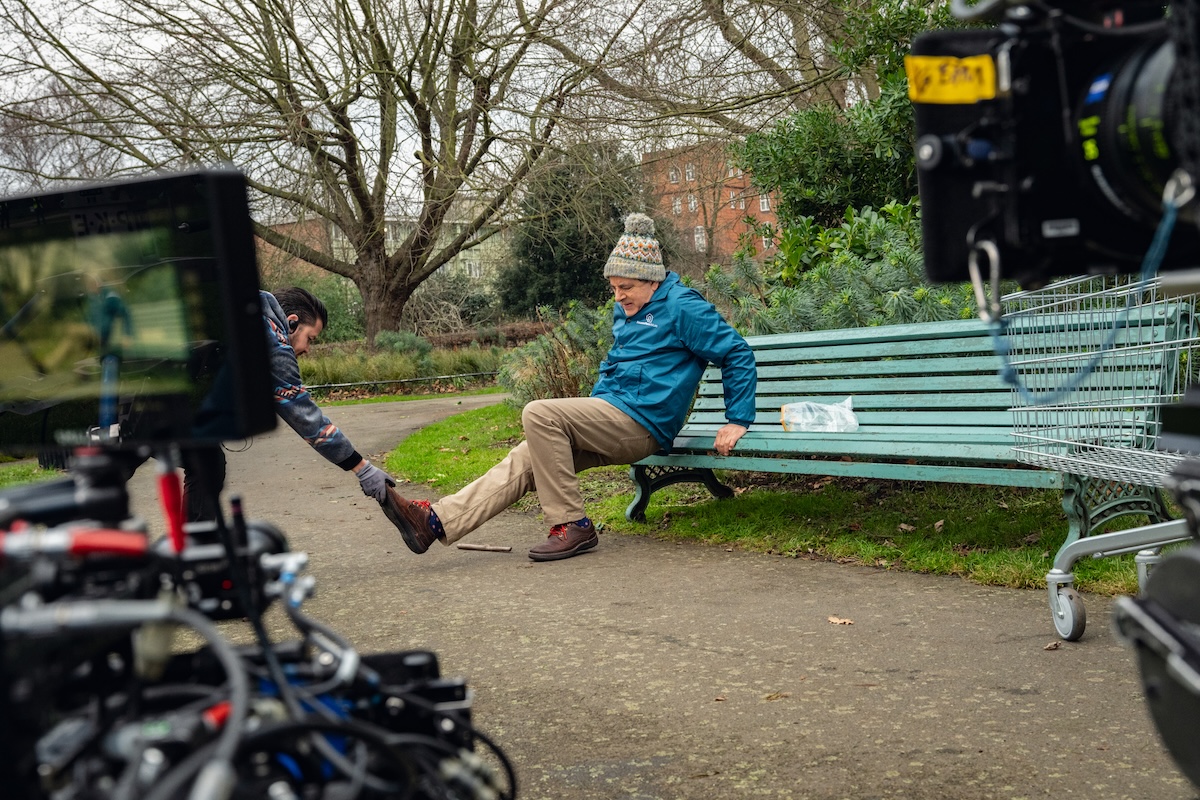
Courtesy of Ana Blumenkron/Netflix © 2025.
LBB> Looking back at the project, what moment or scene are you most proud of — either for how it turned out on screen or what it took to pull off behind the scenes?
David> It’s tricky to pick, but it might just be that penthouse tour I mentioned earlier, of which the rolling bottle and crawling baby is a part. It started in the rehearsal room, where we workshopped ideas like Trevor (*plot spoiler) stashing the baby in a laundry bin an instant before Petra enters.
It’s a sequence in which Trevor – and the audience – are introduced to the world of the Schwarzenbochs, who own the penthouse. The audience sees for the first time the crazy scale and opulence of the apartment with its unique vista of the London skyline.
But there’s a real drama to it – with the baby potentially on the loose – and scuppering Trevor’s new job before it even starts.
The set was designed (kudos to brilliant production designer, Stephane Collonge) to deliver the comic ideas with the requisite spaces and sightlines. It’s literally a house that jokes built. I gave a lot of thought to how I could stage the action so that it moves and flows and builds. I planned and storyboarded every beat. But it doesn’t hurt to have a world-class comedy performer like Rowan Atkinson to bring the whole thing to life. And Susannah Fielding, playing Petra, is the perfect comic foil.


