


Beating the January Blues: How 3D OOH Is Redefining Travel Inspiration


January is a moment of psychological vulnerability and opportunity. The emotional high of the festive season has faded, routines have returned, and consumers are actively seeking something to anticipate. For travel brands, this is not simply a high-visibility moment; it is a critical window to shape future intent.
Research continues to validate OOH’s influence on travel decision-making, with over two-thirds of consumers saying it affects where they choose to go, and more than half reporting that an OOH ad has inspired them to add a destination to their bucket list. Layering immersive 3D creative onto this foundation meaningfully increases stopping power, dwell time, and recall, all critical currencies in a category driven by aspiration rather than impulse.
From Visibility to Mental Availability
For brands like P&O, January success is not about being seen; it’s about being remembered. The strategic objective is to embed the brand as the immediate answer to the question, “Where could I escape to next?”
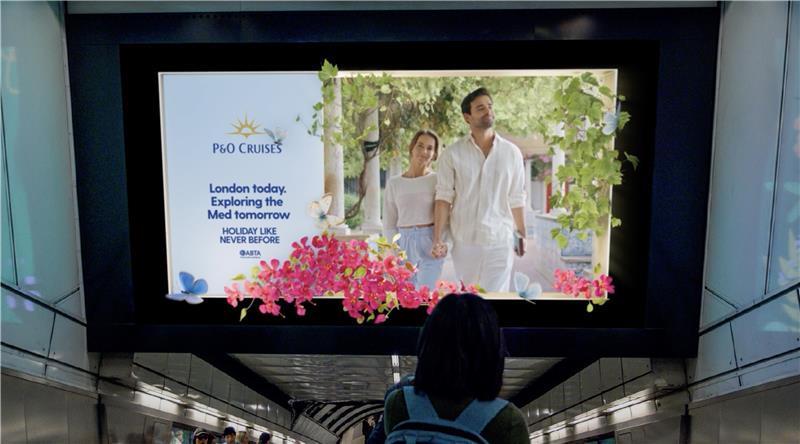
3D OOH plays a pivotal role in achieving this. By introducing depth, motion, and illusion into the physical environment, the creative disrupts habitual viewing behaviour. Viewers don’t just notice the ad, they spend longer with it, decode it more actively, and are more likely to retain it in memory. In cognitive terms, the creative earns attention rather than borrowing it.
This matters because travel decisions are rarely linear. Mental availability, or the ease with which a brand comes to mind at the point of consideration, is a stronger predictor of success than short-term clicks alone. 3D OOH helps build that availability by creating moments that feel culturally and visually distinctive.
Where Spectacle Meets Intelligence: DCO in 3D OOH
In 2026, impact alone is no longer sufficient. The most effective travel campaigns combine visual disruption with contextual relevance.
Dynamic Creative Optimisation (DCO) allows brands like P&O to layer intelligence onto spectacle. Rather than delivering a single static message, the campaign adapts in real time, responding to location, time of day, environmental conditions, or audience mindset.
When paired with 3D formats, DCO ensures the creative is not just visually remarkable, but situationally meaningful, a combination proven to drive stronger recall and higher propensity to act.
What This Signals for Travel Brands in 2026
The evolution of OOH reflects a broader shift in travel marketing: from persuasion to provocation. The role of creativity is no longer to explain, but to transport.
3D OOH, when used strategically, allows travel brands to reclaim public space as a canvas for emotional storytelling, creating shared moments of anticipation in an otherwise transactional media landscape. For audiences navigating the January blues, these campaigns don’t just advertise holidays; they offer psychological relief, optimism, and a sense of forward momentum.
In an era of fragmented attention and accelerated decision-making, the brands that win will be those that understand this: the future of travel advertising lies not in louder messages, but in deeper, more memorable experiences.


