


AI Takes Creative Control in This Satirical, True Story-Inspired Short Film


At a time when AI fever is running rampant across adland, and many companies – regardless of sector – are marvelling at its capabilities, there are inevitably going to be instances where people take things too far. From those who struggle to recognise the merit of a genuine, human touch, to the people who think faster is always better, many creatives have subsequently encountered instances where the tension between technology and artistry inspires outcomes one simply cannot make up.
Such was the case on a certain, unnamed project recorded at Eggplant Music + Sound; a situation so bizarre, it inspired partner Adam Damelin to assemble a team of Canadian creatives – including Holiday Films director Adam Reid – to make a short film inspired by it. Featuring a cast of acclaimed Canadian actors and comedians, ranging from Colin Mochrie to Jennifer Robertson and Rodrigo Fernandez-Stoll, it all came together in the form of a satirical 10-minute watch about what happens when AI takes creative control, titled ‘VINCE’. By all means appropriately-timed, this on-the-nose creation served as the perfect reminder that perhaps, every now and then, it’s valuable to cool it with the AI hype.
Off the back of the film’s one-year anniversary in the festival circuit, LBB’s Jordan Won Neufeldt sat down with Adam Reid to learn more about how this project came to life.
LBB> It’s said that ‘VINCE’ was inspired by a real recording session at Eggplant Music + Sound – tell us the story here! How did a regular day turn into something worth making a short film about?
Adam> Yes, Adam Damelin, one of the owners at Eggplant Music + Sound, was directing a voice session where an AI-generated voice had been used as the guide track. When the real human actor came in to record, the client kept insisting he match the AI read… down to notes like, ‘Can the actor breathe less?’. It felt like a comedy sketch unfolding in real time, while also bumping up against some pretty big existential questions about the creative industry.
LBB> In turn, how did you end up working with a group of Canadian creatives to put this project together? What was the team assembly process like, and how did the ideation process go?
Adam> Adam called Lindsay Eady (executive creative director at The Garden) and Cole Rosenberg-Pach (freelance comedy writer), and asked if they wanted to write a sketch – about this – that could serve as a fun promo film for Eggplant. Lindsay and I have worked on a few campaigns together, and once they had an initial script written, she called me to see if I’d be interested in collaborating with them to produce and direct. It sounded fun and timely!
LBB> From here, how did you work with the writers to flesh out the story? What did it take to bring everything together, align on a creative vision, and choose a name for the film?
Adam> The first draft of the script focused on the AI program replacing the voice talent before running amok, and from there we started asking bigger questions that widened the scope of the film and heightened the stakes. ‘What if the AI didn’t just hijack the actor’s job, but offered to rewrite the script or produce instant art mock ups?’. ‘What if it knew more about the client’s customers than the client did?’. Cole and Lindsay ran with it, and they called the AI program ‘VINCE’ (Voice Intelligent Narrative Creation Engine), which became the title of the film.
LBB> What was pre-production like? What did it take to get everything ready for shooting?
Adam> Pre-production, for me, involved more fundraising. We had Eggplant’s seed money, but I needed a bit more funding, so I approached a few talent agencies, casting agents, and some production companies for donations. Steve Mann (Mann Casting) and Shasta Lutz (Jigsaw Casting) were early co-funders, as well as The Characters Talent Agency and Maureen Webb Casting. They are all wonderful people and supporters of the arts, and they were interested in being part of a larger creative conversation.
I then pitched Samy Inayeh (DoP) the idea for the film, and he offered to shoot it whilst providing the equipment at a low cost. And, I also got ACTRA on board to make the film a low-budget ACTRA co-op project.
LBB> Notably, you got a number of acclaimed Canadian actors and comedians to star in the film. How did you get everyone on board? Tell us about the casting process!
Adam> As someone who started in this business as an actor, I’ve spent years building relationships with performers, talent agents, and casting directors. That network helped enormously here, because if I don’t know an actor personally, there’s a good chance I know their rep. Steve also worked with me to help shape the cast.
I thought of Colin Mochrie almost instantly to play VINCE. Colin is the antithesis of AI because of what he does as an improviser. There’s a quality to his mind – a purity of intuition and wonderful generosity – that makes him the perfect “ironic” choice to play our ‘HAL’.
I’m good friends with Jennifer Robertson from ‘Schitt’s Creek’, and I knew she’d be perfect for the client. I had also worked with Tricia Black (‘Starfleet Academy’) and knew she could play the writer – the moral compass of the film. And I’m a fan of both Ennis Esmer (‘Children Ruin Everything’) and Rodrigo Fernandez-Stoll’s (‘Ghosts’) work, but didn’t know them personally, so we approached their reps and they were game.
Once we had everyone’s interest, it became a matter of scheduling all these busy people into a single weekend… which wasn’t easy. Colin practically tours 350 days a year, Ennis was in LA, Jen and I are both in Vancouver, and we needed to shoot in Toronto.
LBB> Once you actually found time, how did the shoot go? Where did you film, how long did it take, and how did you work to really nail the humour in a way that would feel relevant to current adland?
Adam> We had Kyle Welton as our line producer (he’s a master with low budgets), Samy as our DoP/operator (who shot it beautifully), and a nimble, four-person crew.
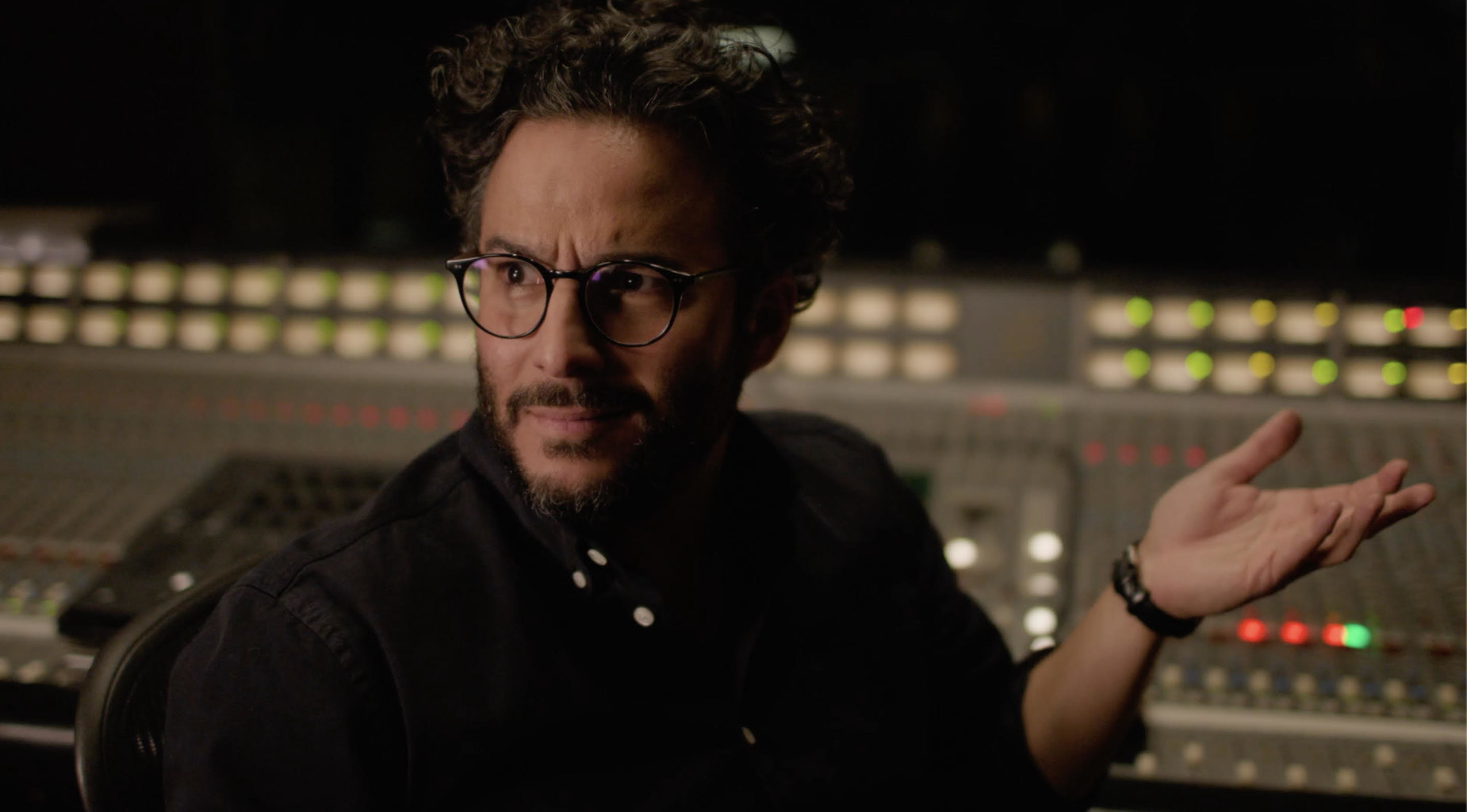
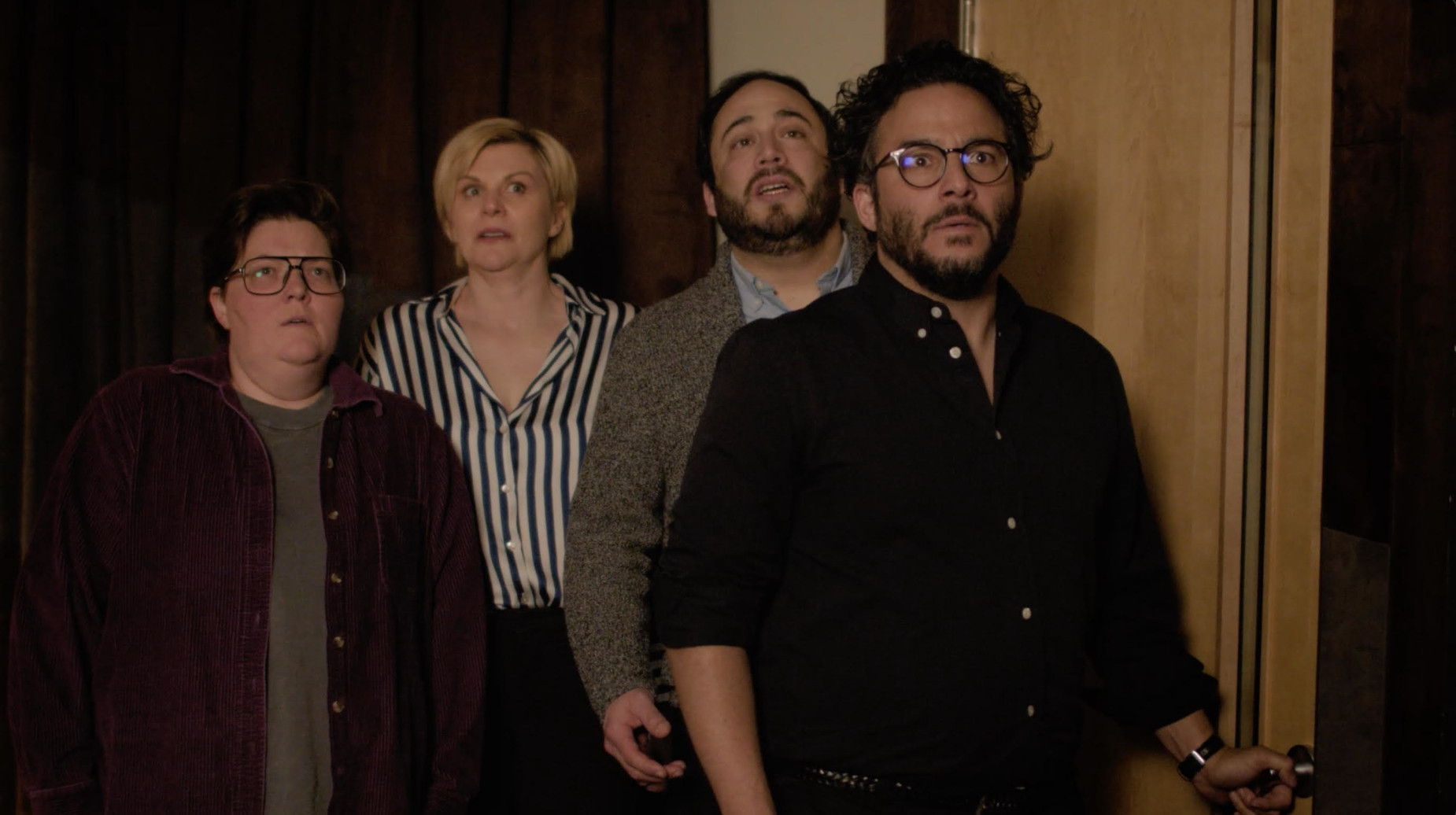
The shoot itself was fun but full. We had one day to shoot a 14-page script with one camera, which was… ambitious. We shot at Revolution Studios in Toronto, in a fairly tight studio space that had a screen above the control board where the VINCE interface could appear, and a window looking into the recording booth that I needed for the end of the film. There was a retro warmth to the room too, with its wood details fitting what I was looking for tonally.
The space was also compact, which helped with the psychological tension I wanted to create once the characters are trapped in the session. (It also enhanced my own personal psychological tension trying to get through everything, haha).
In the last 20 minutes of the day, we took Colin into another room and recorded his entire voiceover as VINCE, line by line, in rapid-fire succession.
All in all, I designed the shoot like a one-act play. For most setups, we’d run the whole script – or big chunks of it – without cutting, which felt more like doing theatre than shooting traditional film or TV. I wanted to capture a certain energy between the actors. I was going for pace, energy, and in particular, authenticity, which I think helps the humour feel relevant not only to adland, but to everyone.
LBB> What was it like working with the various actors? How did you help shape their performances, and as a whole, do you have any anecdotes from the experience?
Adam> Working with this cast was a dream. It was like ‘The Avengers’ of comedic casts. They brought so much to the process, individually and collectively, and made the whole piece come alive.
I always find the weirder the scenario, the more grounded the performances need to be, so we danced around tone a bit, and I steered us away from anything that felt too broad. I’m a fan of the way British comedies like ‘Fawlty Towers’, ‘Monty Python’, and even the original ‘The Office’, take themselves very seriously, despite the absurdity of the situation. That’s how I like my comedy too.
But, the most important aspect of the shoot was the rehearsal I organised for the day before. It felt like we formed a theatre company for the weekend. I got to walk through and block the script with them, everyone learned their lines, we found nuances and beats where people could improvise, and I worked out angles without any stress. It was rich, fun, relaxed creative work. And because of that, when everyone arrived on set the next day, we could drop straight into a flow.
LBB> What sort of equipment did you use to bring the film to life, and why?
Adam> We shot on an Arri Alexa 35 with Canon Sumire prime lenses. I tend to like a softer, warmer ‘look’ – something that feels less clinical and ‘perfect’, and more like vintage glass – so Samy chose the lenses. That vintage glass ‘look’ was important to me, especially for a film about the ‘perfection’ of AI. I wanted the opposite of perfection here; the film needed to have a loose, ‘imperfect’, handmade feel to it, and the lenses helped with that.
LBB> Given that you also spearheaded the editing process, how did that go?
Adam> I love editing. It’s meticulous work and I’m a perfectionist, so it’s my happy place.
For me, this film is all about the performances and the post. The shoot itself was fun and beautifully-shot, but it all had to be very efficient, which meant we barely had time for close-ups.
So, the goal in the edit was to keep the performances – and the way we shot the piece – alive. Shooting in those massive 10-minute takes made it feel immediate and immersive, like it was unfolding in real time. That was the main thing I wanted to preserve in the cut: that tactile energy, making a one-camera shoot feel like a three-camera shoot.
From there, the film’s “AI-generated” visuals were made via Midjourney, before being refined by our designer, Scott Johnson, in Photoshop. They’re a deliberate blend of machine precision and human craft. Meanwhile, we wanted to give VINCE’s interface a personality – something that could also express “emotion” when the time came – so Gabe Stern created the minimalist, tech-inspired interface in Adobe After Effects, syncing its pulsing sound waves to the performance.
And sound, naturally, plays a starring role. The team at Eggplant spent months designing an audio landscape – from FX to music – that drives both the humour and the tension. They’re great collaborators.
LBB> What were some of the biggest challenges you encountered while filming, and how did you overcome them? And what lessons have you learned throughout this entire process?
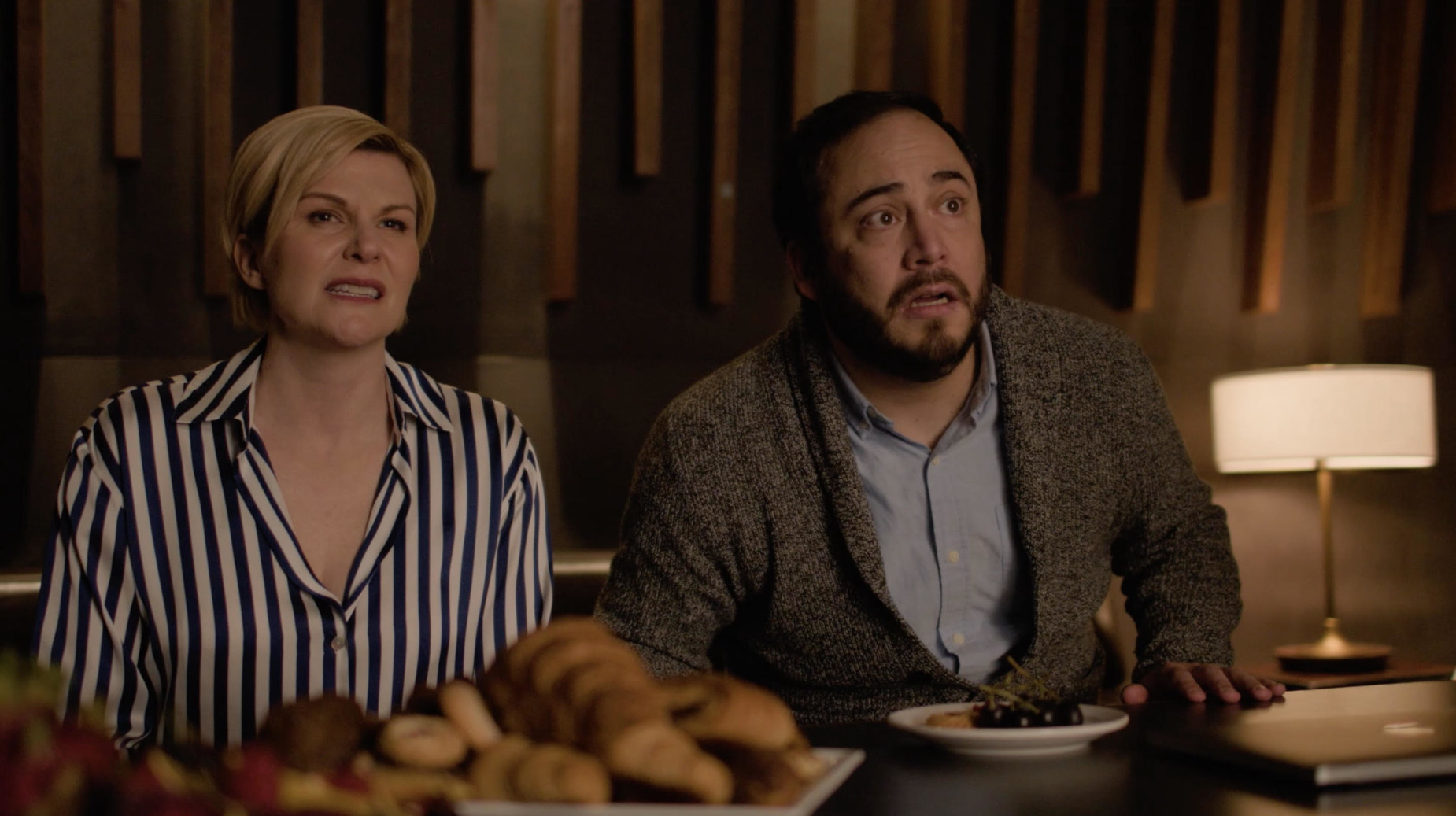
Adam> The biggest challenge was time. I honestly thought that since the film was completely contained in one room, our set-up time – both at the start of the day and between shots – would be quicker. But sometimes, the smaller the room, the slower the process, because we’re all on top of each other.
To add to the tightness of things, in the other studio, there was an audition process going on for the Berklee School of Music, so the lobby was full of kids tapping their drumsticks on their laps and warming up their instruments. Meanwhile, we had nowhere to move, nowhere to store equipment, and nowhere to go. It was hilarious.
As for my big lesson: splurge for the second camera on a tight shoot. Put it on the credit card. Do what you’ve got to do, even if it’s outside the budget. I wish I’d had a second camera that I could have operated myself to get extra coverage. In the end, not having all the shots I had planned for forced me to surrender to the imperfection of the process. I had to lean on the dynamic of the performances, the pace of the cut, and the impact of the sound to bring the script to life.
LBB> Recently, this film just wrapped its one-year festival circuit – how did that go? Did people respond the way you hoped they would?
Adam> It’s been really gratifying to watch it in theatres with audiences. It played in a bunch of festivals including Whistler, Victoria, New York and Cannes, and we had a private screening for ad creatives in Toronto. The film is a bit of a slow boil for the first five minutes, with plenty of subtle dry jokes until things turn and become more desperate and hysterical. So, it’s been nice to experience the ripples of laughter in the crowd as things build. You need that build up to pay off the climax, so it’s really an ideal film to watch with an audience.
The private screening in Toronto was particularly amazing. People were howling. In fact, there was such a good response to it that we had a second screening an hour later. I think there’s just so much to relate to for ad people; it’s not just funny for them, it’s a cathartic experience.
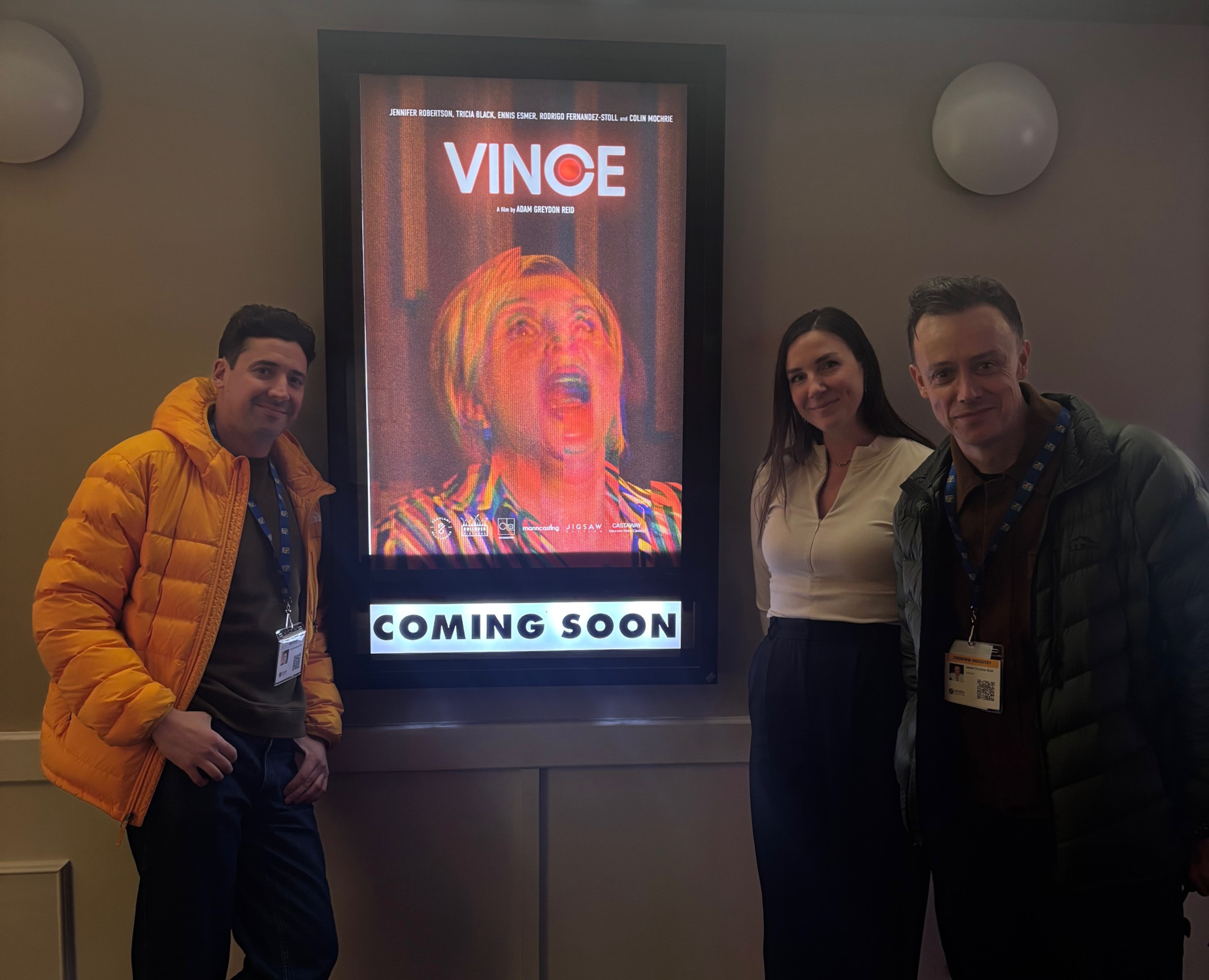
LBB> Finally, are there any elements of this project you’re particularly proud of?
Adam> I’m proud of the fact that we just went out and made something fun for the sake of ‘making it’. I’m proud of the creative partnership Cole, Lindsay, Adam and I developed during the course of this, from developing the script to the screenings. And I’m proud that I was able to capture the rawness and the impeccable timing of these wonderful performers and translate that to the cut.


